

By Benje Patterson*

Gross Domestic Product (GDP) is often missused as a headline measure of the well-being of people in New Zealand and around the globe, even though such conclusions go beyond what GDP was originally designed for.
Put simply, GDP is merely a measure of an economy’s capacity to produce and isn’t a good way of grading end outcomes for our society as a whole or how individuals are faring.
As a result, decision makers should refrain from an overreliance on this single summary statistic and instead always focus on a wider panel of indicators for monitoring their economy and making policy decisions.
This conclusion is particularly applicable in the New Zealand context, where a renewed focus on regional economic development has meant that significant emphasis is being put on understanding differences in economic well-being between our regions.
What is GDP anyway?
Before taking a look at the range of indicators that regions should ensure are part of their monitoring frameworks, let’s take a more detailed look at where GDP came from and what its limitations are.
The modern concept of GDP was a by-product of the Great Depression, when people wanted a yardstick for valuing how much an economy could produce.
Put in slightly more formal terms, GDP was designed to quantify the value added at each stage of production across all final goods and services produced within a geographical area over a fixed period of time (usually a quarter or a year).
Given that these final goods and services, that make up the production-based definition of GDP, can be sold or traded, GDP is often also thought of as an income flow that is able to fund consumption and investment.
It is from this logic that some people then make the heroic assumption that GDP can be used as a proxy of well-being in a region, presumably on the basis that a higher level of consumption indicates more people satisfying their lifestyle demands.
At face value, this logic may make sense, but if we back up a couple of steps, it’s not hard to unpick some shortcomings in this approach.
The limitations of GDP
There are many limitations of using GDP as a complete measure of understanding people’s well-being, but let’s take a quick look at a few of them.
The first key limitation of GDP is that it only measures market transactions. GDP does not include non-market transactions (like when you dogsit for your neighbour), and it does not count the benefit of leisure (because simple pleasures like enjoying relaxing in front of the fire are not a market transaction). In a similar vein, factors such as how content people are feeling and their physical state of health can also not be captured using market transactions.
Another limitation of GDP is that it only considers a one-time flow of activity over a fixed time period, and does not take a broader look at the underlying wealth and resources at an area’s disposal. Surely any assessment of how well off an area is must look at the land, capital, labour, and other accumulations of resources that can be used to generate future economic activity and provide for the next generation.
GDP also does not distinguish between how the activity has been funded and where productive capacity is being targeted. This matters as failing to consider debt financing and what it is being used to produce, invest in, or consume is asking for trouble. If you have any doubt, consider all the money Greece borrowed for frivolous consumption and where that got them.
Finally, GDP is a highly conceptual measure that is prone to revisions as methodologies are improved or new types of input data become available. As a result, it is wise to also consider variables that can be more tangible assessed against outcomes that are less frequently revised.
Considering well-being in New Zealand’s regions
Despite the flaws identified above, GDP is still asked to inform policy decisions on a range of issues.
The appeal of GDP for policy makers is its simplicity as a summary statistic that can instantly give people a feel for how an economy is going.
Using GDP as one performance metric is not a problem persay, but things do get pretty dicey when it is used as a key indicator in more complex policy decisions, involving well-being differences between people and regions.
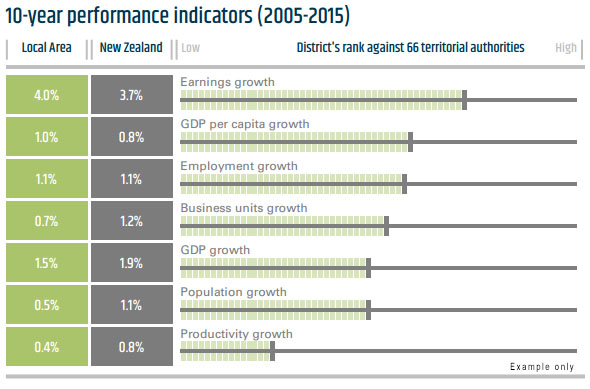
Instead policy makers should consider a range of indicators that have been broken down into a fine level of geographical disaggregation and are updateable. In this way, regions can be sure that they can benchmark themselves against places facing similar challenges and monitor improvements through time.
There a wide range of topics that fit this bill to a rich level of industry detail, including: GDP, employment, skills, occupations, businesses, incomes, housing and rental affordability, beneficiary numbers, migration, infrastructure investment, non-residential and residential building, vehicle registrations, retail spending and more.
Using consistent datasets across these types of topics mean regional decision makers can be confident that they have the tools on hand to monitor outcomes, particularly those affecting the future ability of their area to produce and the well-being of individuals within it.
Summary
- Regional economic development requires appropriate regional economic data for monitoring purposes and making evidence-based decisions
- GDP has limitations and should only be used for getting a headline summary of economic activity
- To understand well-being and performance more generally a panel of other indicators must be used
- Indicators must cover a range of labour market, standard of living, and investment metrics
- All indicators must be able to be updated and benchmarked against peers in other regions.
Benje Patterson is a Senior Economist at Infometrics. You can contact him here » This article originally appeared in Infometrics’ newsletter and has been republished here with permission.
We welcome your comments below. If you are not already registered, please register to comment
Remember we welcome robust, respectful and insightful debate. We don't welcome abusive or defamatory comments and will de-register those repeatedly making such comments. Our current comment policy is here.