
By Bernard Hickey
All over the developed world the masses are revolting and not in a friendly or productive way.
The Brexit vote was clearly a howl of protest by often poorer and older and less educated Englanders who felt insecure, impoverished and alienated from the richer Londoners preaching about the benefits of globalisation.
These Brexiteers essentially said they'd had enough of being told that the free movement of goods, services and capital across borders would make everyone richer and happier in the long run. After 30 years of removing trade barriers and welcoming in migrants, they finally said 'enough' when the powers-that-be told them one more time that remaining open and connected to the markets of the world was good for everyone.
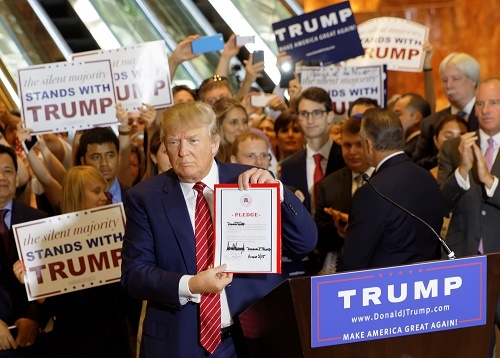
Donald Trump's supporters are doing exactly the same and there are clones of Trump and Brexit campaign leader Nigel Farage all over the developed world, ranging from Marine Le Pen in France to Geert Wilders in the Netherlands and Pauline Hanson in Australia. Winston Peters is in many ways our version of the same populist phenomenon, campaigning against globalisation and migration.
On the face of it, they're wrong. Globalisation has made most of the world richer for most of the time and there's no denying the wealth of much our new world of cheap imported goods, free online services and easy travel around a vibrant fabric of cultures.
This chart from former World Bank economist Branko Milanovic shows exactly how incomes across the world have fared over the last 20 years, ranging from the poorest on the left to the richest on the right.
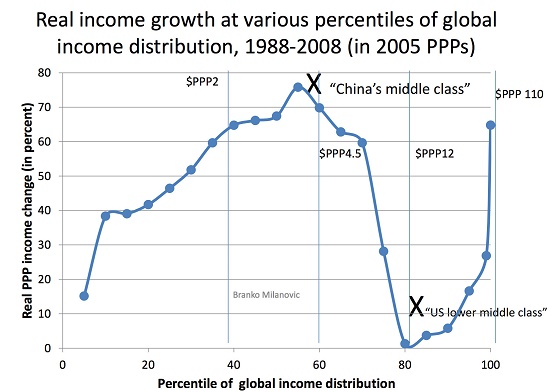
You can see the broad bulk of the middle have seen their real incomes rise 20% to 80% over the period from 1988 to 2008. Hundreds of millions of people in China, Eastern Europe and Emerging Asia have been lifted out of poverty and into the middle classes. Those at the very richest end of spectrum in places like China and America have also done well, but even their income growth hasn't been quite as strong as for those around the middle of the spectrum.
But the chart also shows an alarming gap between the 70th and 90th percentiles, which is where the Brexiteers and Trumpites live. These are those workers (often men) on lower to middle incomes from the rust belts of the North of England and the North and Mid-West of America who have seen their real incomes fall. Their comfortable and increasingly prosperous lives of the 1950s, 1960s and 1970s were upended by the dismantling of the Berlin Wall in 1989 and China's accession to the World Trade Organisation in 2001. Salt was rubbed in the wounds by a range of reforms and austerity that chewed away at the fabric of the post-war social safety net of subsidised education, health care and benefits for the sick and unemployed.
Where once a high school education with decent numeracy and literacy was enough to get a decent job to support a family, now it takes a tertiary education and a whole range of skills to earn a comfortable living. Many of those in manufacturing have been cast aside, unable to retrain and forced to work in lower wage and less prestigious occupations. Many more in the likes of Britain and the United States have been forced to pay for University education and expensive healthcare that their older generations received in subsidised form.
The Brexiteers and Trumpites are now revolting, which often means blaming the 'others' -- those in the governing elites and those arriving from other places. It is ugly and counter-productive because the people who will be hurt the most in the resulting political turmoil are the poorest and most marginalised. The irony of the Brexit decision is those poorer areas in the North of England that voted to leave will be the first hurt in any British recession and the first to miss out on European Union subsidies.
The arrival this week of new household wealth figures for New Zealand reinforced that these underlying changes in the global economy that have made many wealthy, but have left others behind over the last 20-30 years. The top 10% of New Zealand households own half of the wealth, while the bottom 40% of households owned 3% of the wealth. The poorest 5% were actually under water because they owed more than than they owned. New Zealand was more unequal than Luxembourg, Britain and Australia in these figures, although not as unequal as the United States or the Netherlands.
John Key and Bill English brushed this off as "nothing out of the ordinary" and in line with what has happened for 30 years around the world. That may be true, but it doesn't provide an answer to the masses in the developed world who are revolting.
At some point, the governing elites of mature and globalised economies like ours will have to come up with a new deal to redistribute some of the bounties of globalisation to stop these revolts. In the dry language of the markets, the costs of allowing middle England, America and New Zealand to miss out will outweigh the benefits of doing nothing.
That new deal will have to involve some sort of redistribution of income and wealth, and the rebuilding of the welfare state. The alternative doesn't bear thinking about. Just imagine how productive and wealthy our economies would be with a President Trump and a Prime Minister Peters. Or worse, if democracy does not survive the resulting stresses.
A version of this article was also published in the Herald on Sunday. It is here with permission.
We welcome your comments below. If you are not already registered, please register to comment
Remember we welcome robust, respectful and insightful debate. We don't welcome abusive or defamatory comments and will de-register those repeatedly making such comments. Our current comment policy is here.