
Today's Top 10 is a guest post from economist Shamubeel Eaqub.
As always, we welcome your additions in the comments below or via email to david.chaston@interest.co.nz.
And if you're interested in contributing the occasional Top 10 yourself, contact gareth.vaughan@interest.co.nz.
See all previous Top 10s here.

1) Brexit demands a reform of business
Post GFC moves by governments and central banks further favoured the view and raised the angst of those left behind. Three academics write in The Conversation:
People then saw the government support business, while their working prospects diminished. Central banks cut interest rates to historically low levels in the name of stimulating the economy and encouraging investment. Numerous rounds of quantitative easing inflated asset prices (driving the price of a home further out of reach), in the hope that some of the gains would trickle down and benefit those without assets.
The shock of Brexit is an opportunity to make society fairer. This means reshaping the way that businesses are run to benefit not just their shareholders, but all employees and wider society.
The authors propose five ideas to change the status quo. In many ways it means winding back the rights given to corporations and make them accountable again.
1. Curtail the legal powers of shareholders
2. Involve employees in takeover deals
3. Control speculative takeovers
4. Make boards more accountable to employees
5. Protect companies and their assets
2) Brexit & more stimulus from the BoE
The Bank of England unleashed £150bn of stimulus, in the form of lending to households and businesses by easing lending rules for banks. The swift response to Brexit was well signalled by the BoE.
He first spoke on the morning the referendum result was announced, reassuring investors that the Bank would do what was necessary to keep markets stable. Last week he signalled that a cut to interest rates, already at a historic 0.5% low, might be imminent. The latest decision on interest rates will be taken by the Bank next week.
“The UK has entered a period of uncertainty and significant economic adjustment,” Carney said, as he stated it was the Bank’s role “to be straight with the British people” about risks to financial stability.
The RBNZ could take a lesson in being straight with the NZ people, communicating better and being swift with action. Sadly, the action in the UK is more of the same, more debt.
3) Global politics: rule of the jungle
There is little co-ordination in global politics. It is a mess of working groups and other well-meaning organisations. But there is a void in terms of responsibility, authority and co-ordination. It is not surprising that the Panama Papers have shown thousands using international tax regulation inconsistencies to circumvent domestic taxes.
Companies and individuals can act with impunity, mainly because of gaps in tax law. The Panama Papers show that the majority of tax avoidance is technically legal. The International Consortium of Investigative Journalists (ICIJ) state that Mossack Fonseca, the Panama-based firm at the center of the scandal, is hardly scorned by respectable society. ICIJ points out that the firm, “has worked closely with big banks and big law firms in places like the Netherlands, Mexico, the United States and Switzerland, helping clients move money or slash their tax bills,” adding, “More than 500 banks, their subsidiaries and branches have worked with Mossack Fonseca since the 1970s to help clients manage offshore companies. UBS set up more than 1,100 offshore companies through Mossack Fonseca. HSBC and its affiliates created more than 2,300.”
It is not surprising that increasingly voters prefer isolationism to unfettered and uncoordinated globalisation. Brexit, Trump, Pauline Hanson and Winston Peters will be bigger features of isolationist politics of the future.
Turns out people don’t set out to steal intentionally. But when products and services are blocked by archaic rules, like those for video and music, block access to people based by geography, but unconstrained by the internet, things break down. When there are legal, convenient and cheap offerings like Netflix and Spotify, people prefer to use legitimate means:
…44pc of internet users are using exclusively legal means, up from 39pc at the end of 2015. The remaining 31pc did not download or stream any online content in the three-month period. The Minister for Intellectual Property, Baroness Neville Rolfe, said “consumers appear to be turning towards legitimate streaming en masse”.
5) Brexit impact will take years to unfold
Much has been written about the impact of Brexit on the UK economy. The reality is that we will not know the true impact for some time, and even then it will be a guess as we don’t know what could have been. A sharp fall in the Pound, sell-off in the share market and dip in confidence are signs that things are negative. But the real impact on economic activity and capital flows will take years to be seen and understood:
The earliest that economists reasonably believe this could happen would be in the final quarter of 2016, the data for which we would see on January 26. A Brexit-induced recession could take much longer to materialise, however.
Data on foreign direct investment into the UK is similarly lagged, published annually by UK Trade and Investment in the summer, covering investment during the preceding full calendar year.
Only decades after the referendum result will we be able to fully appreciate what Brexit has meant for the UK.
And one thing economists will never know is how the UK would have fared if it were to remain in the EU. Data for this counterfactual will never be available.
6) Australian election: A mess
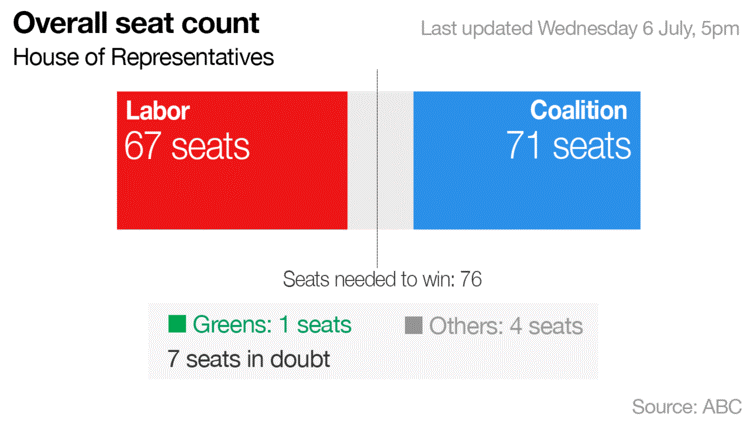
2016 is already one of the most exciting years for politics in a number of countries. Australia is the same, with the current election in a limbo. When first called, it looked like the incumbent would romp home. But it has instead turned into a very close race.
The Australian election matters for two reasons:
- They are our biggest trading partner
- The election shows that if the masses vote, the opposition (in our case Labour, Greens and NZ First mostly) could be in closer contest at the next election than current polling suggests.
They are still counting and this is a very good resource updated daily to keep an eye on things:
Pauline Hanson is back into the Australian Senate, possibly with another Senator. She is Australia’s Trump, actually much more racist.
The rallying cry echoes past demands: “Australia for Australians”. The party retains its focus on “illegal” and unwanted immigrants:
Australians have the right to a cohesive society and deny immigration to anyone who does not abide by our law, culture, democracy, flag or Christian way of life… We don’t want or need migrants bringing their problems, laws, culture and opposing religious beliefs on us.
The anti-immigration and anti-globalisation views that Hanson espouses are increasingly finding favour with voters. While it is still a minority, establishment politics has disregarded the fears, hopes and dreams of the disaffected. The authors ask if establishment politics can rise to the challenge:
Political leaders must contribute to the formation of public opinion, rather than simply respond to whatever emerges around them. Hanson’s return to national politics should push mainstream politicians to principled stands that value humanity over intolerance.
The spectacle of the Olympic games is about to begin. For Brazil it has already been bitter sweet. The economy was soaring when they won the bid, now the economy and politics are in disarray. Olympic games are often like this – there is huge infrastructure built for a one-off event at great cost and a great influx of people for a short period. In Rio it's all that and more:
Public services are under enormous pressure from tighter budgets, public health issues and outbreaks of violent crime. The police and fire services' cars and helicopters have been parked indefinitely, to save money on fuel. Policemen and firefighters have gone on strike – some even occupied the arrival zones of airports in Rio de Janeiro, with banners bearing the message: “Welcome to the Hell”. Elsewhere, in the city centre, state employees are protesting about delayed pay packages and insufficient resources.
With just over one month until the city is due to host one of the biggest sporting events on the planet, tourists and teams from many countries have already started to arrive. Serious concerns have been raised regarding the safety of these visitors; not least, Brazilian football star Rivaldo Ferreira has urged people to stay away from the games, saying that attendees will be putting their lives at risk.
There is some hope:
…other host cities – including London and Sochi – experienced problems in the lead up to the games, yet they were still considered to be successful events.
9) What exactly is density?
Density means different things to different people. Some see forests of apartments and others see a range of homes in different parts of the city. In a useful summary of the ‘density’ conversation the authors suggest:
There is no single scale at which to measure urban density, but the larger the scale the lower the density. The best approach is to understand density as multi-scalar: for any location there is an internal density, a net density, a walkable density and a metropolitan density.
Density is a concept hijacked from physics that doesn’t work well in urban planning.
10) Stumbling on globalisation
Noah Smith’s excellent article on globalisation’s discontents is worth a read. He highlights that globalisation has reduced inequality across countries, but increased inequality within countries. Specifically:
…the global poor and the rich did extremely well, while the rich-country middle classes suffered and stagnated.
He rebukes both the left for their scaremongering that globalisation only benefits the rich and the right for their denial of the very real costs of globalisation:
…challenge to the blithe optimism of libertarians comes from the recent work of economists David Autor, David Dorn and Gordon Hanson, who found that Chinese competition severely damaged much of the American working class. That’s consistent with the story in the elephant graph, and it pokes a big hole in the right’s free-trade boosterism.
So the stories routinely told by intellectuals on both the left and the right have trouble explaining the fruits and failings of globalization. We need new ideas to fit the new facts, instead of relying on our old comfortable shibboleths.
We welcome your comments below. If you are not already registered, please register to comment
Remember we welcome robust, respectful and insightful debate. We don't welcome abusive or defamatory comments and will de-register those repeatedly making such comments. Our current comment policy is here.