
Today's Top 10 is a guest post from Paul Young, a researcher and advocate for climate change solutions. He works for the Morgan Foundation and is one of the founders of Generation Zero.
As always, we welcome your additions in the comments below or via email to david.chaston@interest.co.nz.
And if you're interested in contributing the occasional Top 10 yourself, contact gareth.vaughan@interest.co.nz.
1. Hey, who broke the climate?
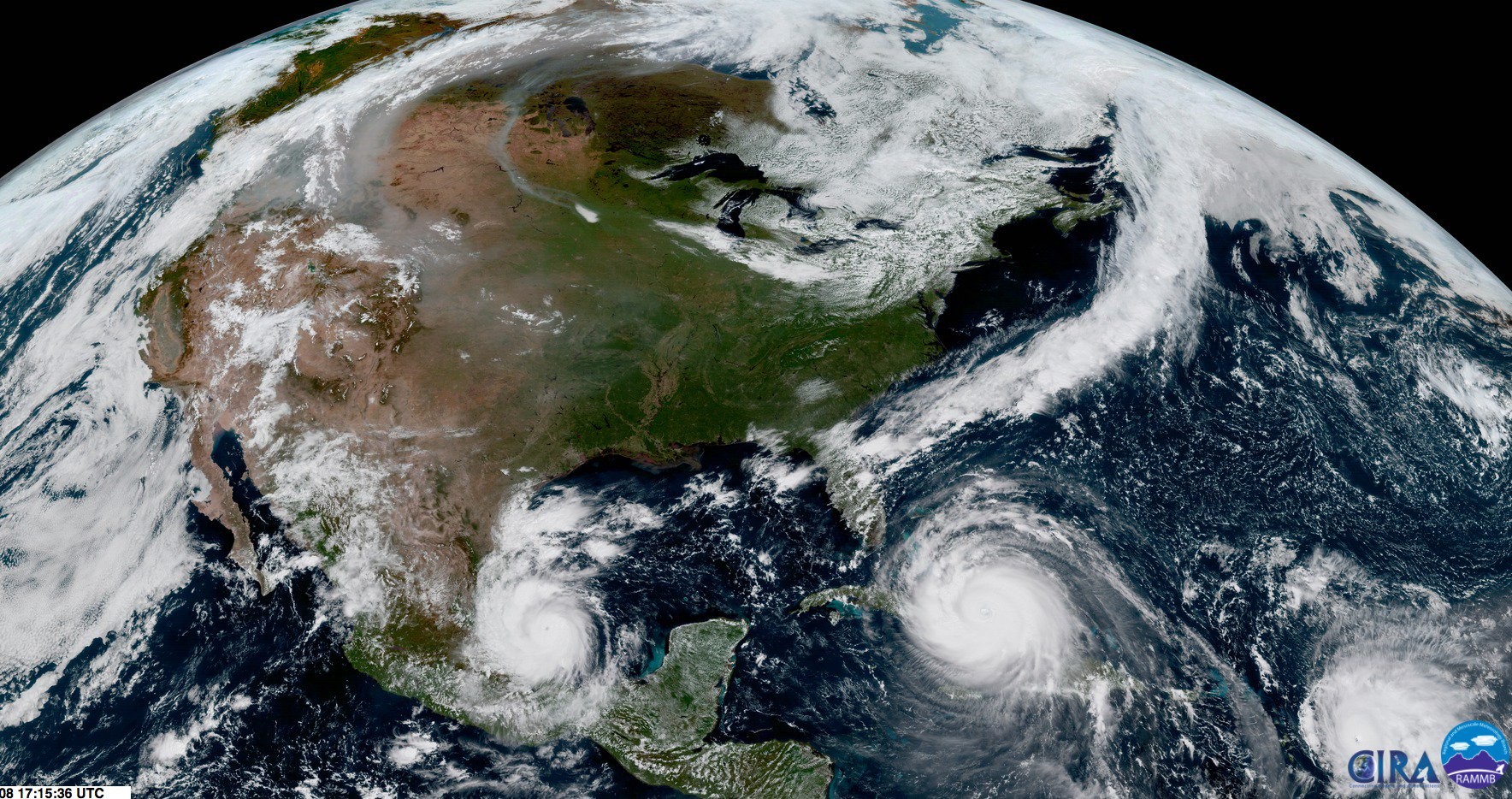
If the image of three hurricanes sitting over the Atlantic Ocean while northern California is shrouded in smoke from wildfires doesn’t make you think something’s up with the planet, well I’m not sure what will.
As climate change damages become an ever more present part of our lives, the questions of who is most to blame and who should pay the costs are getting increasingly real. Lawsuits against fossil fuel companies are popping up around the world and you get the sense this is just the tip of the iceberg.
Now a group of climate scientists have given those lawsuits a bit more leverage with a new study showing how to apportion responsibility for climate damages among fossil fuel producers. Writing in The Guardian, two of the authors have this to say:
Strikingly, nearly 30% of the rise in global sea level between 1880 and 2010 resulted from emissions traced to the 90 largest carbon producers. Emissions traced to the 20 companies named in California communities’ lawsuits contributed 10% of global sea level rise over the same period. More than 6% of the rise in global sea level resulted from emissions traced to ExxonMobil, Chevron and BP, the three largest contributors.
[…] Plainly, companies should not be at liberty to persist for decades in selling products as safe to use when they know they are harmful and have alternatives available to them. Upon learning of the risks of their products, companies could have used their considerable technical and financial resources to greatly accelerate carbon storage and clean energy technologies.
Many, even within the fossil fuel industry itself, are arguing they can still change course, but it is hard to justify the immediate cost to shareholders when just using the atmosphere as a waste dump and leaving impacted communities, taxpayers and future generations to deal with the consequences appears to be a risk-free alternative. But, as we found in the 2008 financial crisis, allowing companies to make private profits while society at large underwrites the risk ends badly for everyone.
2. New Zealand is feeling the heat too.
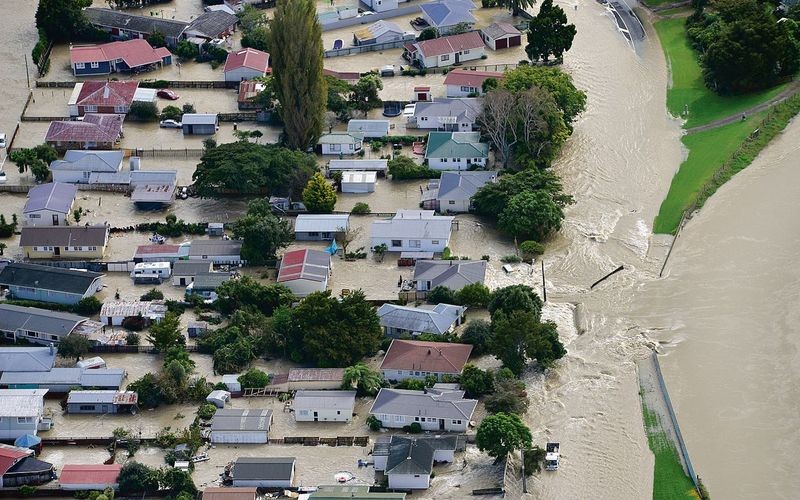
While we’re fortunate enough not to be in the path of destruction laid by terrible twins Harvey and Irma, 2017 has already racked up a record insurance bill for weather damage with over a quarter of the year still to go.
Obviously one data point does not a trend make, but it’s part of a consistent picture of increasing weather extremes and unrelenting sea level rise as the planet warms.
"With three months left in play, 2017 is already the most expensive year for weather events since our records began," council chief executive Tim Grafton said.
"The two July weather events bring the total for significant weather events for 2017 to $230.2m, which now surpasses the year of the Wahine storm in 1968."
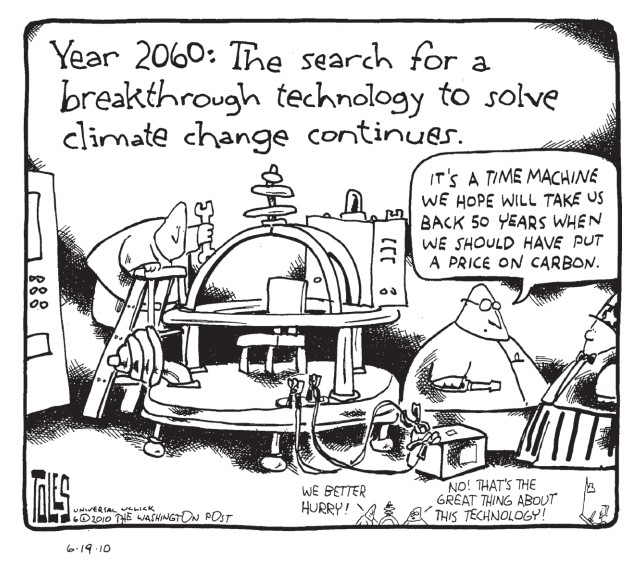
The goals the world (minus Trump) has agreed on for climate safety can be roughly translated into a global CO2 budget.
The New York Times has published this nice interactive feature that demonstrates the radical pace of CO2 emissions cuts required to stay within that budget.
Perhaps after the election once Steven Joyce has tired of trying to find holes in Labour’s budget, he can turn his attention to helping balance these books?
To prevent the worst effects of global warming, we have to keep temperatures from increasing by more than 3.6 degrees Fahrenheit (2.0 degrees Celsius) above the preindustrial level — the upper limit agreed to in the 2015 Paris climate accord.
That means we can’t send more than 2,900 gigatons of CO2 into the atmosphere. This is our carbon budget.
We’ve already used about 73% of our budget.

4. Relentlessly negative emissions.
If you did manage to stay within the carbon budget, you probably needed a good dose of carbon removal to help you out.
The uncomfortable truth is that we’re in overshoot territory already, really. Virtually all studies and scenarios for keeping global warming under two degrees soften the blow by making some pretty heroic assumptions about how much CO2 we can draw down in the second half of the century (effectively putting the bill on the credit card for the grandkids to pick up).
Technical feasibility is one thing, but there’s a lot more to be sorted out if we’re going to do this – like who will pay for it, and how the financing, accounting and governance will work. Venerable climate and energy blogger David Roberts gives a nice overview of a new Nature paper on these issues here.
Of course, in New Zealand, we can get started today by planting some trees.
The technology on which most hopes are pinned is bioenergy with carbon capture and sequestration, or BECCS.
[…] The idea is that as plants grow, they absorb carbon from the air. When biomass is burned for energy, that carbon is released. If you can capture that released carbon and bury it, you have a net carbon negative process — carbon is removed from the atmosphere.
To bury enough carbon to put the 2C target in reach, BECCS will have to be massively scaled up, requiring biomass planted and harvested over an area as large as India, or larger. (One reason many scientists, including Kevin Anderson, think it will never happen.) It is a truly gargantuan undertaking.
Which makes it very strange that we’re not talking about it.
The odds of averting climate catastrophe hinge heavily on China, and they are stepping up the plate. In less than a decade, China has moved from being the scapegoat for dirty development to the engine room of the global green economy.
In this profile of ClientEarth founder James Thornton, he gives some on-the-ground insight into how China’s leaders are grappling with environmental challenges. It’s also an inspiring read on how he and ClientEarth have achieved huge wins for the environment through legal action.
First invited to Beijing in 2014 to help implement China’s new law allowing NGOs to sue polluting companies for the first time, Thornton has seen how serious the world’s biggest polluter is about addressing its environmental problems. He believes their concept of “ecological civilisation” is the best formulation he’s heard for the new environmental story we must tell.
“Facing the ruin of their environment, the Chinese looked hard and amended their constitution. This core document now calls for the building of an ecological civilisation,” he says. “We built an agricultural, then an industrial, and now must build an ecological civilisation.”
“I have no cynicism about whether they mean to do it. My job is to try and clean up the environment for future generations. The Chinese really want to do that.” This task, apparently insurmountable for the west, is made possible by China’s 2,500-year tradition of centralised government.

6. Are electric vehicles about to explode?
One David Roberts blog is never enough, so here he is again on a much more encouraging topic: electric vehicles.
[China’s announcement that it is working on a timetable to end internal combustion vehicles] is just one of many remarkable developments around EVs recently. The past year has seen trumpet blast after trumpet blast heralding the arrival of an EV revolution — sooner than most analysts expected.
How fast that revolution will unfold is the source of much dispute and uncertainty. And it matters a great deal to oil demand, electricity demand, greenhouse gas emissions, air pollution, and global trade flows.
In many ways, questions around EVs parallel questions around renewable energy. They have both been consistently underestimated. If they continue beating expectations, revolution is nigh. But there’s also a lot of hype, wildly conflicting projections, and plenty of risks and pitfalls ahead.
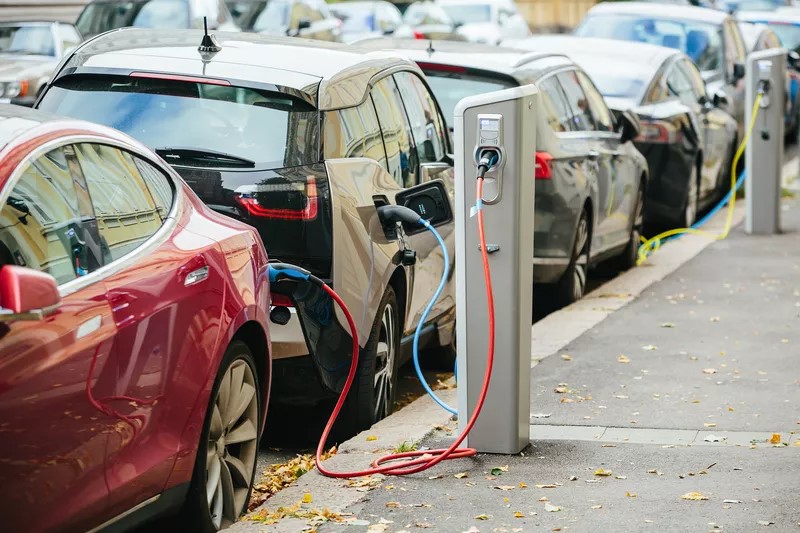
I have no doubt that electric is the way of the future for vehicles, and we need to accelerate the shift as fast as possible. But we also mustn’t lose sight of the problems that EVs don’t solve – like making our cities work better. In Rod Oram’s latest column for Newsroom, he lays out the opportunities through improving our urban environment, how badly we are still stuffing this up, and a challenge to political parties and voters.
When cities work well, they are powerful hubs for productivity, job creation, and innovation. This is known as the agglomeration effect. Globally, cities account for 80% of GDP. But they also account for 70% of energy use and greenhouse gas emissions, according to the work of the Global Commission on the Economy and Climate.
Thus the challenge is to design, build and run cities in ways that maximise the economic benefits and minimise the environmental impact. The two work hand-in-hand, though. An attractive built-environment, which uses natural resources wisely and is well served by public transport, is a delightful place to live and work.

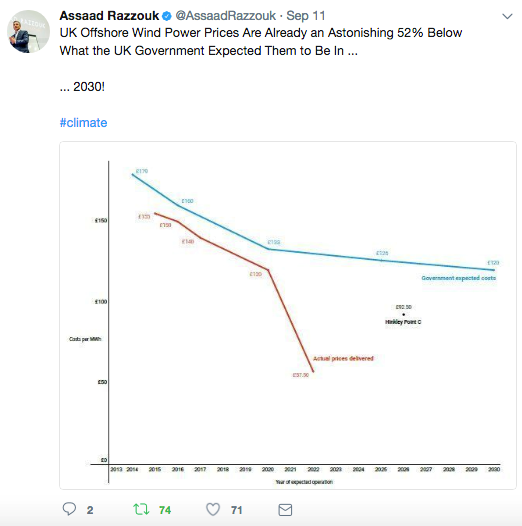
If you follow renewable energy you get used to seeing some very impressive cost trends, and shoddy, conservative deployment projections being blown out of the water (looking at you, International Energy Agency). But what just happened in the UK is truly phenomenal: the tendered price of new offshore wind projects plunged to half of what it was projected to be by 2030. Carbon Brief reports:
Two offshore wind schemes won contracts at record-lows of £57.50 per megawatt hour (MWh). This puts them among the cheapest new sources of electricity generation in the UK, joining onshore wind and solar, with all three cheaper than new gas, according to government projections.
The offshore wind schemes are also close to being subsidy-free: the Department for Business, Energy and Industrial Strategy (BEIS) expects wholesale power prices to average £53/MWh in the period from 2023 to 2035, covering the bulk of their 15-year contract period.
The auction results shift the conversation, from renewables being expensive, towards how cheap, variable zero-carbon power can be integrated into the grid, while maintaining sufficient supplies of power throughout the year.
9. Going green earns the green.
We’re hearing quite a lot this election about how we need “a strong economy” (what does that mean, exactly?) in order to deliver all the nice things we want. Like, you know, saving the planet and stuff. Those little luxuries.
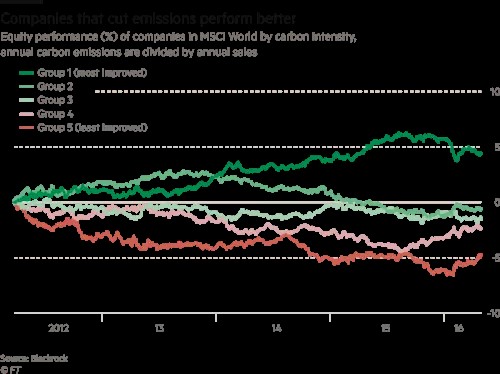
This article in the Financial Times shows through beautiful financial data how that statement is completely backwards. Companies focused on an ethical low carbon direction are outperforming their competitors.
But hey, let’s keep on making excuses for why New Zealand can’t cut our emissions.
The BYD investment story is a small part of a much bigger trend. Investors are finding that if they are good to the planet and to people, they also end up, on average, benefiting themselves. There is mounting evidence that funds which observe environmental, social and governance (ESG) standards in their strategies tend to outperform those that don’t by a significant margin.
“It is time for ESG investing to become mainstream,” says Isabelle Mateos y Lago, global macro investment strategist at BlackRock, which manages $5.7tn in equities, fixed income, real estate and other assets worldwide. “It is no longer just something for a few tree-hugging individuals to get involved with. In the research process of every team at BlackRock, we are increasingly ensuring that they take ESG into account.”
10. New Zealand’s inconvenient truth.
Is it legit to cite your own work in a Top 10? I’m about to find out.
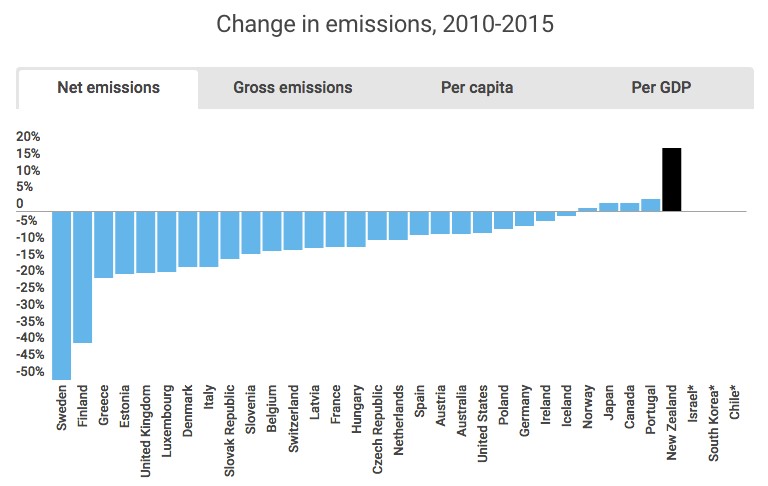
Last month I drilled into the data on New Zealand’s recent performance on greenhouse gas emissions compared with the rest of the OECD. Suffice to say, it ain’t good. So I wrote a piece for The Spinoff with some shiny interactive graphs to drive the point home.
The data assembled above shows one thing very clearly: whichever way we choose to look at it, New Zealand is doing very poorly at reducing our emissions.
We are one of the highest emitters per capita and per unit of GDP in the developed world. This should drive us to work harder than others. But we are not – our record in recent years also rates among the worst. Unlike the vast majority of developed countries, our emissions are still going up. Rather than improving our position, we are falling further behind.
We continue to rely on excuses (or myths), rather than look at the real reasons for our poor performance, like our weak and ineffective laws and policies.
I suspect most New Zealanders are unaware of this information, and many will be shocked. If we want to be true to the values we espouse and the stories we tell about our nation, we need to stop kidding ourselves with soothing platitudes, and get to work.
We welcome your comments below. If you are not already registered, please register to comment
Remember we welcome robust, respectful and insightful debate. We don't welcome abusive or defamatory comments and will de-register those repeatedly making such comments. Our current comment policy is here.