
The next OCR review is on February 19, 2025, about five+ weeks away.
Financial markets are pricing in a -50 bps rate cut then, which would take the Official Cash Rate (OCR) down to 3.75%.
If that in fact happens, almost certainly, floating mortgage rates will fall then by a similar amount. And that would take them back to about 6.9%.
But what will fixed rates do? Short term mortgage rates like the 6 month fixed will likely fall too. Maybe not the whole -50 bps, but much of it. But it is much less certain that other fixed rates would fall by anything like a -50 bps OCR cut.
Mortgage brokers are out talking their book, raising expectations of big rate cuts ahead for borrowers. But mortgage brokers are hopelessly conflicted here. New mortgage transaction flows are weak because the housing market is weak. Their business model is being shunted into the refinance activity. The way they can keep their fee flows up is to have borrowers make more transaction activity, to fix shorter and more often.
But away from their noise, what are the chances one year or 18 month home loan rates will fall sharply too?
Actually no-one really knows (and anyone who says they do should be treated with scepticism).
But we can read some tea leaves related to the pressure on money markets and bank funding costs - because it is these realities that will give banks the room to move and respond to any competitive pressures.
First, we can look at how the wholesale swap rate market has reacted since the last -50 bps OCR cut on November 27, 2024, taking it down to 4.25%. At that time, the one year swap rate was 3.82%. Today that same rate is 3.53%. So it is only pricing in a -29 bps change. If that held, these wholesale markets are suggesting a -25 bps change is the most banks could 'afford'. There are still five weeks to go, but by now you might have thought the OCR signals would have driven more of a swap market change.
And the reason the swap change is limited probably has a lot to do with the new upward direction at the long end of the rate curve. That is an international trend. Long term money is getting more expensive.
Banks fund their operations from local and international sources, so the international pressures are real for them. However, most of their funding is from domestic customer deposits. And New Zealand customers like to keep their deposit terms short, in fact very short.
But banks lend long, mainly for mortgages.
So bank treasurers who have to manage this mismatch need to get their long term funding from sources that will supply that. And they are mostly overseas. And long term yields and funding costs are rising there, so they won't be lending to our banks at lower rates than they can get elsewhere. In fact, they will probably need a premium to lend to 'New Zealand'. None of this argues for lower rates ...
... unless you believe banks will force their depositors to accept less, in the same proportion that the OCR might fall.
But banks are constrained by regulation. It's a simplification, yes, but it is true enough; the Core Funding Ratio limits how much bank funding can shift away from local depositors. Banks need that depositor funding base and can ill-afford to have any meaningful leakage of depositor support.
Furthermore, an increasing share of depositor funding is coming from term deposits, the expensive end of this source.
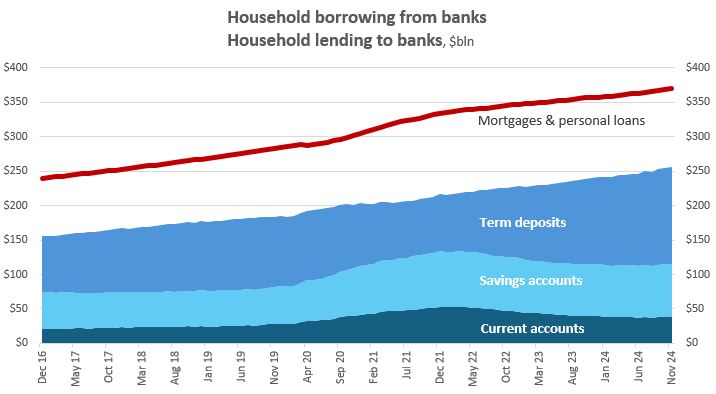
So, the depositor funding is shifting to the higher-cost term deposit category. And the wholesale funding banks must raise to bridge the gap between their lending book and their depositor funding will largely come from offshore for the longer term tenors, which are also rising in cost.
None of this argues for big cuts available for lower fixed home loan rates. Competition for market share might allow some small -10 or -20 bps home loan rate cuts. But banks would have to reject their shareholder return expectations to go more than that even with a -50 bps OCR cut. What do you think are the chances of that? Maybe Kiwibank, who has a shareholder who until now has not wanted market returns, might be a candidate. But with the recent expectation on the Kiwibank board to raise capital in "the market", it seems unlikely they will have the funding or tolerance for low returns. New market pressures are about to influence Kiwibank, even requiring them to start earning overall returns "like the others".
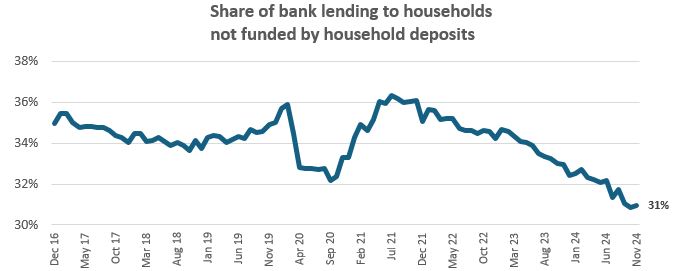
It is hard to envisage a 2025 where fixed home loan rates can fall much further than say the low 5% level. Long rates are probably going up on the Trump Effect. Short rates probably can't follow the OCR down.
Of course time will tell. We are not making any predictions, only reading the tea leaves as they swirl in January.
Yes, you may have home loan rate decisions to make. Your guess though will be as good as anyone else's - and probably better than that mortgage broker who says for certain they know what is going on. (They may be registered with the FMA, but interest rate forecasting skill is not a factor in that registration.) There are two types on mortgage brokers - 'hunters' and 'farmers'. Their compensation isn't regulated in the same way banks employees are restrained, so while that dodgy bank 'recommendation' behaviour (tied to their pay) has been regulated away, it has just moved over to mortgage brokers. Buyer beware. The confliction is real.
Daily swap rates
Select chart tabs


We welcome your comments below. If you are not already registered, please register to comment
Remember we welcome robust, respectful and insightful debate. We don't welcome abusive or defamatory comments and will de-register those repeatedly making such comments. Our current comment policy is here.