

By Terry Baucher*
 This month tax and the economy will be in the foreground in the run-up to the Budget on May 24th. The talk will be of millions and billions of dollars spent or not spent on this, that and the other. But economies are made up of people and sometimes an individual event brings a brutal reality to otherwise abstract concepts.
The news of the tragic suicide of Paul Jenkins last week is one of those events. Mr Jenkins, then living in Geelong, apparently killed himself shortly after receiving a demand for over $53,000 of child support arrears relating to his daughter from a previous relationship. Although Mr Jenkins had moved to Australia and was living with a new partner, the Inland Revenue Department used its powers to request the Australian Child Support Services Agency to collect the outstanding debt on its behalf.
Whatever the circumstances behind this tragedy and leaving aside the enormously complicated question of a parent’s responsibilities to the children of a relationship after that relationship ends, the story highlights a concern that the current IRD procedures for collecting any overdue child support appear to be not only ineffective but also counter-productive.
Child support payments are collected and distributed by the IRD usually on a monthly basis. The problem is that the penalties for late payment of child support are very onerous, an initial 10% and then a further 2% per month on the outstanding amount (including penalties). According to the New Zealand Institute of Chartered Accountants the effective annual rate of late payment penalties is an eye-watering 36.8% in the first year of non-payment. It’s therefore quite easy to quickly run up large arrears through non-payment as seems to have happened with Mr Jenkins.
Parental runaways
In the past one option to deal with arrears was to leave New Zealand. Therefore, although it might be surprising to discover that the IRD can, and do, enlist the support of Australian authorities to collect arrears, this is necessary to buttress compliance.
In fact, according to the Office of the Auditor-General as at March 2010 in each of the ten largest child support debt cases where the liable parent had never made a payment the individual involved now lived overseas. The total amount those ten parents owed? Over $7 million.
But before getting steamed up over this apparently outrageous non-compliance look at the following graph:
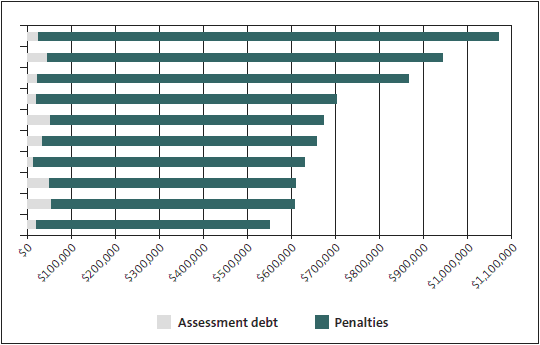
As can be seen the actual amount of child support owed by the ten largest debtors is maybe not even five per cent of the total owed. The rest is penalties.
Too steep a price to pay?
Which begs the question is the current penalty regime working? According to a 2010 report from the Office of the Auditor-General many Inland Revenue staff felt that the current penalty regime acts as a disincentive. No wonder, because the amounts outstanding are scarcely believable: at 30 June 2009 total child support outstanding was $1.56 billion including over a billion dollars of unpaid penalties. The IRD has so little confidence that it will collect these outstanding penalties that its bad debt provisions in respect of penalties were more than 99%.
So if the IRD doesn’t believe that it will ever collect any penalties for unpaid child support why persist with a regime that isn’t working? Particularly in an area which causes great resentment amongst payers. Well that was the conclusion the Office of the Auditor-General reached in 2010 when it recommended the IRD “assess whether the current child support penalty regime provides an impediment for parents to comply with child support obligations.”
The IRD have been carrying out an internal review and although no formal moves have been made to change the penal rates for non-compliance the IRD cancelled $287 million of child support penalties in the latest Crown financial results for the eight months to 29th February 2012.
This is a first step in the right direction but tragically one too late for Mr Jenkins and his family.
*Terry Baucher is an Auckland-based tax specialist with 20 years experience. He works almost exclusively with high net worth individuals and owners of medium sized and emerging businesses. Prior to starting his own business, he spent six years with one of the "Big Four' accountancy firms including a period advising Australian businesses how to do business in New Zealand.
We welcome your comments below. If you are not already registered, please register to comment
Remember we welcome robust, respectful and insightful debate. We don't welcome abusive or defamatory comments and will de-register those repeatedly making such comments. Our current comment policy is here.