
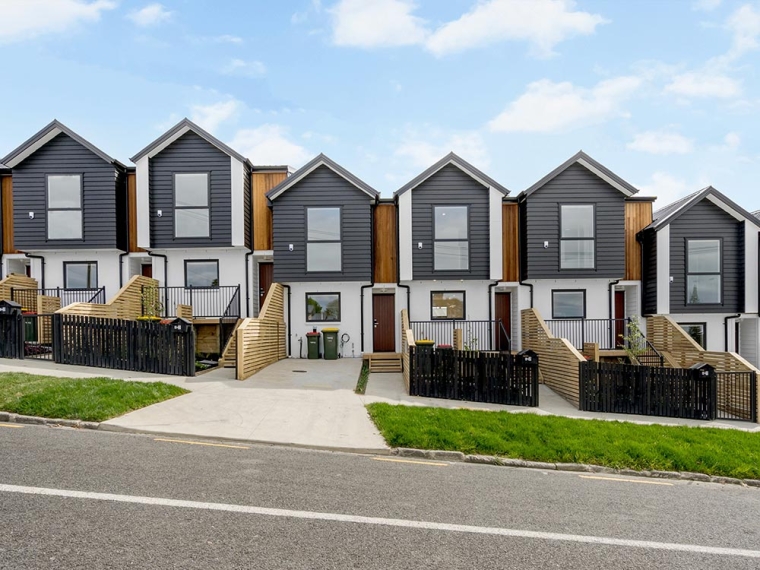
New rules for New Zealand’s largest cities will require city councils to relax urban limits and make huge swathes of land available for immediate development - if councils want to opt out of medium density residential standards (MDRS).
Housing Minister Chris Bishop will detail his "Going for Growth" policy in a speech to the Real Estate Institute of New Zealand on Thursday morning, as part of efforts to tackle the housing crisis.
While the policy risks slowing progress on new housing, by allowing councils to opt out of the density housing rules, it will require them to zone for 30 years of housing growth first.
All this land will have to be ‘live zoned’, meaning it can be built on now and isn’t just set aside for future growth. For a fast-growing city like Auckland, that may mean making enough land available to almost double the current housing stock.
Bishop said this will “flood the market” with development opportunities and allow economics, rather than planning rules, to decide which ones are taken up.
The reality of the policy is that cities will have to allow higher density housing in existing suburbs to meet these housing growth targets, but councils will have more flexibility to protect certain areas and allow further sprawl to do some of the work.
A key part of Bishop’s plan will be to remove city limits and allow more rural land to be converted into housing. This will help to limit land value growth by creating a sort of valve that will release some price pressure from urban land markets.
But converting farmland into housing is expensive, both for developers to build and for councils to service, and so urban development is often more attractive and cost-effective.
Existing rules requiring density around key transport corridors will be strengthened and expanded. A list of specific rail and bus lines considered to be ‘rapid transport’ will be published to prevent “boring debates” about what meets the technical criteria.
Finally, the new rules will require more mixed-use zones that combine commercial and residential buildings, plus abolish minimum floor sizes and balcony requirements.
Mixed-use zoning may mean allowing dairies and cafes in most suburban areas and larger businesses such as restaurants, shops, and offices in higher density areas.
Bishop said getting rid of the balcony size requirements could knock up to $70,000 off the cost of a new apartment in Auckland.
These are the six elements of the plan: set 30-year growth targets, relax city limits, define transport corridors, require mixed-use zoning, get rid of size and balcony rules, and make the MDRS optional.
While losing the density standard will disappoint housing advocates, who saw it as the easiest way to deliver more homes, the rest of Bishop’s plan will work to deliver similar outcomes.
The Ministry of Housing and Urban Development has assembled an expert advisory group, made up of many pro-housing economists, who have been helping to craft the policy.
We welcome your comments below. If you are not already registered, please register to comment
Remember we welcome robust, respectful and insightful debate. We don't welcome abusive or defamatory comments and will de-register those repeatedly making such comments. Our current comment policy is here.