

‘Since 1999, house prices have risen over 400 percent, more than twice as fast as average incomes.’
So spoke the Australian Treasurer Jim Chalmers in his recent budget speech. He might have added that the figure is closer to 500% in some capital cities.
Chalmers was spruiking major tax changes in his budget to address housing unaffordability which his government identifies as a cause of serious intergenerational inequity.
The thrust of his strategy is to remove two tax concessions that he believes favour investor landlords to the detriment of first home buyers. The first is negative gearing – the ability to offset property losses against other income – and the second is the 50% discount on gains currently allowed when calculating capital gains tax.
For good measure the Treasurer also wants to introduce a minimum 30% tax rate on capital gains.
The proposed reforms are subject to certain exceptions for residential property already owned and future acquisitions of new housing. Nevertheless, if enacted, the reforms will represent a dramatic change to the economics of investing in the housing sector.
Just how dramatic is highlighted in a comprehensive analysis by the research team at Morgan Stanley Australia. It expects house prices to fall between 5 and 10%. That would constitute ‘one of the largest price corrections over the past 40 years’.
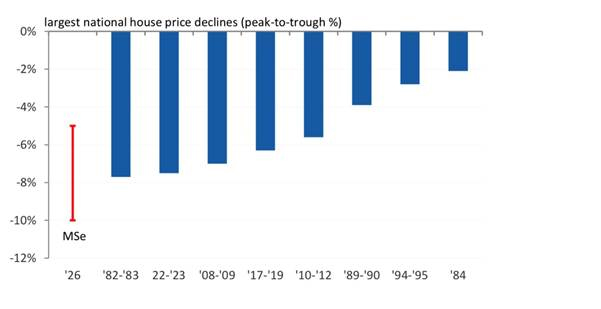
Source: Morgan Stanley Australia
SQM Research is forecasting falls of up to 9% in Sydney and 7% in Melbourne because those are the markets most exposed to investors.
But not all commentators are that pessimistic.
Westpac expects investor activity in the residential market to fall by 34% in the near-term and for total housing market turnover to decline 20% – not a great outcome for real estate agents and lenders to investors.
However, the bank forecasts house price growth ‘to stall flat on average across the major capital cities’ rather than turn negative. Different markets will have different outcomes with Westpac seeing falls of 3 to 4% in Sydney and Melbourne in 2026 but rises in Perth and Brisbane.
Significantly, Morgan Stanley estimates that ‘a 15-20% decline would be required to fully restore investor economics’ to the position pre-Budget i.e. to make investing in residential rental property as attractive as it was previously.
No leading market commentator is predicting house price falls of that severity. Therefore, if Morgan Stanley is correct, the golden days of investing in rental housing in Australia are over.
It’s the end of what Morgan Stanley calls a 30-year housing ‘super cycle’.
This is momentous given that for decades residential rental property has been a long-term source of wealth creation for many Australians. According to 2025 figures from Property Update, more than 2.2 million homes, roughly 22%, are owned by investors.
And it’s not just the budget changes that are weighing on Australian house prices. A challenging environment had emerged before the budget thanks to rising interest rates, rising inflation, and economic uncertainty attributable to the Iran crisis.
The Reserve Bank of Australia has increased the cash rate by 0.25% on three occasions in 2026, most recently the week before the budget. That has quickly flowed through to higher bank lending rates which in turn has reduced the borrowing capacity of most borrowers.
Until recently at least one further RBA rate hike was anticipated in the short term. However, that risk has lessened over the last fortnight due to a drop in the Consumer Price Index from 4.6% to 4.2% and a rise in the unemployment rate from 4.3% to 4.5%.
But that interest rate reprieve is only expected to be temporary, and it will do little to assuage the general sense of gloom permeating the housing market and the wider economy.
According to some commentary in the Australian press, the latest budget may have implications for New Zealand. Faced with higher taxes on residential property investment at home, the suggestion is that some Aussie investors might look offshore to jurisdictions with less onerous tax rules.
Jurisdictions like New Zealand – a capital gains tax-free zone.
See for example the article in the Australian Financial Review entitled ‘Property investors may be tempted by UAE, New Zealand’.
And the issue goes beyond residential property. The budget’s proposed removal of the 50% discount for calculating capital gains will apply to all assets including shares and unit trusts. This has led to widespread criticism and claims that the change will drive some Australian entrepreneurs offshore to friendlier tax climes.
The Australian ran a piece headed ‘Australia risks business exodus to New Zealand’.
An exodus seems unlikely but even before the latest budget there were stories of investors in high growth Australian startups moving to Queenstown before new funding rounds produced massive capital appreciation.
There are clearly significant potential tax benefits if you can satisfy the relevant tax residence rules.
And you want to live in New Zealand.
*Ross Stitt is a freelance writer with a PhD in political science. He is a New Zealander based in Sydney. His articles are part of our 'Understanding Australia' series.
We welcome your comments below. If you are not already registered, please register to comment
Remember we welcome robust, respectful and insightful debate. We don't welcome abusive or defamatory comments and will de-register those repeatedly making such comments. Our current comment policy is here.