

There has been very little overall movement in residential rents in the 12 months to May, according to the latest rental bond data from Tenancy Services.
The national median residential rent charged for new tenancies in May this year was $600 a week, up by $5 a week compared to May last year, a 0.8% increase.
However, that increase is probably not significant because the median rent first hit $600 a week in December 2023, and remained at that level for 19 of the 30 months leading up to May this year, and the differences in the months where there was movement were small.
That suggests that at the national level, rents have been flat for the last two and a half years.
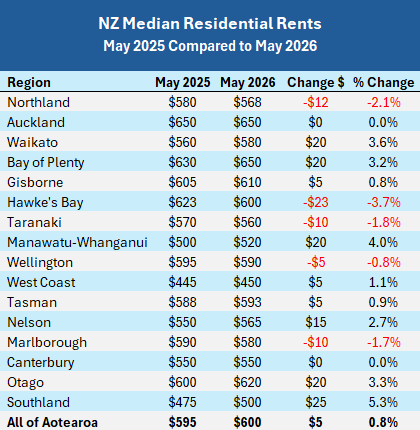
It is also significant that there was no movement in the median rents between May 2025 and May 2026 in the country's two largest rental regions, Auckland and Canterbury, where the median rents remained at $650 and $550 a week respectively, with no change from 12 months previously.
In the Wellington region, the median rent declined by $5 a week from $595 a week to $590 between May 2025 and May 2026.
The biggest annual decline was in Hawke's Bay, where the median rent was down by $23 a week (-3.7%) in the 12 months to May.
Going against the trend, the biggest annual increase in median rent was in Southland, where it increased by $25 a week (5.3%), from $475 to $500 a week in the year to May.
Additionally, Waikato, Bay of Plenty, Manawatu/Whanganui and Otago all recorded increases of $20 a week over that period.
So at the regional level, there appears to be no rental growth in the country's three largest urban centres, with low to moderate growth in most other areas.
The table below shows the annual rent changes in all regions.
The comment stream on this story is now closed.

We welcome your comments below. If you are not already registered, please register to comment
Remember we welcome robust, respectful and insightful debate. We don't welcome abusive or defamatory comments and will de-register those repeatedly making such comments. Our current comment policy is here.