
By David Chaston
Debates about housing affordability often include the statement that house prices should be available in a city for a price that does not exceed three times the household incomes of people wanting to buy their first homes.
How realistic is that in New Zealand in 2011?
The house-price-to-income multiple is a simplified, yet internationally recognised measure of housing affordability. It has the great advantage that it easily allows international comparison.
The recently released Demographia study uses this benchmark, and compares cities in seven countries and judges housing affordability against this 'three-times-household-income' benchmark.
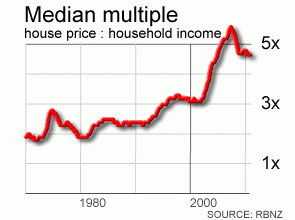
In its data release at its Financial Stability Review in November 2010, the RBNZ included a long series tracking household incomes and house prices. That data is charted above.
It clearly confirms that before the start of the recent housing bubble in 2004, on average New Zealand houses were available for three times household incomes, or less.
But in the period since, prices have risen much faster than household incomes. Affordability has become unaffordability.
The RBNZ data only measures the overall national situation. It does not provide information for cities and towns, or any regions.
It also uses gross household incomes, and this is a flaw in this 'median-multiple' approach.
People buy houses with their take-home pay - sometimes referred to as their after-tax income. And there have been three tax-cuts in the past two years, which improved take-home pay significantly. Clearly, tax cuts improve affordability, but they are not captured in the 'median-multiple' measure.
In addition to our Roost Homeloan Affordability reports, interest.co.nz monitors median multiples of 25 towns and cities in New Zealand on a monthly basis.
At December 2010 there are four cities where you can still buy a median-priced house for about three times the local household income. They are:
- Rotorua, where median houses are currently priced at 3.1 times income,
- Wanganui, where they are 2.6 times,
- Timaru, where they are 3.1 times,
- Invercargill, where they are 2.6 times as well.
In addition, a number of other cities have scores just above these levels, such as
- Whangarei, at 3.8 times,
- Gisborne, at 3.4 times,
- Palmerston North, at 3.5 times,
- Upper Hutt, at 3.8 times, and
- Dunedin, at 3.8 times.
In most of these cases, this measure of affordability has improved over the past year.
However, relating pre-tax incomes to house prices is a fairly simplistic measure of affordability. Not only does it not take account of tax cuts, it does not take account of interest-rate changes. There will be very few first-home-buyers indeed who don't borrow to buy. Mortgage criteria and interest rates are significant factors in measuring affordability, but are not accounted for in the median-multiple measure.
(The Roost Homeloan Affordability reports do account for the impact of tax cuts, and other factors including changing mortgage interest rates.)
You can find the latest median-multiple tracking of all major New Zealand towns and cities here. It is updated monthly.
We welcome your comments below. If you are not already registered, please register to comment
Remember we welcome robust, respectful and insightful debate. We don't welcome abusive or defamatory comments and will de-register those repeatedly making such comments. Our current comment policy is here.