
Since the start of 2012 a total of 20% of the sales of houses, flats and apartments have been to first home buyers, Property IQ says, with sales to first home buyers rising since Reserve Bank restrictions on banks' low equity mortgage lending were introduced on October 1.
Property IQ says it recently began categorising property sales in a way that makes it able to identify whether new home owners are first home buyers, movers or property investors.
"The data for October and November, in the first two months following the introduction of the (Reserve Bank's loan-to-value ratio) LVR caps, shows a slight nationwide increase in first home buyer activity," Jonno Ingerson, Property IQ's research director says.
"This is perhaps not surprising given that there would still have been people with pre-approved loans, and the expectation that there would be a rush of first home buyer activity before the market settled. So far there have been no dramatic changes in any areas, but that may be yet to come," Ingerson added.
Property IQ says across New Zealand 20% of sales of houses, flats and apartments since the beginning of 2012 have been to first home buyers. It has defined a first home buyer transaction as one where none of the new owners have owned property in New Zealand previously, and they have also taken out a mortgage.
Ingerson told interest.co.nz the volume of first home buyers, as a percentage of the overall national total, was 20.3% in August which was a 5% year-on-year increase. In September it was 22.1%, a 13% year-on-year rise, 22.7% in October giving a 12% rise year-on-year, and 24.8% for part of November making for a 26% rise year-on-year although the full November figures aren't yet available.
In September Finance Minister Bill English said Reserve Bank advice was that its restrictions on low deposit lending could force about 25%, or 7,000, first home buyers to delay or downsize their home purchase. See our story on this here and more detail here.
Ingerson notes that, as you'd expect, there's variation in the percentage of first home buyers in different regions and suburbs across the country.
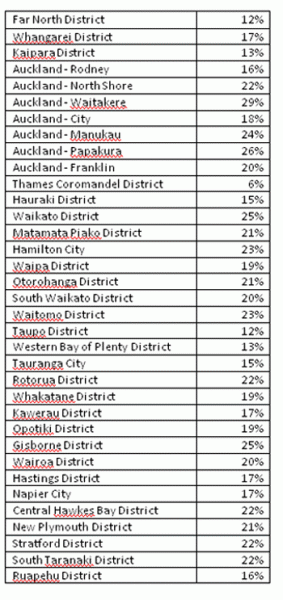
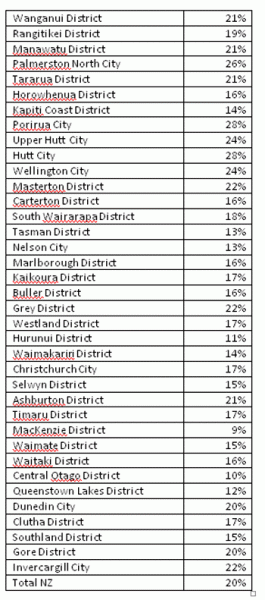
"The highest proportion of sales to first home buyers is in West Auckland at 29%, closely followed by Porirua and Hutt City. South Auckland, Upper Hutt and Wellington City sit in the mid twenties, while North Shore, Hamilton, Rotorua, New Plymouth, Wanganui and Dunedin are all in the low twenties," said Ingerson.
"Of the main centres Tauranga (16%) and Christchurch (17%) are considerably lower. So too are the areas surrounding Christchurch as people have moved there either from Christchurch or from further afield to assist with the rebuild. Also at the low end of the scale are areas where people either retire to or have holiday homes such as Taupo, Kapiti, Nelson and Queenstown. And the lowest of all is Coromandel where only 6% of sales were to first home buyers."
And here's what Property IQ says about Auckland
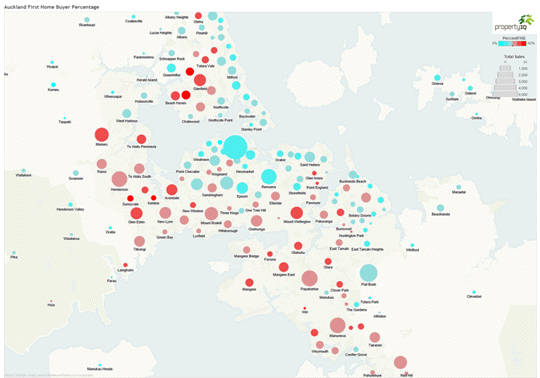
One of the main reasons for the LVR caps was to slow down the increase in property values in Auckland. If we look at where first home buyers are purchasing in Auckland we can make some assessment of whether that will be successful. The accompanying map (you can view the map below) shows the relative number of first home buyers by suburb across Auckland. The dot on each suburb is sized based on the total number of sales in the suburb since the beginning of 2012, with a larger dot reflecting more sales and a smaller dot fewer sales. The colour of the dot represents the percentage of sales in that area that were to first home buyers. Red indicates it has an above average percentage of first home buyers, while blue reflects it being below average.
It is clear to see where first home buyers have been active, with fewer in the more expensive suburbs, such as central Auckland, and coastal North Shore. The suburbs with the highest percentage of first home buyers are in parts of North Shore, in suburbs such as Birkdale, Beach Haven and Bayview, then through Sunnyvale and Kelston in the west. These suburbs all have 35% to 39% of sales to first home buyers.
Others with over 30% of first home buyers are Glenfield, Glen Eden, Glendene, Massey, Avondale, Mangere East and Clendon Park. Glen Innes and Point England just to the east of central Auckland also have over 30% of first home buyers but they are smaller areas with fewer overall sales. Many of these areas with a higher percentage of first home buyers are also the same areas that have increased the most in value over the past year. The impact of LVR changes
So what impact may the LVR caps have on first home buyers in Auckland? One of the defining factors of the Auckland market at the moment is the high demand combined with low supply. This has meant multiple interested parties for each property many of who may have missed out on several previous properties. The question is how much impact the LVR caps will have on this. If there are multiple interested parties for each property, and the LVR caps remove some of these, there are still potentially several interested parties remaining.
Furthermore, the removal of first home buyers from the market opens opportunity for property investors. There are several ways that first home buyers are reacting to the changes. Some are choosing to stay out of the market for now and save more for a deposit, others are finding money from elsewhere, for example from parents, and others are resetting their expectations lower so don't need as much for a deposit.
Over the coming weeks and months, we will be measuring exactly what does happen to the number of first home buyers and whether investors become the perhaps unintended beneficiaries of this new policy. Furthermore we can do this for every transaction rather than relying on a survey of only a small number of buyers.
Below are Property IQ's figures showing the percentage of first home buyers by area since the beginning of 2012
We welcome your comments below. If you are not already registered, please register to comment
Remember we welcome robust, respectful and insightful debate. We don't welcome abusive or defamatory comments and will de-register those repeatedly making such comments. Our current comment policy is here.