

By Greg Ninness
We may have seen the end of capital gains in the Auckland housing market’s current cycle, with the rapid price rises of the last few years coming to a halt over the last couple of months.
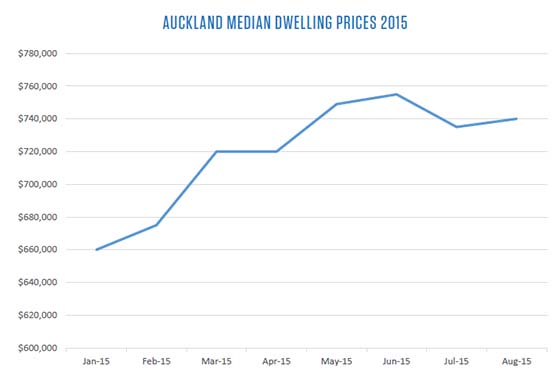
The accompanying chart (below) shows the changes in the REINZ’s Auckland median selling price this year, starting off at $660,000 in January, then taking a breather in March and April when it hit $720,000 before it resumed its climb to $755,000 in June.
It has come back a bit since then, back down to $735,000 in July and edged back up to $740,000 in August, but basically it has been bouncing around just below June’s peak.
To me that suggests a classic peak and plateau, where prices hit a high and then stay around that level with relatively minor movements from month to month, with the overall trend being flat.
However I also believe that you need three months of consistent figures before you can be confident there’s a trend in real estate, which means we’ll have to wait until next month to see whether prices have plateaued or not.
If they have, you can kiss goodbye to capital gains from Auckland house prices for the time being and that would leave the market finely balanced and in a potentially precarious position.
Listings surge
One of the features of the Auckland market this winter was an unusual increase in properties being listed for sale.
What I’m hearing from the market is that this surge of new listings was from two main sources.
Firstly, investors who had seen the value of their portfolios increase significantly over the last couple of years and decided that the big rise in prices had run its course and were selling properties to lock in those capital gains and avoid the possibility of having to sell when prices were going backwards.
The second group were home owners who had been thinking of moving but were hanging on while prices were still rising quickly to get the best price for their homes.
They have obviously decided that a bird in the hand is now worth two in the bush.
So there appears to be two groups of people who have already decided that the market has peaked and are confident enough in that belief to act on it.
When there’s a big increase in the number of homes coming on to the market it can put downward pressure on prices but so far that hasn’t happened.
Demand from buyers has been so strong that it has soaked up the extra supply and maintained prices at their near record levels.
But I suspect the balance is a delicate one and it may not take much of a further increase in supply or a lessening of enthusiasm from buyers to see prices start to decline.
The actions of ethnic Chinese investors over the next few months are likely to play a pivotal role in determining which way the market heads.
Two drivers
Over the last couple of years the rapid rise in Auckland house prices has been driven by two main fundamentals.
The excess of demand over supply, driven largely the sharp increase in net migration, and the enthusiasm of investors who have been prepared to pay prices that provide exceptionally low, perhaps unsustainably low, rental yields.
And over the last year or so ethnic Chinese buyers have been increasingly dominant in the residential investment market.
It is not difficult to understand their enthusiasm.
The transformation of China into an economic powerhouse has been one of the great wonders of the modern age and it has created a whole generation of people who have only known constantly improving prosperity.
Many of them see rapidly rising markets as normal and if there is a problem, Big Brother in Beijing will intervene and prop the market up.
When a market is seen as hot they pile in and lately Auckland property has been hot.
Then when mums and dads start seeing the value of their homes rise, mortgage interest rates being cut to next to nothing and the quick and sometimes enormous capital gains that can be made from investing in property, they pile in as well.
At that point the increase in prices that’s been caused by the underlying demand from owner occupiers exceeding supply becomes supercharged, as investors chasing capital gains start paying inflated prices that can’t be justified by the income returns the properties are capable of providing.
But what happens if prices stop rising and the ability to make quick capital gains disappears?
Herd mentality
I believe there’s something of a herd mentality among many of the investors who have been piling into the Auckland housing market with such enthusiasm lately.
When the river of capital gains dries up, as it may have already, we could see many investors cutting their losses and exiting the market with the same enthusiasm they entered it.
We are already seeing the first signs of that in the unseasonable rush of new listings coming on to the market over the last couple of months.
If the current rising tide of new listings turns into a flood over spring and summer, it will push more properties on to the market while reducing buyer demand, and I doubt that prices will be able to withstand the downward pressure that would create.
Although the currently low, and potentially even lower, mortgage interest rates and the fundamental imbalance between supply and demand of homes for owner-occupiers will provide a floor to any price falls, it’s a floor that could be a fair way down from the highs we’ve become used to lately.
The market is teetering on the edge of a correction.
It won’t take much to push it over.
This article was first published as a Property Line Market Update on September 22. Property Line reports are emailed directly to subscribers of interest.co.nz's free email newsletters. The newsletters are sent out about 3-5 times a week and contain all of interest.co.nz's property articles.The newsletters are free, interest.co.nz does not share subscribers' details with third parties and you can unsubscribe at any time. To receive your free Property Newsletters and stay up to date with the latest property news, enter your details in the subscription box below:
 Our free Property email newsletter brings you all the stories about residential and commercial property and the forces that move these huge markets. Sign up here.
To subscribe to our Property newsletter, enter your email address here. It's free.
We welcome your comments below. If you are not already registered, please register to comment
Remember we welcome robust, respectful and insightful debate. We don't welcome abusive or defamatory comments and will de-register those repeatedly making such comments. Our current comment policy is here.