
This Top 5 comes from interest.co.nz's Gareth Vaughan.
As always, we welcome your additions in the comments below or via email to david.chaston@interest.co.nz. And if you're interested in contributing the occasional Top 5 yourself, contact gareth.vaughan@interest.co.nz.
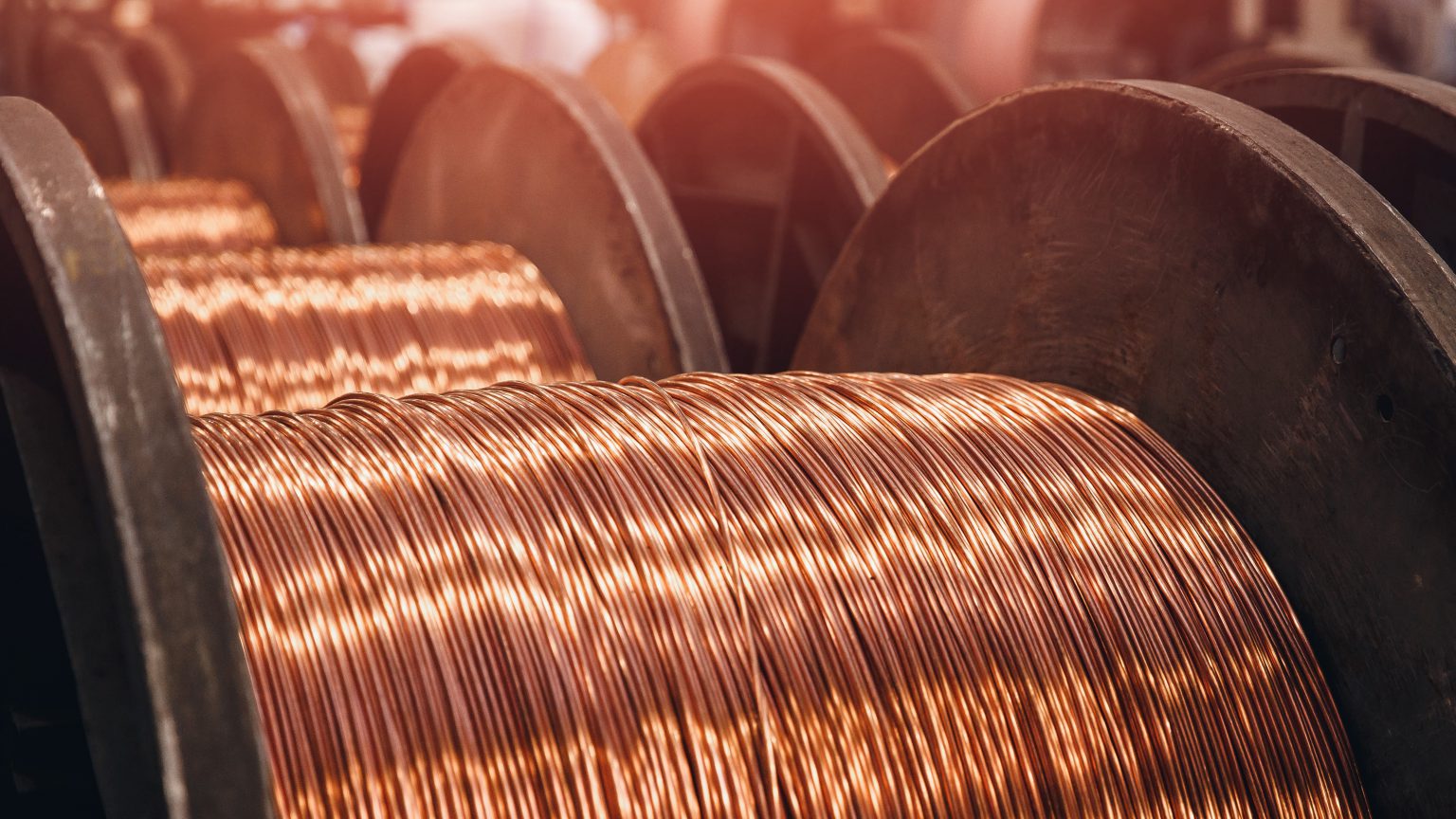
Back in the day there was a regular interest.co.nz commenter named "Wolly." It was rare for a story to be published without the addition of a comment from Wolly. One of the things Wolly took a particular interest in was copper. I was reminded of this during the week when listening to an episode of Bloomberg's Odd Lots Podcast.
The headline on the epidsode is; Why Copper May Be One of the Tightest Markets The World Has Ever Seen. Bloomberg's Tracy Alloway and Joe Weisenthal talk with Goldman Sachs metals strategist Nick Snowdon about copper. Wolly would love it.
Snowdon paints the picture of a perfect storm for the copper market. The story he sets out is a classic case of a world that's looking to combat climate change and decarbonise, needing dirty old, water intensive mining to help achieve this.
There's essentially no decarbonisation without copper. It's an integral raw material for the key green technologies, EVs, EV charging infrastructure, renewables. We see the demand from decarbonisation efforts over the course of this decade generating as much of an uplift for demand as China did in the 2000s.
That's coming up in an environment where we hit peak copper supply within the next two years, and there's a complete absence of fresh investment coming into the sector. And so after that peak supply is trending into an open ended contraction. So you have this clear tightening tension between the boom in demand tied to the green transition, and really that complete lack of growth coming from the supply side.
The green transition as Snowdon puts it, requires a lot of copper.
If you look at the global copper market today, demand in 2022 will come in at around 24 million tonnes. Green versus non-green demand: Today the world is dominated by non-green demand. That's copper going into construction, wiring in your house, wiring in electronics, in cars, in the grid. Out of that 24 million tonnes this year will make up about 22.5m tonnes.
Green demand, which we categorise as electric vehicles, electric vehicle charging infrastructure, and then the green power sector [such as] wind and solar, that only amounts to about 1.5 million tonnes of copper demand today. But if you look at what's going to play out over the next five to 10 years, that balance between green and non-green demand is going to switch quite sharply. By 2025 green demand will have doubled, gone to closer to three million tonnes. And by the end of the decade that number will have risen to between six to seven million tonnes. So green demand will go from today only being about 5% of the global demand to closer to 20%.
Whilst he doesn't see a shortage of copper per se, getting to it isn't simple.
There isn't a shortage of copper in the earth's crust. There are a lot of potential mineable options out there, but we're just not seeing capital flowing into those projects.
Over the last two years even though the copper price has doubled, there hasn't been a single new copper mine approved...The reasons for that are similar to some of the issues facing broader commodity extraction industries. The number one constraint is the last cycle, the near death experience in 2013-14, [the] overbuild. There's now a much more conservative mentality in management teams.
If you want to build a copper mine today, even before you break ground, you will spend two to three years waiting to get the right permits to actually move forward with construction. Twenty years ago that same process took six, maybe 12 months maximum. [There are now] much, much higher hurdles from an environmental and social perspective.
Nonetheless Snowdon argues copper is way better at what it does than its competitors.
One thing we've got to recognise about copper is it is not a raw material where it has close competitors in its key role as a conductor. Because it's such a good conductor it really has a primacy over its key roles in the grid, in cars. It's not to say there aren't other conductors. But things like aluminium require a lot more aluminium to achieve the same level of conductivity as copper. So it's just not practical for uses when you have a small amount of space. There isn't a competitor to copper for the majority of its key roles. It's not to say there couldn't be some substitutions towards other raw materials in less space confined use.
Necessity is the mother invention. And if copper prices go to the levels we expect, if not higher, then will that incentivise much greater efforts in trying to find alternatives? Or perhaps more reasonably will dilution of the the level of copper used in some of these areas?... You may well see slightly less copper used in an EV in five to 10 years time partly because of the high prices and partly because it's technology that's new, that's developing and over time they'll find efficiencies.
Semi-precious metals
Select chart tabs
2) Victims of a not so stable stablecoin.
The recent collapse of the TerraUSD (UST) cryptocurrency stablecoin, promoted as being pegged one-to-one with the US dollar, left victims all around the world. Here Rest of World, which describes itself as a global non-profit publication covering technology beyond the Western bubble, details some of them. They come from Argentina, Venezuela, Iran, Iraq, and Nigeria. They include Valeria from Argentina.
Valeria had spent months learning about UST before starting to invest in various protocols about four months ago. In mid-May, the stablecoin lost its peg, meaning that its value diverged from that of the dollar, and its price plunged to mere cents. Valeria watched her savings dwindle to zero, unable to remove the money from the protocols, which had blocked withdrawals. “I invested in a stablecoin that today is worth $0.08,” she told Rest of World. “I feel sickened and helpless.”
The apparent security of stablecoins has made them attractive to people in countries that experience high inflation or currency devaluations, such as Argentina, Iran, and Nigeria. The UST crash, which has hit other crypto assets, shattered that illusion. Valeria is one of more than a dozen people Rest of World spoke with, from countries including Argentina, Venezuela, Iran, Iraq, and Nigeria, who invested in UST — the third-largest stablecoin — and its accompanying Luna token, and who said they have now lost tens of thousands of dollars in savings.
“They scammed [me],” Mudasir, a UST holder from Pakistan, told Rest of World. “I have nothing left, not even a penny.”
There are certainly sad stories here. And you do wonder how many people tipping their money into UST actually understood it.
But while users were flocking to UST for its perceived stability, according to Sabbatella, few understood that it still had inherent risks. Unlike other stablecoin providers that claim to hold reserves tied to the underlying asset they track, such as Tether, UST wasn’t backed by actual U.S. dollars but rather a complex algorithmic system that maintained the peg through a network of traders in underlying cryptocurrency Luna. In what some experts suggest may have been a coordinated maneuver, a massive push to buy UST caused the stablecoin to lose its peg, resulting in a bank run — and ensuing death spiral — where holders rushed to sell.
The Washington Post has the story of Molly White, a software engineer who has become something of a watchdog over the world of cryptocurrency mania. As a sector in its infancy, the crypto world makes all sorts of promises to investors or speculators, but contains many scams. White is looking for, and documenting, them.
A 28-year-old software engineer who writes Wikipedia articles for fun, White is an odd figure to make the crypto industry cower. On her website, “Web3 is Going Just Great,” White documents case after case of crypto malfeasance: investments that turn out to be scams, poorly-run projects that collapse under mismanagement and hacks that drain supporters’ money.
As much of the financial and tech elite has rallied around crypto, White has led a small but scrappy group of skeptics pushing the other way whose warnings have seemed vindicated by the cratering in recent weeks of cryptocurrency prices.
“Most of my disdain is reserved for the big players who are marketing this to a mainstream audience as though it’s an investment, often promising to be a ticket out of a really tough financial spot for people who don’t have many options,” White said. “It’s very predatory.”
To White and her fellow critics, crypto company founders and the venture capitalists backing them are presiding over a massive, unregulated attempt to rid regular people of their money by exaggerating the potential of crypto technology. Years spent online, researching esoteric Internet cultures have made White a rare figure who can maneuver the technically complex, meme-filled world of crypto, translating it into digestible prose.
4) The practicalities of getting grain out of war ravaged Ukraine.
Russia's invasion of Ukraine has caused turmoil for global food supplies. Ukraine is a major supplier of wheat, corn, barley and sunflower-oil. New routes and methods are being devised, as the United Nations accuses Russia of waging war on global food security. Options include reviving a Soviet-era railway line where about a quarter of the 20-kilometre line is missing.
Bloomberg has the story.
The railway line from Reni to Galati via Moldova would be a relatively small piece of the jigsaw, but it illustrates the enormity of the challenge.
TTS, a Romanian company that operates on the Danube and in the port of Constanta, has been working on clearing bushes and small trees to open up the route. “We are a logistics company and we’ve done many things in this life that defy geography,” Ion Stanciu, TTS’s deputy chief executive officer, said in an interview on May 20. “And now we’re starting from the same principle.”
Romania is keen to upgrade Galati to ease congestion at Constanta on the Black Sea. Galati is connected by the broad-gauge railway that’s compatible with the Ukrainian system and may facilitate the quicker rerouting of grains. The government wants to fast-track the construction of the missing section of 4.6 kilometers and the work will take three months, Prime Minister Nicolae Ciuca said last month.
Yet it’s still unclear who will do it, according to TTS, which has spent two months testing logistic options via railway or trucks. The route involves three countries and three different railway operators. Romania’s transport minister said he hopes to find a company to build the missing portion of track this week and may visit Galati with his Ukrainian counterpart.
“Ukraine was exporting 20 million tons of metals per year and even more grains only on water, so to think that it would be possible to completely replace these capacities is a dream,” said Petru Stefanut, TTS’s CEO. “What we’re all trying to do, is to help them as much as we can. But we can’t compare what they had and what they’ve lost.”
5) The global food shock could last years.
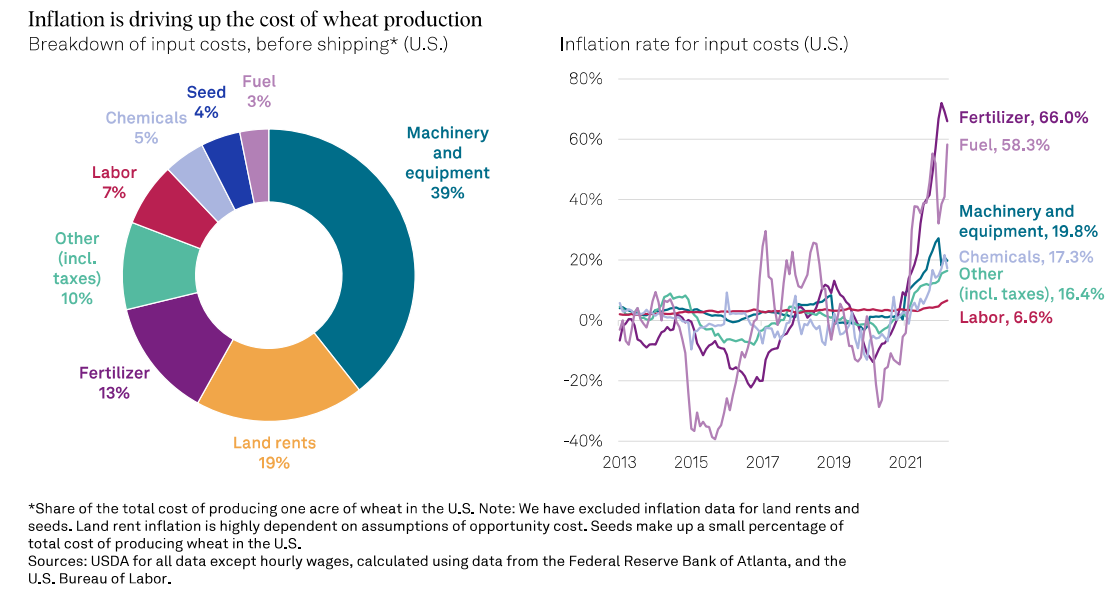
Credit rating agency S&P Global Ratings issued a report this week entitled The Global Food Shock Will Last Years, Not Months. It contains a bleak outlook, and some bleak charts.
International markets appear to be viewing the fallout of the war in Ukraine on food prices as a single-year shock. In contrast, we believe the shock to food supply will last through 2024 and beyond, with negative implications for emerging market countries, affecting GDP growth, fiscal performance and social stability.
The potential impact of such developments on sovereign credit ratings will depend upon, among other things, the extent and severity of the food shock, the ability of governments to minimize the social and economic costs, and international efforts to help the affected countries. Although many of the sovereigns most exposed to this risk already have very low credit ratings, the negative economic or political fallout of the food shock could contribute to the rating downgrades.
We see four key reasons why the food shock could drag on into next year and likely longer:
° The war in Ukraine is lasting longer than most expected;
° The disruption to the harvests of key producers this year is jeopardizing the 2023 crop. In Ukraine, in particular the key sowing season of April-May was missed in much of the country, owing to labour and other input shortages, including of harvest machinery;
° Surging prices of fertilizers, machinery, and other inputs are placing additional costs on production for future years' crops; and
° Fertilizer and food exporters, in particular major producers such as Russia, are increasingly imposing export controls.
We expect that these factors will culminate in increasing competition for key inputs in 2022 and 2023. Food supply out of the conflict zones is unlikely to ramp up meaningfully enough to offset the ongoing disruptions. This will mean higher prices, and hence another round of food inflation through 2024 by our reckoning.
Ukraine and Russia are agricultural heavyweights, and the outbreak of war between the two has sent importers scrambling to find alternative sources. The countries (both or individually) rank among the top three global exporters of wheat, maize, rapeseed, sunflower seeds, and sunflower oil. Together they account for 12% of all food calories traded. Russia and Belarus were the first and sixth largest exporters of fertilizers globally in 2020. Prices of ammonia, a byproduct of gas production, have soared since the invasion of Ukraine.
Food inflation and food shortages are central to demonstrators' frustrations in many regions of the world. Last month, Peru was rocked by an extended period of protests and strikes, with food, fertilizers and fuel at the center of protestors' concerns. In Sri Lanka, ongoing protests over rising food prices and fuel shortages, although mired in broader economic malaise, have brought down the prime minister, with calls for the president to go too. These events are early political fallouts of the war in Ukraine, in our view.
We welcome your comments below. If you are not already registered, please register to comment
Remember we welcome robust, respectful and insightful debate. We don't welcome abusive or defamatory comments and will de-register those repeatedly making such comments. Our current comment policy is here.