
By Riley Chance*
This statement is drawn directly from the Labour Party’s website: “The New Zealand Labour Party’s roots lie in activism for workers’ rights and democratic reform, which can be traced back to at least 1840”
I need to start by stating I’m politically left-leaning. If you read the title and hoped to enjoy some Labour Party bashing you will be disappointed like I’m disappointed with the government for what they are doing – or for what they’re not doing.
I have a question. How much is this government prepared to spend on an anti-union campaign in the tertiary education sector? The tertiary education minister Chris Hipkins may argue universities are independent organisations, universities are, however, state owned. As the minister, Hipkins can act or choose to look away.
Given their history and their name you would expect the Labour Party would not condone anti-union activity. Surely, they should encourage staff to join the unions? Here I hoped to add a link to a Labour Party priority around workers’ rights – but there isn’t one. The closest, ‘Securing a strong economy’ is so open to interpretation that it is meaningless, particularly in relation to the rights of working people.
Some Context:
Chris Hipkins has stated that universities are in “good financial shape”, I wrote about that here.
Conversely, Massey University, who I’m using as a base case, would have their staff believe they are in a financial crisis. This year a beaming Jan Thomas, Massey’s vice-chancellor, emailed staff – “In the latest financial forecast, Massey indicated [sic] a -$46.0M deficit**” She went on to extoll staff to focus on cost containment, “turning off lights when not in use”. Sound advice to save money and reduce emissions – I used to give my children the same advice.
I’m reliably informed that senior leaders at Massey have been ringing bells of doom as they inform staff about, amongst other things – budgets, enrolments, staff student ratios, Capex, Opex, headcount, ‘the gurgler’, levers and the mind-numbingly stupid practice of internally charging for floorspace – Ignoring the cries from faculty, what about education and research? The message from the lectern, illuminated by dazzling gaslights, is cost saving, cost saving, cost saving.
This belt-tightening rhetoric comes as inflation is surging. In October this year, union members of universities went on strike as one for a pay increase to keep wages and salaries in line with inflation. The union was demanding 8% to avoid staff having an effective pay cut, the universities individually offered much less. The fight remains unresolved.
In amongst the bargaining demands was an interesting claim that went largely unnoticed. The union wanted to defer passing on any agreed wage rise to non-union employees for six months (now 18 weeks). Massey was only prepared to hold off passing on the wage rise for six weeks (now eight weeks).
The union stance is understandable. They represent fee-paying union members who are taking a risk by striking. Why should non-union staff benefit at all? They are simply freeloading off their colleagues. Before you start typing, let me answer the obvious retort. Yes, some may choose not to be in the union on principle. Fine. Don’t accept the union organised settlement – it’s the same principle. Negotiate your own pay.
On the face of it, Massey’s stance is difficult to understand. The VC and her compliant band of merry senior ‘leaders’ seem desperate to save money – their jolly, pre-Christmas, axe-wielding restructures feature regularly in the media. But the unions have presented them with the perfect opportunity to save money – considerably more than Thomas’ call to switch off lights. Don’t pass on the pay rise for six months. Better still, don’t pass it on at all.
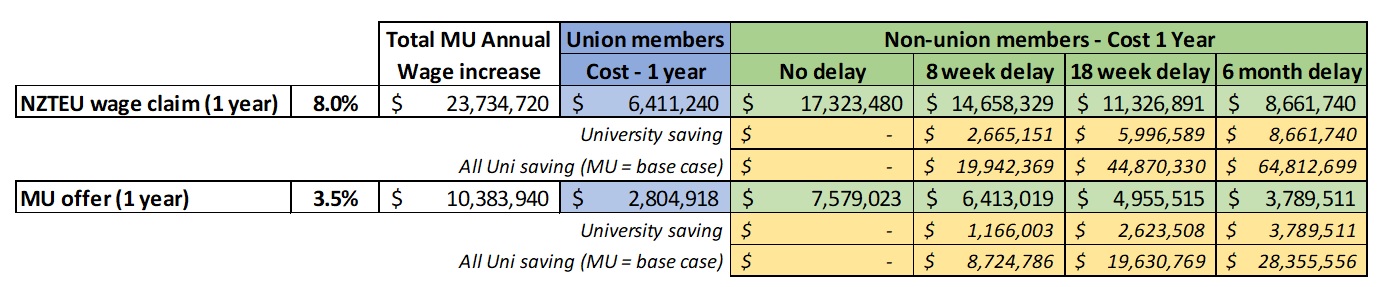
Here’s a table that approximates the amount of money that Massey and the sector (using Massey as the base case) could save under the current claims and offers.
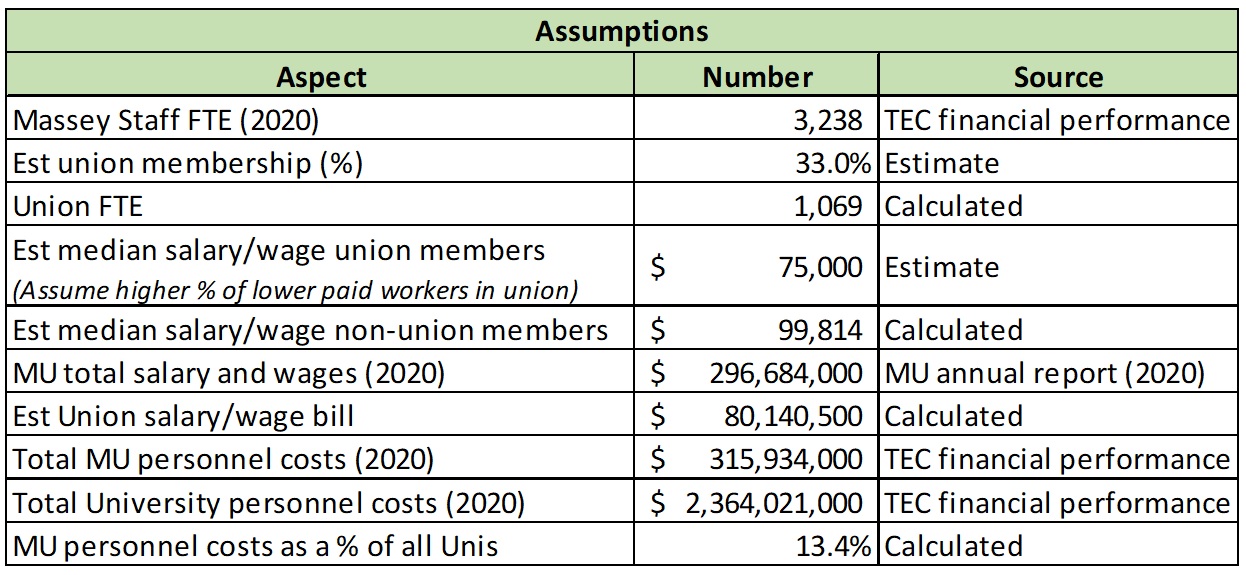
(For those wanting to tear the analysis apart, I have documented the data sources and assumptions used at the end of the article. Tweaking the assumptions changes the numbers not the effect)
To summarise, If Massey delayed passing on the wage-increase secured by the union for its members, it could save between $1.1M to $8.6M (depending on the final settlement and length of delay). If you extrapolate that out across all tertiary institutions, the ball-park becomes $8.7M - $64.8M.
I said it was difficult to understand their position, it is of course easy. There is only one plausible reason for a cost-focused organisation to not snatch such substantial savings – to dissuade people from joining the union.
Again, before you start stabbing your keyboard with angry fingers, I understand that a stronger union will change the balance of power over time. This may make it harder to ignore future pay demands from the people they refer to as their greatest asset (their only productive asset).
Maybe. If you stop for a minute to consider the purpose of our state-owned universities, you get a different perspective.
Like health, education is a public good. If you are about to go under the knife in one of our excellent, publicly-funded hospitals, do you want see highly trained, experienced and motivated clinicians in the room? Or whoever survived a good-old fashioned financial bloodbath?
Nobody in hospital wishes the government had saved more on health.
Our future societal and economic wellbeing relies on having the best and brightest minds possible to solve a range of ‘wicked’ problems we are facing. A low-cost education system that ignores educational quality, reliant on hustling international students is nothing short of ludicrous.
Education, like health, is a public good. To look at it in isolation is to take an immature view.
The quality of education, like health, is directly related to the quality, experience and time staff have to educate. As I wrote previously, ‘The New Zealand Government, as a sovereign currency issuer, can invest as much as it wants in education, assuming it believes more education is better than less education. I certainly haven’t read many arguments that the solution to the wave of mis- and disinformation swamping New Zealand is less education’.
So what?
The point I wish to make, the Labour Party is in power. The public who voted them in expect policies in line with that broader worldview and that includes policies and actions to help workers. What’s happening currently only makes sense if those in power are right-wing, free market proponents of trickle-down – think Liz Truss not Jacinda Ardern. (I did warn you).
So, while I hope Hipkins is working out how to reign in Universities NZ***, I suggest that rather than trying to weaken the union movement and focus on profit rather than education, universities employ their senior managers to run around each evening turning off the lights. It will help the bottom line without impacting on education quality and it is much better use of their time.
Assumptions employed:
**MU announcement. Message from the vice chancellor: Financial performance
***The University Vice Chancellors committee, arguably a lobby group (coming article)
*Riley Chance, a nom de plume, is an author who also works in education and management.
We welcome your comments below. If you are not already registered, please register to comment
Remember we welcome robust, respectful and insightful debate. We don't welcome abusive or defamatory comments and will de-register those repeatedly making such comments. Our current comment policy is here.