
By David Mahon*
December 24, 2022
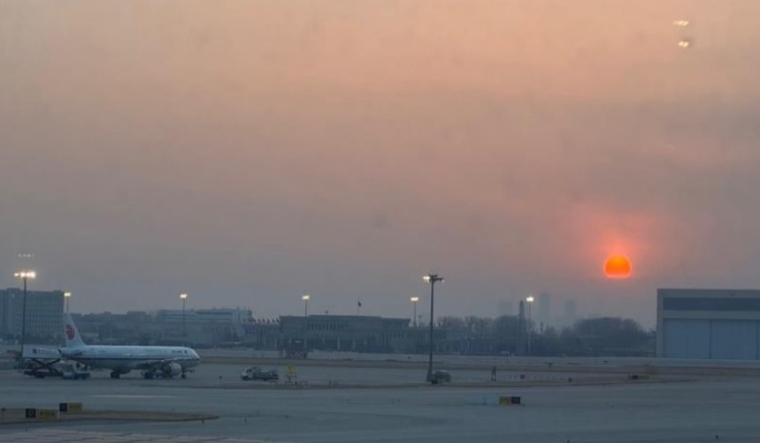
On December 20th, I landed back in Beijing from London on a packed Air China flight. We were the only plane taxiing across the apron, and none were taking off or landing. After disembarking and being COVID tested, we were led through an almost empty international terminal where the walls and floors were bleached from repeated disinfecting. The formerly shiny cathedral styled Terminal 3 looked faded and scarred. It was dark before we were loaded onto buses and driven slowly, headlights flashing, into suburban Beijing.
The man next to me had a severe cough, often barking like a seal and removing his mask to better gasp for air. The bus was otherwise eerily quiet. Perhaps we were all thinking the same thing, ‘What will our quarantine facilities be like? Will we be driven deep into the countryside to some featureless hotel, or be taken to one of the new quarantine centres?’ Forty minutes later we turned into a cluster of buildings surrounded by thickets of high-rise apartments, some with lightened windows and others, dark monoliths against the darker night.
We were still in the city, yet despite my 38 years in Beijing, I had no idea where. We sat on the bus surrounded by people in hazmat suits in the last of a series of seemingly pointless delays. I could now sense the restlessness of the passengers, who having arrived at their destination at last, were still exasperatingly confined to the bus. Our minders exchanged papers, walked away, returned, marked clipboards and then walked away again. Some just stamped and shuffled in the bitter, sub-zero cold beside our luggage arrayed like tombstones in the dim light.
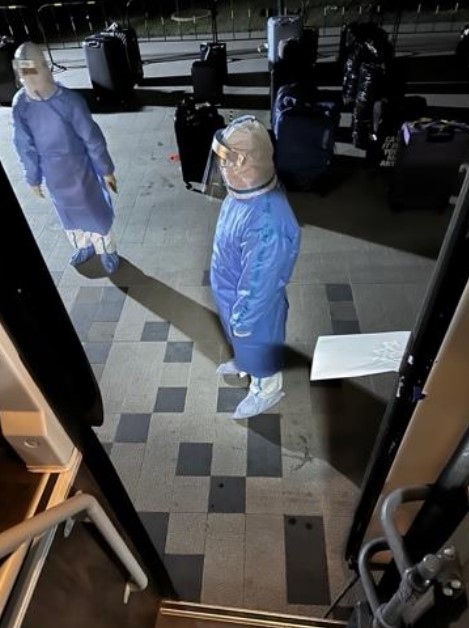
We were at last processed all over again in the lobby of one of the towers and given slips of paper with room numbers on them, a bag of COVID self-testing kits, and allowed to go to the lift banks in groups of four. We were met on our floors and led to our rooms. Some people were visibly irritated but still surprisingly patient, given they were all jetlagged and struggling with luggage, and some clearly nervous at the prospect of being confined for the next five days in one room. With COVID travel requirements being relaxed daily all over China, we were perhaps the last cohort about to be quarantined.
Confinement (a day later)
Our rooms are small but clean, and despite mine facing north, reasonably light due to the floor to ceiling window on one side and a glass door opening onto a small balcony. There is no sign in the room identifying the centre’s location, but I worked out where I was by checking on Google Maps. There had been a few signs in the lobby when we arrived, but I had struggled to read them. The phone in my room just goes to a recorded message, saying I must call another number if I have COVID, which when called, goes to another recorded message.
The quarantine centre was thrown together last year. The walls are thin, and you can hear people moving about and talking. The man next door coughs himself to sleep, then coughs himself awake in order to hack and wheeze with varying intensity through the day. He is not my neighbour from the bus, for that man had a vigorous, resonant, strangled cough. This poor man is clearly old, and his coughing fits are punctuated with gasps, and end in a pulmonary whimper. The building itself is like a body with organs separated by thin membranes, blinking awake in the dark mornings with bright white eyes, murmuring, stirring through the short cold days, and then sleeping again. A heat generation system in the basement is its heartbeat.
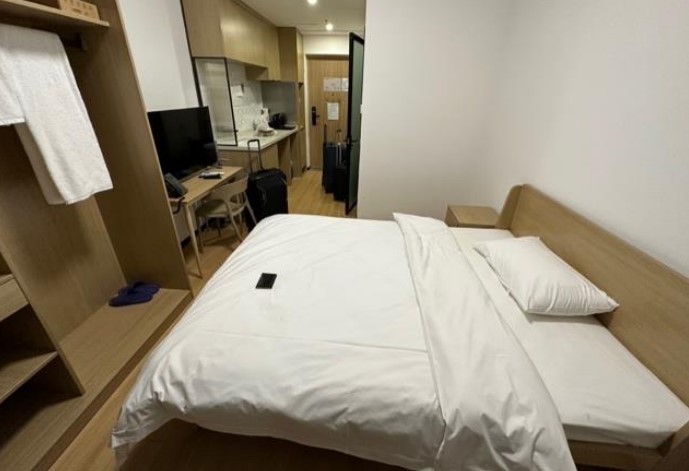
I brought enough tinned fish, crackers, waxed cheeses, and mint tea to last me, so have cancelled the quarantine centre food, which like most airline food is tasteless. I was allowed one outside order, so I chose fruit, instant noodles and some apples. In ordinary life, time passes too swiftly, and I often fail to do all that I have set out to do in a day; in confinement, time slows and stretches, no matter what tasks I undertake to hasten it. These eight days of seclusion will bring my combined total of quarantine days in China to around 65 over the last two years, half of which were incurred through travelling in and out of Beijing on domestic business trips.
I will get out of this centre on Christmas afternoon to spend a further three days at home. The rules make little sense, as restrictions in most Chinese cities have been lifted with no more COVID testing. If people get sick they are expected, although not forced, to stay home. While the rest of China is free, we are confined because we have come from overseas. I spoke to the officials in my district, and they said I could go for walks once I am home. Some friends have suggested I join them for Christmas celebrations, but I will not do that. Technically, rules for returnees must be obeyed and officials in my suburb may get into trouble if I break them.
Never apologise
Over these last three COVID years, policymakers have struggled to balance public health measures with individual and public prosperity. Although the COVID rules initially saved lives, they were left in place too long until they cost lives, livelihoods, and eroded public trust — trust that will take the Chinese Government years to rebuild. After telling the population that Omicron may kill them in order to ensure obedience, the government reversed its position and abandoned most restrictions in the face of protests and alarming data showing that the economy was about to stall.
Rather than liberate the people to resume their lives, the shift has shocked them into an even deeper scepticism, as they wonder why the change has been so sudden, and why it contradicted advice given only days before. Many have stayed home, fearing the virus. Restaurants have opened but still largely remain empty. COVID testing is no longer required, but the streets of many Chinese cities are almost deserted.
The aptly titled ‘COVID tsunami’ is sweeping a COVID-naïve nation, causing widespread fear and illness, with many people suffering from serious fevers and putting hospitals under pressure, but not yet overwhelming the system as some forecast. In a country where there is no tradition of family doctors, people go straight to the hospital when they feel sick. As so many people have stockpiled flu medicines, it is almost impossible to find ibuprofen or paracetamol in pharmacies or online. My suitcase is lined with boxes of medicines purchased in London for my friends and colleagues.
As the present wave of illness passes, economic activity will recover, along with a degree of public trust. Travel will resume; foreigners will return, slowly, and then in steady streams, and Chinese businesspeople and tourists will again travel the globe.
Face
By the end of 2023, China will have become a key driver of the global economy once more. This will not be a return to normal, but rather the beginning of new era: one in which Chinese people will remember that their government made serious errors in trying to handle COVID, confining them too tightly for too long, and too proud to admit when they were wrong. It is common for politicians to mistake stubborn pride for strength, and it is a feature of power that those who wield it feel incapable of contrition. The Chinese middle class in particular is likely to be more questioning and less biddable than they were before COVID, and the Chinese Government will have to adapt to their demands, perhaps ensuring the people are better and more transparently governed.
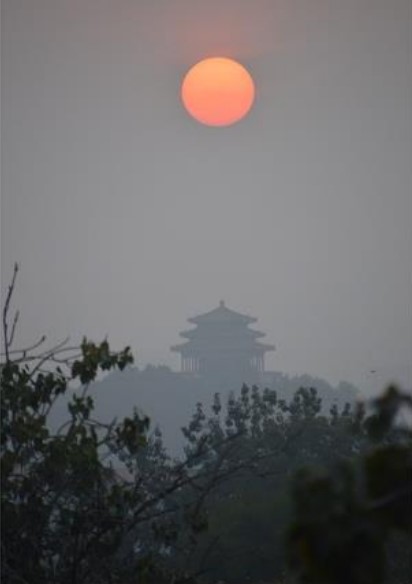
White clad workers with light blue, synthetic overcoats are banging on the doors of my corridor as they leave lunch boxes outside each one. As if this activity had woken him, my neighbour begins coughing again. In 24 hours, I can leave for my south-facing, sun-filled apartment, looking toward the back of the Forbidden City.
*Mahon also spoke to interest.co.nz recently for an episode of the Of Interest podcast. You can listen to this here.
*David Mahon is the Executive Chairman of Beijing-based Mahon China Investment Management Limited, which was founded in 1985. This article is here with permission.
We welcome your comments below. If you are not already registered, please register to comment
Remember we welcome robust, respectful and insightful debate. We don't welcome abusive or defamatory comments and will de-register those repeatedly making such comments. Our current comment policy is here.