
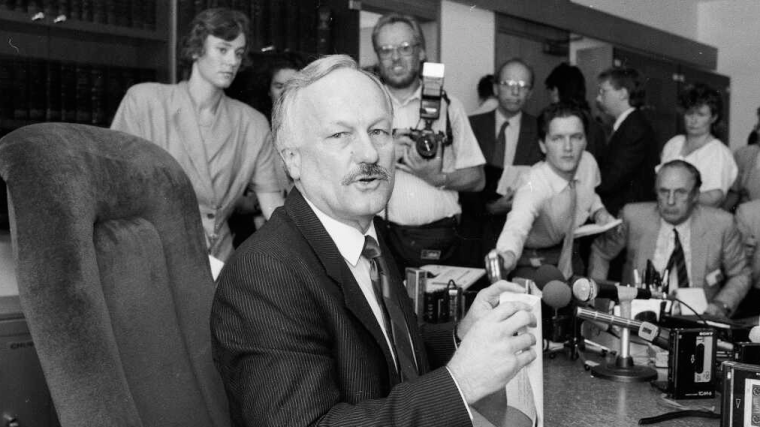
Act Party co-founder Roger Douglas is sitting on the fence this election.
In an open letter to New Zealand voters, the former Labour finance minister and Act Party co-founder said he would be a swing voter in 2023.
Douglas was one of two founding members of the Act Party in 1993, alongside former National Party MP Derek Quigley, after being instrumental in Labour’s neoliberal reforms in the 1980s.
There is a reason it was called ‘Rogernomics’.
But Douglas has become increasingly disillusioned with the Act Party, which he says has strayed from its original principals and now “represents only the wealthy”.
A report by BusinessDesk quoted Douglas as saying the party had been captured by a “small libertarian element who did not want public super or public healthcare at all”.
One critical factor in his change of heart was the Act Party’s opposition to tax bracket indexation.
Interest.co.nz has previously reported that Act voters overwhelmingly support indexation, but the party leadership has rejected it.
The National Party has promised a one-off correction to the tax bracket, while the Green Party has promised a realignment of the brackets every three years — albeit with higher top rates.
Douglas said the Act Party was not satisfied with National and Labour tolerance of bracket creep that has "robbed lower income earners” and it wants to go even further.
“They want to keep bracket creep in place and then use the extra billion dollars-plus of taxes per year … to lower the highest income earners' in New Zealand personal income taxes,” he said.
“Really, this is not the Act party I formed in 1993,” he said.
Polls on track
The Act Party looks to be in line for its best election result ever, with recent polling showing more than 13% support from voters.
This could give the party 17 seats in Parliament and allow them to form a government with National with a one-seat majority.
This result would bring in 10 new MPs (two current members are resigning and Chris Ballie has been bumped to 17th on the list, down from 4th) and make it the third largest party.
Te Pati Maori is likely to win five or six seats, up from two, and the Green Party is on track for 13 seats. That result would mean three new seats and six fresh MPs, due to several resignations.
Labour is likely to lose a whopping 22 seats, after winning an outright majority last election, while National will pick up about ten seats.
Seymour sympathises
Act Party leader David Seymour said he had “enormous admiration” for Roger Douglas’ contribution to New Zealand but didn’t want to get into a public argument with him.
“I also feel honoured in a way because he has attacked the party leader of every single party he has been in since Norman Kirk in the early ‘70s,” he said.
Seymour said he’d read the open letter and thought Douglas had found Act to not be as radical as he might like them to be.
“In some ways I sympathise with him, I wish we were more radical as well some day.”
“Our tax policy is much less radical than the 23% flat tax [Douglas] proposed in 1988, that [he] fell out with Lange and lost his job over”.
There is some solace for Seymour in the letter, Douglas at least said that voting for Act was better than for the Labour or Green parties. But he would be considering voting National this year.
National party leader Christopher Luxon said he wanted as big a party vote as feasible and he’d accept all-comers.
“We’ll take Roger Douglas, and we’ll work hard to get as many New Zealanders as possible to party vote National,” he said.
Finance Minister Grant Robertson was just relieved the controversial political figure wasn’t supporting the Labour Party again.
“Crickey-dick. I guess the National Party might have to ask themselves some questions after that [endorsement]”.
We welcome your comments below. If you are not already registered, please register to comment
Remember we welcome robust, respectful and insightful debate. We don't welcome abusive or defamatory comments and will de-register those repeatedly making such comments. Our current comment policy is here.