
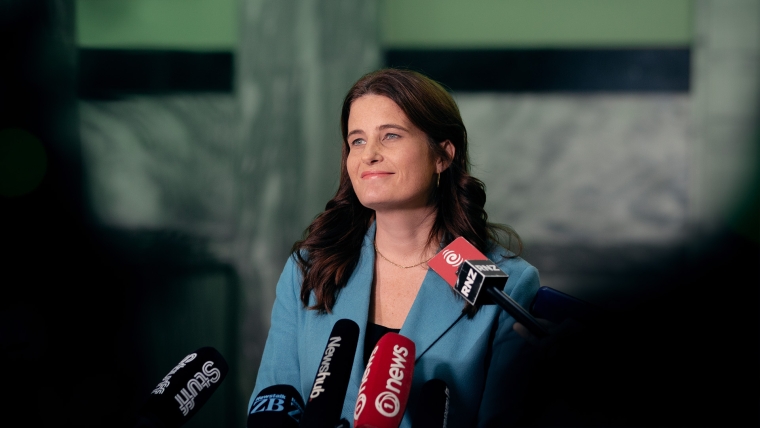
Nicola Willis, the deputy leader and finance spokesperson of the National Party, says she hasn’t read the Council of Trade Union’s document which attempts to calculate the cost of her party’s policies.
In the absence of a full fiscal plan, the CTU has added up the cost of the detailed policies that National has announced so far.
Willis dismissed the document as Labour Party propaganda on Tuesday, but said on Wednesday she hadn’t read it and wasn’t going to.
The National Party has released a long list of policies but hasn’t yet explained how it will fund most of them.
An 11.5% adjustment to the tax brackets would be the biggest single line item at an estimated cost of $1.7 billion each year. Which translates to $5.1 billion across three years.
Last year, National said this tax adjustment would not require spending cuts to core services such as health and education, and could be met from existing spending allowances.
The CTU has since re-forecast the cost of these tax cuts, based on wage growth figures included in the Budget 2023 Economic and Fiscal Update.
This analysis estimated the cost of the cuts would start at $1.9 billion in 2024/2025 and rise to $2.1b in 2026/2027, bringing the total cost of the policy to $6 billion across three years.
Another tax cut would be reinstating interest deductibility for rental properties. Treasury forecasts this would cost $490m in 2024 and $650m in 2025.
The CTU included a $190m cost for removing the ‘ring-fencing' rule which prevents landlords from offsetting tax losses with other sources of income.
However, this is not a policy that the National Party is currently committed to. This may be a reminder to take the CTU’s calculations with a grain of salt. On the other hand, it is an ACT Party policy and has been estimated to cost much more than $190m per year.
National would bring the Bright Line test (a capital gains tax on property investors) back from 10 years to just two years, at a cost of $50m per year according to the CTU.
The ACT Party shares this policy with National and estimated it would cost at $60m each year in its own alternative budget.
Finally, National has promised to reverse a yet-to-be-passed law imposing GST on Airbnb and Uber, which was expected to pull in $47 million each year once implemented.
All these changes would add up to about $8.5 billion across the first three years of a National government, or more like $7 billion if some policies were phased in over the term.
On top of this, National has a long list of policies which would require new spending. Only some of these have been announced with costings.
Room to move
The operating allowance for the next three budgets has been set at $3.5 billion. This would give the next government a total of $21 billion for new spending during the three year term.
Each year’s $3.5 billion increase gets carried over into the next year, making each step-up cumulative. Governments can choose to increase or decrease this allowance.
In the most recent budget documents, Treasury estimated inflation and wage growth would mean baseline expenses may need to increase by $2.8 billion in the future just to maintain existing services.
“This suggests that the current settings for the Budget 2024 operating allowances should be sufficient to cover cost pressures to existing services but would leave limited headroom for other investments,” it said.
Again, this increase would be cumulative and therefore adds up to $16.8 billion in three years.
This would leave the next government with just $4.2 billion for new policies, which would be more than absorbed by National’s $7 billion to $8.5 billion tax cuts.
Of course, Governments are able to reprioritise expenditure, raise more revenue, and find cost savings. Labour was able to save $4.7 billion (across four years) in Budget 2023 to help fund new initiatives.
National has been banking on being able to find much more significant cost savings to make room for its spending priorities and tax cuts, but has yet to say where they are looking.
The CTU believes this will be a much more difficult task than Willis and her party expect.
“An example here is the proposed cut of $400m to contractor spending by the government. Without clarity of what contractor spending will be cut, by whom, when, and how, it shouldn’t be incorporated into the accounts,” it said.
Despite being sceptical, the CTU did include the $400m cut in its analysis of National’s policies — which it says will require $3.3 billion to $5.2 billion in spending cuts to balance.
“Cutting those services would be well beyond the scope of cosmetic tinkering or removing a few communications staff. This would see progress in many areas stalled or ended, as funding would simply not be in place,” it said.
Readers can join the search for cost savings using the budget information on our website.
The single largest line item is superannuation at $21.6 billion, which makes up half of the Social Development budget which itself makes up a quarter of all Government spending.
Health was next at 16% or $26.5 billion, followed by Education at 13% or $21.5 billion.
Labour’s fiscal plan, included in Budget 2023, would return the government to an operating surplus in the 2025/2026 fiscal year.
However, that forecast doesn’t include any election promises that the party might choose to make — such as removing GST from fresh fruit and vegetables.
Finance Minister Grant Robertson said this week that any tax cuts that were announced as part of the election campaign would be fully funded.
In a media release, the Act Party said it had identified $38 billion of cuts across four years.
The list included: getting rid of international film subsidies and the provincial growth fund, scrapping the first year of free university education, firing roughly 100,000 public servants, abolishing ministries dedicated to minority groups, and ditching climate policies such as the Clean Car Discount and the entire Climate Change Commission.
We welcome your comments below. If you are not already registered, please register to comment
Remember we welcome robust, respectful and insightful debate. We don't welcome abusive or defamatory comments and will de-register those repeatedly making such comments. Our current comment policy is here.