
The focus in New Zealand is understandably on the latest election. However, Australia had its own vote on Saturday, the ‘Voice’ referendum – a referendum that confirms a trend in Australian politics that may also be emerging in New Zealand.
The issue at stake in Australia was whether the Constitution should be amended ‘to recognise the First Peoples of Australia by establishing an Aboriginal and Torres Strait Islander Voice’, a representative body entitled to give non-binding advice to the Australian Parliament on matters relating to Aboriginal and Torres Strait Islanders.
The objective was twofold. First, to formally recognise the original inhabitants of the Australian continent in the nation’s founding document. Secondly, to enable those people to have a say on matters affecting them.
To succeed, the Voice proposal required a ‘double majority’ – a majority of all Australian voters and a majority of voters in at least four of the six states.
As public polling had been predicting for months, the proposal was unsuccessful and achieved neither of the required majorities.
While counting has not yet been completed, the result is clear. The No vote currently sits at 60.5% and the Yes vote at 39.5%. Furthermore, the No vote exceeded the Yes vote in every state.
Many kiwis will be surprised that Australia rejected a seemingly modest proposal in such strong terms. There are numerous explanations but here are some of the key ones (in no particular order).
- There was a lack of detail on the nature and operation of the proposed Voice. The plan was always to determine the specifics later through a process of consultation but that created uncertainty for many voters.
- The referendum campaign took place during a housing and cost of living crisis, and many viewed the referendum as a distraction for the government.
- There was high profile opposition to the Voice among Indigenous Australians - some thought the proposal went too far, some not far enough. And the No campaign was led by Indigenous Australians.
- The Voice referendum was a standalone exercise but also part of a broader reconciliation project known as ‘Voice, Treaty, Truth’. The Treaty component unsettled some voters.
- The referendum did not have bipartisan support. The Coalition, the opposition in Parliament, campaigned against the Voice.
- The Voice was seen as anti-democratic and divisive in some quarters on the basis that it would have given special rights to one small minority.
- Some No supporters spread disinformation about the implications of the Voice. This created fear and uncertainty for some voters.
- Some Yes supporters were too quick to label as racists and bigots those who questioned the Yes case. This was a repeat of Hillary Clinton’s famous blunder when she called half of her opponents a ‘basket of deplorable’. Insults don’t win votes.
After what was a toxic referendum process, the relative importance of each of these factors in the referendum outcome is highly contested. The No side points to division and lack of detail; the Yes side blames disinformation and the lack of bipartisanship.
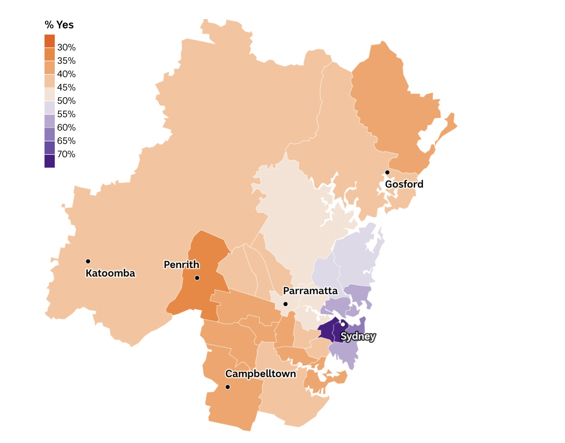
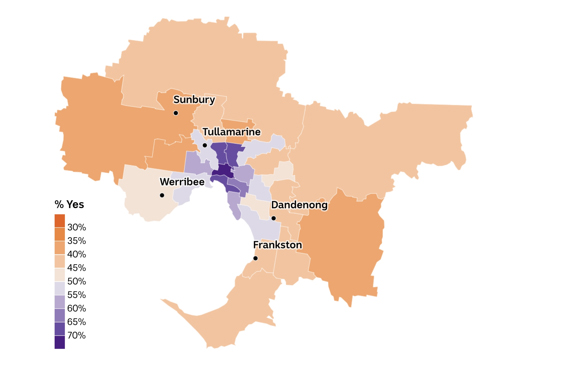
Putting aside that controversy, the most striking feature of the referendum result is the stark divide between Australia’s inner cities and the rest of the country.
At this stage, it appears there was majority support for Yes in only about 30 of Australia’s 151 electorates. Apart from one seat in Tasmania, those electorates are all close to the heart of Australia’s capital cities.
Here’s the picture for Sydney.
Source: The ABC
It’s the same story in Melbourne.
Source: The ABC
It was similar in Brisbane, Perth, Hobart, and Canberra – a concentration of Yes voters in the urban centers.
This reflects a divide on cultural issues between inner-city Australians and the rest. The former are wealthier and better educated and they are far more supportive of progressive causes like indigenous rights and climate change.
That was demonstrated in last year’s general election by the success of the culturally progressive ‘teal independents’ and the Greens Party in picking up many inner-city electorates. New Zealand is likely seeing something similar in the strong support for the Green Party on Saturday in Central Wellington, Rongotai, and Central Auckland.
It’s a trend that looks set to continue in Australia. And it will bring with it greater political polarisation.
The divide between the inner cities and the rest is closely related to another fascinating aspect of the Voice referendum. The Yes campaign received the overwhelming support of what might be termed Australia’s ‘elites’ (an elusive and contentious term). Many of the country’s institutions, from universities, religious groups, and sporting bodies to arts organisations, unions, and big business, endorsed the Yes campaign.
The big four banks alone donated over $7 million to the campaign, and BHP and Rio Tinto each gave $2 million.
The referendum result indicates that in many cases these institutions’ support for the Voice was at odds with the views of a majority of their members, shareholders, staff, congregants, customers or other stakeholders. This reinforces the picture of two different, even conflicting, Australias.
At a press conference on Saturday Prime Minister Anthony Albanese, the man who instigated the referendum, played down the divisions. In an echo of Barack Obama, he said that ‘We are not Yes voters or No voters. We are all Australians’.
Where to from here for reconciliation between Australia and its First Nations people? According to Marcia Langton, an Aboriginal academic and prominent proponent of the Voice, ‘reconciliation is dead’.
The PM is more optimistic, at least in public. He’s recommitted to advancing reconciliation and to listening to First Australians. However, it may take some time to heal the wounds of his rejected referendum.
*Ross Stitt is a freelance writer with a PhD in political science. He is a New Zealander based in Sydney. His articles are part of our 'Understanding Australia' series.
We welcome your comments below. If you are not already registered, please register to comment
Remember we welcome robust, respectful and insightful debate. We don't welcome abusive or defamatory comments and will de-register those repeatedly making such comments. Our current comment policy is here.