
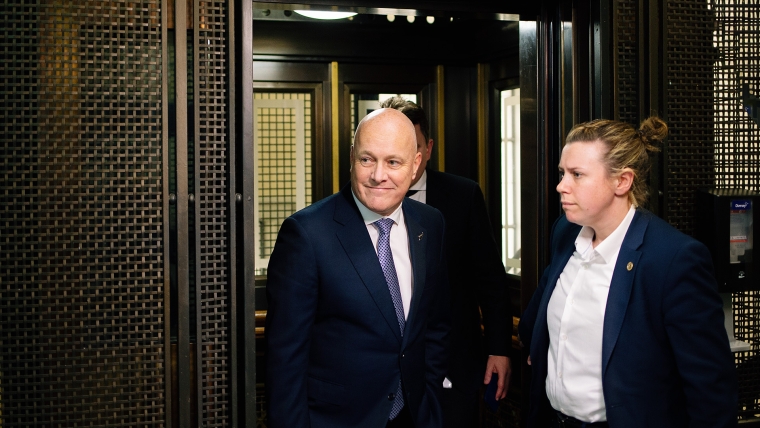
National Party leader and Prime Minister-designate Christopher Luxon says he has reached an agreement with his coalition partners and is ready to form a government.
Luxon said the final impasse was broken on Thursday morning, resolving 40 days of exhaustive negotiations to form the first ever three-party coalition.
While governments since 1996 have typically involved more than one party, most have had only two parties in the formal coalition and others involved through confidence-and-supply agreements.
The “final impasse” was understood to be which coalition partner would be given the role of Deputy Prime Minister. The office has traditionally been held by the support party’s leader.
With two support parties in this coalition, it was not obvious who should get the title.
David Seymour, the leader of the Act Party, argued it should be given to him as the leader of the second largest party, but there was no sign the other two leaders agreed with him.
Winston Peters, leader of NZ First, served as Deputy Prime Minister in coalition with Labour following the 2017 election.
In an impromptu press conference on Thursday afternoon, he said he had finished negotiating but wouldn’t reveal whether he had secured the job for a second time.
Seymour was seen in a local bar and cafe with his chief of staff while Peters was still inside the Treasury building finalising agreement details.
Peters did not seem to think the suggestion of him and Seymour sharing the role was a realistic option.
“We’ve never had a co-Deputy Prime Minister, ever. We’ve never had one in this country, why do you think that is the case,” he asked reporters.
Luxon would not be drawn on the subject either, telling reporters that all the details would be revealed during a signing ceremony on Friday morning.
Comprehensive partnership
The coalition agreement was “incredibly comprehensive” and would outline a well-defined work programme for the three year term.
“There is a lot of specificity there, that’s very deliberate so that we are all aligned about what we are shooting for, and what we are trying to achieve,” he said.
While all three parties had made compromises, there was “massive alignment” on broad goals with few areas of disagreement.
Negotiations had included deciding the policy programme and assigning ministerial positions, but also focused on building relationships and setting a process for resolving conflicts.
These last two items are necessary to ensure the three-party coalition can survive a full Parliamentary term and then successfully contest the 2026 election.
Luxon said he had been conscious that this specific coalition arrangement had not been done before and the three parties had wanted to ensure it would work.
“It's historic … that’s why we’ve spent so much time making sure we get it right.”
The caretaker government, which still occupies the iconic Beehive building in Wellington, has been told to be out by the end of Friday, so the new administration can move in by Monday.
Chris Hipkins, the current Prime Minister and leader of the Labour Party, said in October that his boxes were already packed and he was ready to hand over the keys.
After the signing ceremony on Friday morning, Luxon plans to announce the full list of ministers so they can take over the relevant offices that weekend.
The Prime Minister’s office is on the ninth floor of the Beehive and ministers often take the offices below in order of seniority — although there is no hard and fast rule.
On the tenth floor is the Cabinet office, where Luxon hopes to hold the first “ceremonial” meeting and photo opportunity with his new executive after they are sworn in on Monday.
Parliament plans to sit on December 5 for the three weeks remaining before the Christmas break.
We welcome your comments below. If you are not already registered, please register to comment
Remember we welcome robust, respectful and insightful debate. We don't welcome abusive or defamatory comments and will de-register those repeatedly making such comments. Our current comment policy is here.