
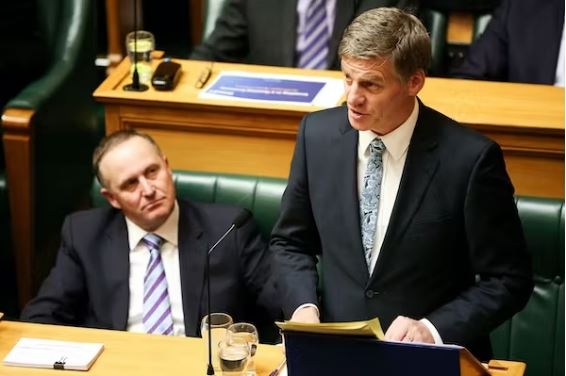
Former Prime Minister Bill English has been put in charge of reviewing the Crown housing agency Kāinga Ora’s finances and operations.
The National Party promised an independent review of the agency’s financial situation, procurement and asset management, as part of the new Government’s 100-day plan.
Housing Minister Chris Bishop said he was “deeply concerned” about Kāinga Ora’s operating deficit, which was $520 million last year and is forecast to grow.
“This deficit has a direct impact on OBEGAL and continues to put pressure on the return to OBEGAL surplus,” he said in a statement.
Kāinga Ora is the country’s biggest landlord with $45 billion in total assets, annual expenditure of $2.5 billion, and $12.3 billion of debt.
Bishop said ministers had received “worrying advice” about the financial situation of Kāinga Ora, since taking office in November.
“We are not releasing that information at this time as it is commercially sensitive, but it confirms that an independent review is the right course of action at this time”.
English was National’s finance minister and was responsible for Housing New Zealand between 2008 and 2016.
He will lead the review with former investment banker Simon Allen and engineering consultant Ceinwen McNeil.
“It is critical that Kāinga Ora is focused on efficiently building social houses for people in need while also delivering value for taxpayers’ money, and this review will be able to provide recommendations to ensure that these objectives are being met,” Bishop said.
In the year ended June, the Crown agency invested $3.5 billion, completed 2,893 homes, and had another 6,600 under construction.
Gareth Stiven, Kāinga Ora’s finance manager, said construction and maintenance costs had increased faster than rental income, putting “considerable pressure on our budget”.
The agency had developed a more efficient process to cut costs and was working on its own review of its asset management and maintenance system.
House prices have fallen significantly over the past two years and the value of Kāinga Ora’s portfolio dropped to $45.1 billion, from $48.8 billion in June last year.
Still, it had $30.3 billion net assets and was looking to take on additional debt.
“We are monitoring our capital position alongside our operating environment to ensure the pace of our investment is manageable within our overall financial parameters,” Stiven said.
S&P Global Ratings and Moody’s have both given the Crown agency an AAA rating within the past year, but only due to it being underwritten by the New Zealand Government itself.
Kāinga Ora’s “stand-alone” rating from S&P was downgraded to an A- in February and noted its gross debt and interest costs will grow substantially by 2025.
“In our view, the ratios are generally weakening as debt and interest expenses rise and EBITDA compresses,” the rating agency said
We welcome your comments below. If you are not already registered, please register to comment
Remember we welcome robust, respectful and insightful debate. We don't welcome abusive or defamatory comments and will de-register those repeatedly making such comments. Our current comment policy is here.