
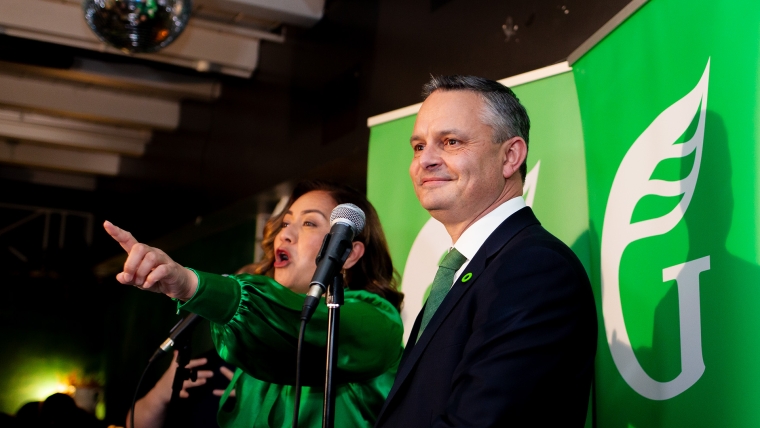
Green Party co-leader James Shaw has announced he will resign from party leadership in March, but stay in Parliament long enough to usher his members’ bill through the house.
“Our historic election result in 2023 ushered in a new era for the Green Party. Now is the time for a new co-leader to work alongside Marama to take this new caucus into the future,” he said in a statement.
Shaw served as Climate Change Minister for six years in the two Labour-led Governments and has led the Green Party, alongside Metiria Turei and Marama Davidson, for the past nine years.
When first elected to the leadership in 2015, Shaw said his goal was to lead the party into government and “safely out the other side”.
“We are the only government support party to have increased our support during our time in government, and we did it in each of our two terms in government,” he said.
The Green Party dropped out of government in the 2023 election, as political favour swung to the right, but it added one seat to its caucus and won three electorates.
Shaw signalled he would stay on after the election, only long enough to help settle the first-term MPs which will make up the majority of its 15 person caucus.
The number of new MPs will grow to nine once Shaw leaves Parliament, including a replacement for third-term MP, Golriz Ghahraman, who resigned amid shoplifting charges.
It sets the stage for the Green Party to reinvent itself and attempt to drive the agenda for left-leaning politics in the decade to come.
Succession season
Green Party co-leaders are elected by the membership and nominations will open on Wednesday and a replacement for Shaw should be selected by March.
Since the party membership also ranks the candidates on the electoral list, it can be used as a rough proxy for popularity among the rank and file.
Chlöe Swarbrick is number three on the list and would likely have sufficient support to secure the leadership. However, she hasn’t signalled that she wants to take on that job.
Next is Julie Anne Genter, who has been in Parliament since 2011 and served as minister. She unsuccessfully contested the co-leadership after Metiria Turei resigned in 2018.
Finally, second-term MP Teanau Tuiono holds the fifth list spot and was floated as a possible replacement for James Shaw when some members attempted to oust him last year.
It is also plausible the party could select one of the first term MPs or even somebody outside of Parliament, although the latter option is unconventional.
Davidson will stay on in her role for at least the next year but wouldn’t commit to contesting the 2026 election as a co-leader.
Pragmatic idealism
James Shaw and the party’s defining achievement has been ushering in the Zero Carbon Act, a law which requires NZ to bring net-emission to zero by 2050, with bipartisan support.
“We passed the landmark Zero Carbon Act, with unanimous support across Parliament, which made us one of the first countries in the world to place the Paris agreements 1.5 degrees temperature target in national legislation,” he said.
“I'm really pleased to see the zero carbon act survive its first real acid test and the recent change of government”.
While the Greens have always been a leftist party with social justice values, more attention has been paid to its economic and social policies in recent years.
This may be partly because the party has secured virtual political consensus on climate action and locked the net zero emissions target into law.
Shaw said it was the right time for a new co-leader to take the caucus forward. However, his departure doesn’t necessarily mean a sudden shift in ideology for the Green Party.
Both co-leaders rejected that characterisation that Shaw was the party’s “centrist linchpin”.
“One of the things that we often joke about is the extent to which we're typecast in these kinds of caricatures. That is just a function of politics, and when I am no longer here someone else will get typecast with that [identity]”.
He told reporters that pragmatism was a way to deliver idealism and the two concepts were complementary, not contradictory.
“The Greens, for many decades, have talked about building consensus and that means building consensus with people who fundamentally disagree with you, not just with people who already agree with you”.
Green MPs were often working to build consensus and looking for “non-tribal” ways of working in Parliament, he said.
“That has been a tradition of ours long before I got here and I expect that to continue”.
Examples include a memorandum of understanding with John Key’s National Government and Golriz Ghahraman’s close working relationship with National’s Gerry Brownlee.
A members’ bill, drafted by Lawyers for Climate Action and sponsored by James Shaw, was drawn from the ballot after the summer break.
Shaw intends to stay in Parliament to “shepherd” the bill through the legislative process. If passed, it would recognise a right to a sustainable environment in the existing Bill of Rights.
He hopes Parliament will hold a conscious vote for the Bill. That could allow him to chalk up one more pragmatic, bipartisan, idealistic win before riding off into the sunset.
We welcome your comments below. If you are not already registered, please register to comment
Remember we welcome robust, respectful and insightful debate. We don't welcome abusive or defamatory comments and will de-register those repeatedly making such comments. Our current comment policy is here.