
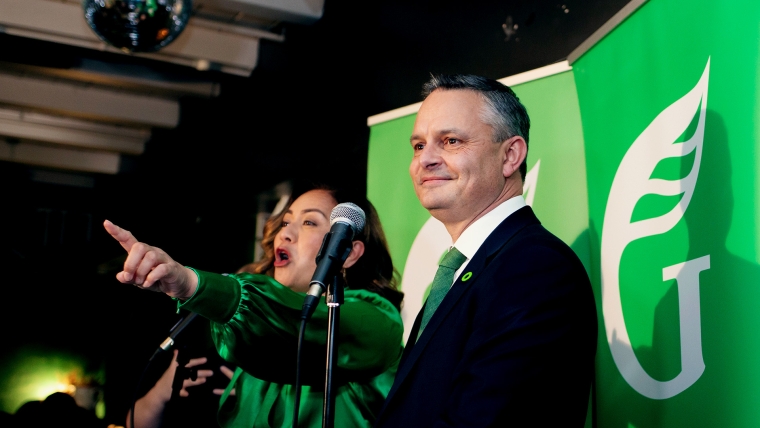
The former Minister of Climate Change James Shaw says solutions to climate change are “largely an infrastructure issue” and represent the greatest investment opportunity for New Zealand since the rebuild after World War Two.
Shaw spoke at the Building Nations Conference – like ComicCon for infrastructure enthusiasts – which was held in Auckland on Wednesday.
Shaw said while he knows a lot of people feel “quite daunted” about the scale of what needs to happen, it needs to be seen as an enormous opportunity.
“If you accept that this is basically a royal asset replacement programme, and in New Zealand, that there are a number of, shall we say, timely opportunities for asset replacement, then the next question is, how do you unlock that? And that requires gargantuan amounts of investment, for which reason this is also the biggest investment opportunity since World War Two. So that's kind of exciting,” he said.
The former co-leader of the Greens Party left Parliament in May after a 10-year career in politics, stepping back into the private sector via infrastructure investment firm Morrison.
The firm manages over $38 billion in assets, on behalf of institutional investors and sovereign wealth funds like the NZ Super Fund.
During his decade as a politician, Shaw served as Greens Party co-leader (2015-2024), Minister of Climate Change (2017-2023), Minister of Statistics and Associate Minister of Finance (2017-2020), and Associate Minister of Environment (2020-2023).
Before leaving Parliament, Shaw announced his goal to reduce or eliminate 150 million tonnes of global climate pollution by 2030 through his future work in the private sector, aiming to prove that if he could achieve it, the Government could too.
He wagered to the Coalition Government’s Climate Change Minister Simon Watts that the last person to reach the goal would buy the winner drinks.
At the Building Nations conference, Shaw said he had picked 150 million tonnes of climate pollution because it happened to be New Zealand's commitment under the Paris Agreement.
“And because I'm bloody minded and we were taking forever to get cracking on it, I thought, well, I'll just do it and demonstrate that it's actually not nearly as hard as everybody says it is. And that we can stop hand wringing and just do some stuff.”
Shaw described climate solutions as being infrastructure related in “virtually every category that you can think of” ranging from electricity generation and distribution, stationary and industrial energy, building and construction, waste management and data infrastructure.
“And if you think about those categories, then you kind of go, well, what do we need to shift in each of those categories in order to decarbonise the economy as a whole?” he said.
“In each of those categories, there are solutions to be found.”
Shaw said climate change is the single greatest risk that civilization and species have ever faced, calling it the “omnicrisis” – a situation where multiple crises are happening at once.
“So stopping climate change really is something that's going to take everything. That's going to take all of us, and it's going to take everything that we've got.”
He remarked, that before the election last year, he had floated the notion that one of the reasons why infrastructure is politicised in this country “is because we're really cheap”.
“So you can choose to have a road or light rail system. Actually, most countries in the OECD have roads and light rail systems and they tend to both get paid for [with] private finance. That's how we've got a lot of ability to kind of have both.”
That was a different story in NZ, Shaw said, with the country only prepared to pay for one of those assets at a time.
65 months
“Climate change is an economic policy under this government,” Simon Watts told conference attendees on Wednesday.
“Why? Because the interlinkages between climate change, renewable and clean energy adaptation and infrastructure investment, innovation in terms of agricultural emissions reductions, all are underpinned by the integrity of our economy.”
Watts had the last speaking slot of the day and used it to give an overview of the work the Government was doing around climate change, like Parliament's climate inquiry, agriculture being taken out of the Emissions Trading Scheme (ETS) and the decision to cut the number of units available in the ETS by 24 million (more than half) between 2025 and 2029.
He said the Government particularly wanted to work with the infrastructure sector in order to deal with the impacts of climate change that NZ was already facing but also prepare for future impacts.
“We're in the critical decade of delivery. We need to get on and do the doing and we've only got 65 months between now and 2030.”
NZ is set to very narrowly meet its current second emissions budget of 303 million tons of carbon emissions between 2026–2030, however the Climate Change Commission believes there are “significant risks” of NZ not meeting its second or third emissions budget.
In mid-July, the Ministry for Environment (MfE) publicly released documents on its second emissions reduction plan which revealed NZ is set to narrowly meet its first and second emissions budgets for 2022-25 and 2026-30.
On Wednesday, Infrastructure Minister Chris Bishop also announced a National Infrastructure Agency (NIA) will be established from December later this year.
Bishop said the NIA will, among other things, act as the Crown’s “shopfront” to facilitate private sector investment in infrastructure. The agency will also partner with agencies – and in some cases local government – on projects involving private finance, administer central government infrastructure funds.
The NIA will be established by repurposing Crown Infrastructure Partners which currently manages the delivery of several billion dollars' worth of government projects.
“Our intention is that the NIA will unlock access to more capital for infrastructure and give the private sector a one-stop shop to partner with the Government,” Bishop said.
Bishop said if the private sector was looking for an investing opportunity around infrastructure in NZ or wanted to pitch a project, the NIA would be opening for business “very shortly”.
We welcome your comments below. If you are not already registered, please register to comment
Remember we welcome robust, respectful and insightful debate. We don't welcome abusive or defamatory comments and will de-register those repeatedly making such comments. Our current comment policy is here.