
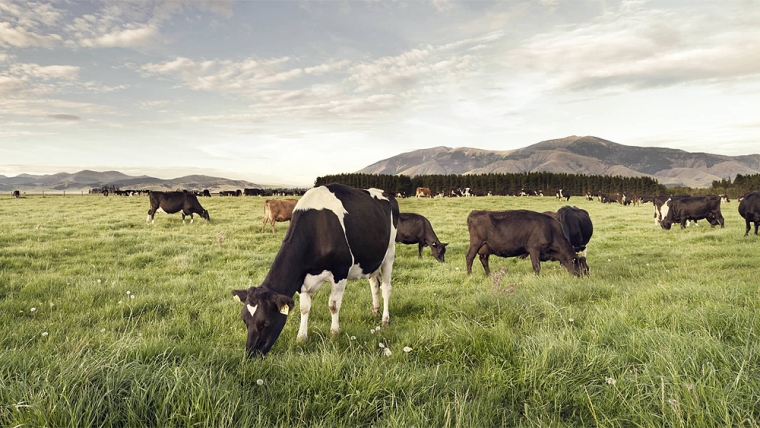
The Coalition Government says the Emissions Trading Scheme (ETS) will be its main tool for tackling climate change but it won’t be applied to New Zealand farmers.
Three of the four Ministers of Agriculture—Todd McClay, Andrew Hoggard, and Mark Patterson—and Simon Watts, Minister for Climate Change, confirmed the policy on Tuesday.
The Climate Change Response Act will be amended to exclude agriculture, animal processors and fertilizer companies from the ETS before a backstop kicks in next year.
Any farm-related emissions from these sectors will be unpriced until sometime before 2030 when the Coalition Government hopes to have set up a separate pricing system for the sector.
Carrots & sticks
The Labour Government had been working with the sector to develop agricultural pricing ahead of a 2025 deadline which would’ve seen it dropped into the ETS.
It was a ‘carrot and stick’ type approach which collapsed in 2023 when the National Party pulled its support and signaled it would delay pricing if it were to win the election.
Now in Government, the party will set up a new version of the Crown–industry partnership to work out how to price emissions before the new 2030 deadline.
It will be called the Pasture Sector Group instead of He Waka Eke Noa, which has been formally disestablished, but will serve a similar purpose.
Wanye Langford, president of Federated Farmers, said he hoped the group would focus on reducing, rather than pricing, on-farm emissions.
The group aims to avoid emissions pricing altogether and encourage farmers to use their resources to reduce methane output instead of “paying a tax”.
He said the Pasture Sector Group would be different from He Waka Eke Noa as it included a tighter-knit group of farming representatives and would have new terms of reference.
Federated Farmers has three bottom lines: methane targets need to be reviewed, viable and cost-effective tools should be available for farmers, and no emissions leakage should occur.
"We can see those bottom lines explicitly reflected in today’s government announcement and that gives us a lot of confidence for the future," Langford said.
Delay today
Todd McClay said it was “time for a fresh start on how we engage with farmers and processors to work on biogenic methane”.
The Minister has also asked for advice that may be used to challenge the Government’s own Climate Change Commission’s advice on how much agriculture emissions should be reduced.
He wants to approach methane from a “no additional warming” perspective, which could effectively allow the sector to freeze their emissions at their existing levels.
Green Party co-leader, Chlöe Swarbrick said the Government would not be able to achieve its climate commitments if it kept delaying pricing half the country’s total emissions.
“The science tells us we must reduce methane emissions. Fair pricing is a crucial way to achieve this, putting the sector on an even footing with the rest of our economy,” she said.
Searching for solution
Simon Watts said the Coalition would invest $400 million over the next four years to support the commercialisation of tools and technology that could reduce on-farm emissions. This includes a $50.5 million funding boost for the New Zealand Agricultural Greenhouse Gas Research Centre.
Things such as a methane vaccine, lower-emission cattle breeds, and methane and nitrous oxide inhibitors could make the pricing less costly when imposed in 2030. (See more on these here).
“These investments signal the Government's support for farmers while ensuring New Zealand meets its international climate change obligations,” Watts said.
Tthe Act Party said the Government—of which it is a part—should have gone further and repealed the Zero Carbon Act and abolished the Climate Change Commission.
We welcome your comments below. If you are not already registered, please register to comment
Remember we welcome robust, respectful and insightful debate. We don't welcome abusive or defamatory comments and will de-register those repeatedly making such comments. Our current comment policy is here.