
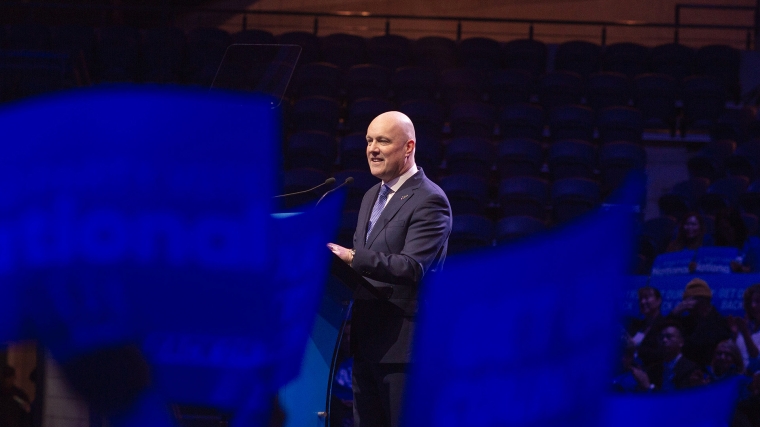
A few weeks ago, I wrote that Christopher Luxon and the National Party were likely in a stronger political position than they appeared to be in headline voter polls.
My assessment was that while party support hadn’t changed significantly since the election, Luxon’s favorability had improved and his party had an upper hand on voters’ top issues.
This undercurrent of support may eventually translate into some stronger poll performances, particularly as interest rates come down — or so I thought.
Well, on Friday an updated Taxpayers’ Union–Curia poll threw cold water on my hot take, with the National Party’s worst result in that particular poll since August 2023.
The result hasn’t dramatically changed Interest.co.nz’s own polling average. This is partly because the last six public polls have had widely differing results for the Labour Party.
A Roy Morgan poll published earlier this week put them at just 23% support, while a Talbot Mills survey from a similar period put the party at 32%. This demonstrates the need for an average.
Our average still shows an eight point gap between the left and right coalitions, but it doesn’t include Labour’s internal polling, which The Post reported as having just a two point gap.
Are these poor polls early signs of dissatisfaction with the Coalition ahead of its one-year anniversary next month? It is too early to say, but it will be worth watching the next polls.
While individual polls do move around, National’s 4.1% decline in the TPU–Curia poll was larger than the margin of error, which does suggest at least some voters abandoning them.
The Act and New Zealand First parties picked up about 1.5% of this lost support, while Labour seemingly scooped up the other 2.5% — plus some Green and Te Pāti Māori voters to boot.
Poor health
As to what could be driving a shift in the polls, one of the better theories is that a series of problems in the health portfolios have rubbed New Zealanders the wrong way.
There has been ongoing controversy over Casey Costello’s smoking policies, a broken promise and sudden U-turn from Nicola Willis over funding for cancer drugs, and then Shane Reti sent a Commissioner to crack down on hospital costs after Health NZ hired too many nurses.
And if that wasn’t enough, the Coalition broke another promise and paused construction of the long-awaited Dunedin Hospital due to an alleged billion-dollar cost blow out.
These may or may not be sensible decisions made by competent ministers who are balancing competing priorities in difficult circumstances, but they look bad on television and in news headlines regardless.
An estimated 35,000 people protested the Dunedin Hospital decision, which would be somewhere in the ballpark of a quarter of the city’s entire population.
TPU–Curia poll also asked voters about their top issues. Health had climbed into second place in their October poll, at 35.5% and up 4.2% points. It now ranks above Cost of Living which has been the top issue for years, but has dropped to third place with Economy on top.
It could be speculated that some voters’ attention has shifted from inflation and high interest rates, to employment and healthcare. This would mean moving from Labour’s weakest issues, to some of its strongest ones.
Ipsos NZ’s issue polling for August already showed healthcare/hospitals jumping into second place, surpassing crime, housing, and the economy. Concerns about unemployment had also doubled, albeit from very low levels.
That survey also reported Labour as being seen as the party most capable of managing healthcare and unemployment, although National was ahead on almost everything else.
A previous TPU–Curia poll report, which was released in full, also showed health as being one of Labour’s stronger issues, although National was still ahead.
Playing defence
Finance Minister Nicola Willis, an adept politician, was seemingly conscious of her party’s vulnerability when discussing the Crown’s financial accounts on Thursday.
“I know that New Zealanders put a huge priority on the health services that a government delivers, and that is why we put significant funding in and why we view those frontline services as critical,” she said.
“But we also need to make sure the resources we put in are well-managed and that we have targets that we are accountable for meeting them.”
She complained that media reports on Health NZ didn’t acknowledge the Coalition had increased the budget by $1.4 billion this financial year, just as other governments had done.
Health NZ had also been told it would be the “first port of call” for future funding and had been guaranteed increases of more than $1.3 billion in each of the next years.
But that didn’t mean it could exceed that budget in any given year, which was why the Commission had been sent in to ensure the agency manages its finances responsibly.
“That doesn't mean there won't be more resources for health, there will be,” she said.
If National’s internal polls look anything like these ones, we can expect some big health related announcements in Budgets 2025 and 2026.
This story has been updated to reflect the Government’s commitment to build a hospital in Dunedin for up to $1.9 billion.
We welcome your comments below. If you are not already registered, please register to comment
Remember we welcome robust, respectful and insightful debate. We don't welcome abusive or defamatory comments and will de-register those repeatedly making such comments. Our current comment policy is here.