
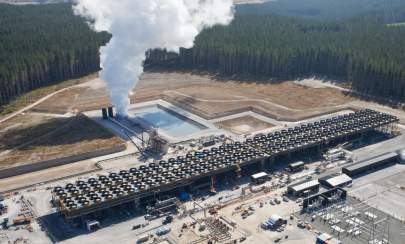
New Zealand is taking tentative steps on energy policy that could double the current output of geothermal energy.
This would be done by drilling much deeper than existing geothermal wells and thereby extracting far more energy.
If it works, it could make New Zealand’s electricity overwhelmingly renewable. It would do so cost effectively, because geothermal energy is continuous. The earth’s core is always hot and pressure fluctuations can be averted by injecting fluid as well as taking it out from underground.
By contrast, wind farms don’t work when the wind doesn’t blow, meaning back-up generation is required for calm days but sits idle at other times. This practice is known as overbuild, and is expensive. Similar problems affect solar energy.
At present, about one-fifth of New Zealand electricity is geothermal. That is achieved by drilling wells 2.5 to three kilometres into the earth in places like the Taupo Volcanic Zone, where the earth’s crust is relatively thin. But the new programme would go deeper, to 6.5 kilometres, and get access to far hotter temperatures – 700 degrees C compared with 400 at shallower depths.
In an initial move, the Government has committed $5 million to design and cost the first of three exploratory wells. If it works, $60 million would be available to push the matter further. Private sector and iwi involvement would also be sought.
“Having a secure and resilient energy supply is a priority for the Coalition Government and is critical to rebuilding the economy and giving businesses the confidence to invest,” say the Regional Development Minister Shane Jones and the Science, Innovation, and Technology Minister Judith Collins.
"More use of geothermal energy would reduce emissions and reliance on fuels such as gas and coal, as New Zealand moves to more renewable energy," Jones says.
“Renewable energy, at present, cannot be relied on for our entire energy needs. Hydroelectric generation currently provides 60% of our power needs. However, as this winter has shown, a lack of rain can quickly turn into a crippling issue.”
The initiative will be led by GNS Science and the Ministry of Business, Innovation & Employment (MBIE).
An advantage of the scheme is that going deeper means more energy can be extracted while not expanding the surface area of a power station, according to the GNS team leader, Isabelle Chambefort. And the scale of the resource is huge.
“As part of this programme, we did an inventory of some of our resources and we estimate we can generate more than 30,000 megawatts hours,” she says.
“We would be doubling the percentage of our generation from geothermal, and it is really the key to having renewable energy.
“We need to increase by at least 50%, our electricity generation. We cannot build more dams from an environmental point of view and we cannot build nuclear so really the only solution that we have to increase base load is geothermal.”
The lobby group, Energy Resources Aotearoa (ERA), welcomes the Government’s announcement, calling it a potential game-changer for energy and economic development in New Zealand.
"New Zealand has been a leader in geothermal technology for decades and will now join the US and Iceland in advancing (this technology) and the valuable intellectual property that goes with it," says ERA’s chief executive, John Carnegie.
Chambefort says the costs of generation would be about $100 per megawatt hour, which is compatable with prevailing prices and cheaper than gas, over-built solar or solar augmented by battery storage.
A report published earlier this year by the economics consultancy Castalia estimated deep wells would cost a lot more than existing, shallower wells. But even if the price were to double, the scheme could still make sense, especially under a tough emissions regime or shortages or restrictions or even bans on fossil fuels. And it would help meet growing demand for electricity in sectors such as transport, which conventional geothermal could never do.
Chambefort says New Zealand’s research will match efforts in Iceland, the US and Japan, and is still frontier research at this stage rather than an in-use technology. But she says its potential is huge.
Officially this area of research is known as Supercritical Geothermal Technology (SCGT), and would use water heated well above boiling point, but constrained by the pressure of the earth from evaporating away as steam.
“There is nowhere on Earth right now where a power station is utilising supercritical water in a geothermal environment,” Chambefort says.
“But is it important to note that supercritical water is used every day in thermal plants which use super-heated water to turn the turbine, so this this is technology that does not need a huge development.”
We welcome your comments below. If you are not already registered, please register to comment
Remember we welcome robust, respectful and insightful debate. We don't welcome abusive or defamatory comments and will de-register those repeatedly making such comments. Our current comment policy is here.