
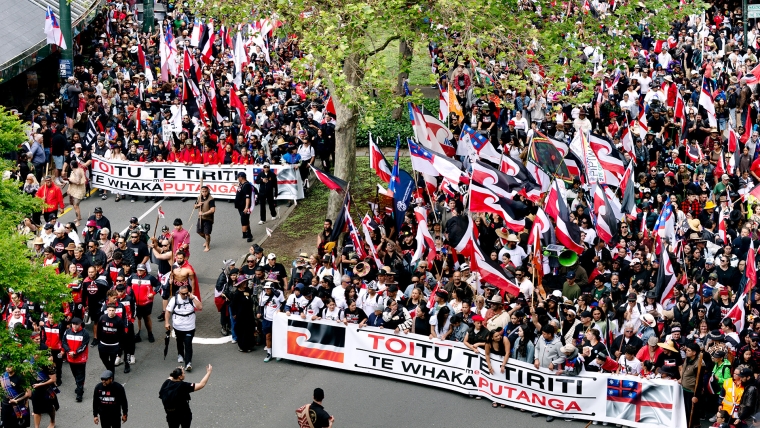
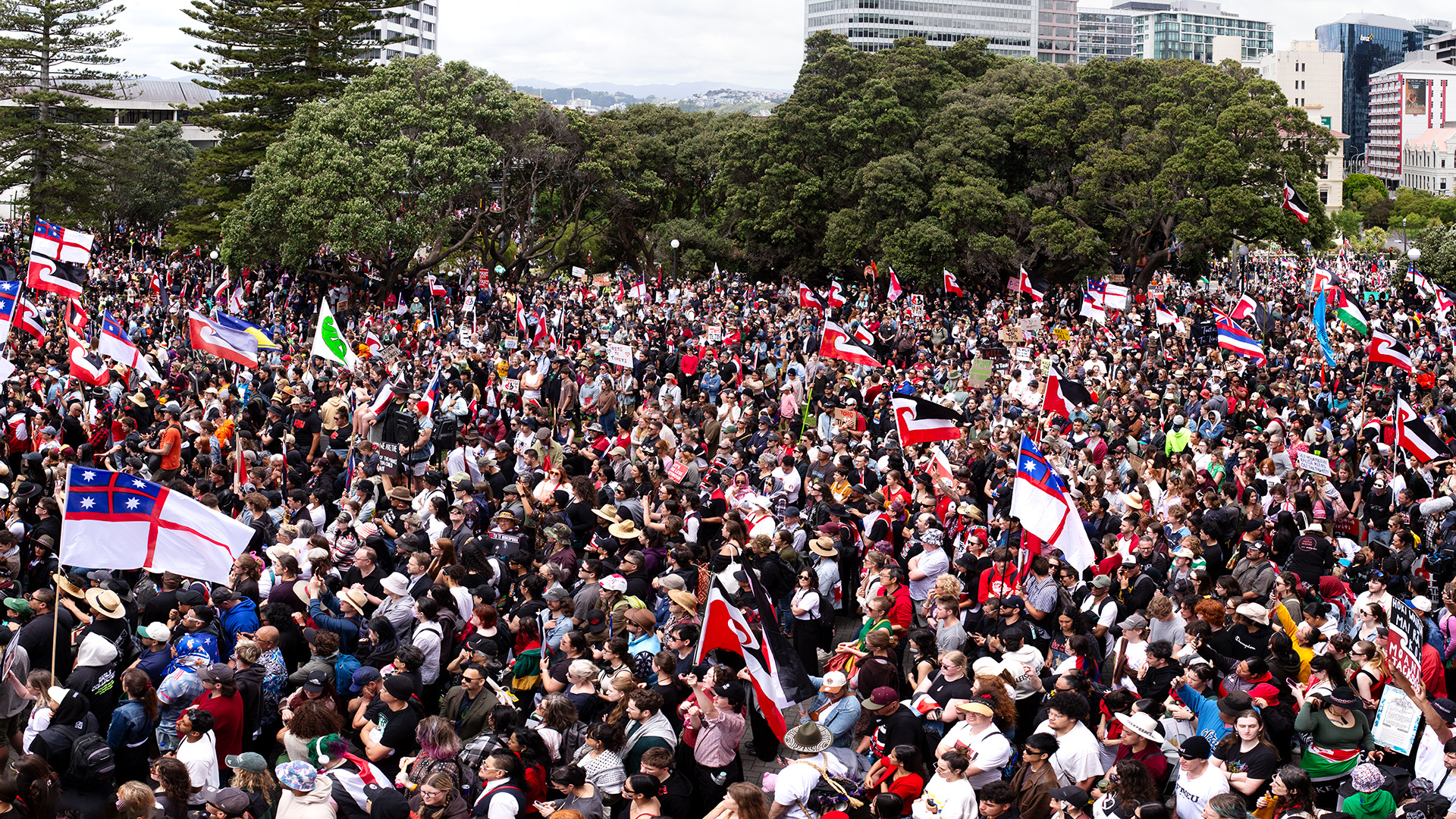
More than 42,000 New Zealanders rallied outside Parliament on Tuesday to demonstrate their opposition to the Treaty Principles Bill and other policies perceived as being anti-Māori.
That makes it the largest protest at Parliament in New Zealand history and one of the biggest anywhere in the country ever.
Onlookers gathered on balconies and at windows to watch a river of red Tino Rangatiratanga flags completely flood the forecourt, steps, and surrounding streets.
It was a big protest all over a bill that won’t even pass its second reading.
Act Party Leader David Seymour introduced his Treaty Principles Bill last Thursday and it was voted through to a select committee process by reluctant National and NZ First MPs.
The Justice Select Committee opened for submissions on Tuesday and hopes to finish its hearings by the end of February, after which the Bill be voted down at its second reading.
However, the record-breaking protest turnout wasn’t just because of the Treaty Principles Bill.
Shane Jones, an NZ First MP and senior minister, said there was an anxiety among Māori that their identity was “being imperiled” by the coalition Government and some of its allies.
“We've got to work very hard to assure them that, [firstly] identity is not only a personal responsibility, but also we're not doing anything to invalidate Māori identity,” he said.
Anti-Māori accusations
While he’s right that a majority of Parliament want to see Māori thrive, the Coalition formed around a long list of policies which were targeted at things they care about.
Abolishing the devolved health authority, forcing councils to hold votes on Māori wards, and requiring public services to use less Te Reo are just three examples, but the list goes on.
Māori are growing as a proportion of the population and the financial reparations from Treaty settlements have been bolstering their economic and political power.
Some suspect NZ’s white majority feels threatened by the increasing status of Māori and has elected the Coalition government partly in the hopes it will slow that progress.
This would be an unfair assessment of most voters and politicians, but there is a cohort of voters who believed a “Māori elite” was being handed the keys to the country — and wanted a new government to pull the handbrake.
You could see elements of this in the heated debate over co-governance in Three Waters and among the Groundswell protests, which were supposed to be about rural issues.
So, the protests have rallied against the Treaty Principles Bill but are really about protecting the progress made over the past 50-or-so years from a perceived backlash.
Organizers of the protest said the hīkoi, which had traveled from the Far North over the past nine days, would “continue” and various speakers asked the crowd to register for future updates.
Trap, set, & match
But here’s the thing, it may not be about the Bill for Seymour either. His campaign is starting to look more like a trap set for National which threatens to break apart its big tent coalition.
The party was created in 1936 as an amalgamation between the conservative and liberal parties of the time, and it still has two factions of centrist and right-wing MPs and voters.
Centrists are aghast at National’s tolerance of the Treaty Principles Bill, while those on the right are furious it won’t be voted into law.
Paul Goldsmith was put under pressure in a Newstalk ZB interview on Monday night, admitting there was a “wide variety” of responses to his explanation of the party’s position.
This is what political scientists call a ‘wedge issue’ and it has the potential to shift conservative voters into the Act Party, leaving National to be a smaller, centrist party.
For what it is worth, MP James Meager did not agree. He said it wasn’t the first time National had taken a position that not everyone in the party agreed with.
“The benefit of being a broadchurch party is that you can have views right across the spectrum, whether that’s liberal, conservative, urban, [rural], town. So, no: I think we’re fine”.
We welcome your comments below. If you are not already registered, please register to comment
Remember we welcome robust, respectful and insightful debate. We don't welcome abusive or defamatory comments and will de-register those repeatedly making such comments. Our current comment policy is here.