This warming is fuelling Australia’s current record-breaking heatwave. Other consequences are visible globally, from Iran’s crippling drought to catastrophic wildfires and unprecedented floods in the United States to deadly cyclones hitting southern Asia.
We know what to do to tackle the climate crisis: replace fossil fuels with clean energy technologies such as solar, wind, electric vehicles and batteries. We are well on our way. Globally, the power produced by renewables overtook coal last year.
Petrostates such as Saudi Arabia and the US have made trillions from oil and gas. Now they are fighting a rearguard action to prolong fossil fuels. The US is pushing European nations to buy its gas, for instance.
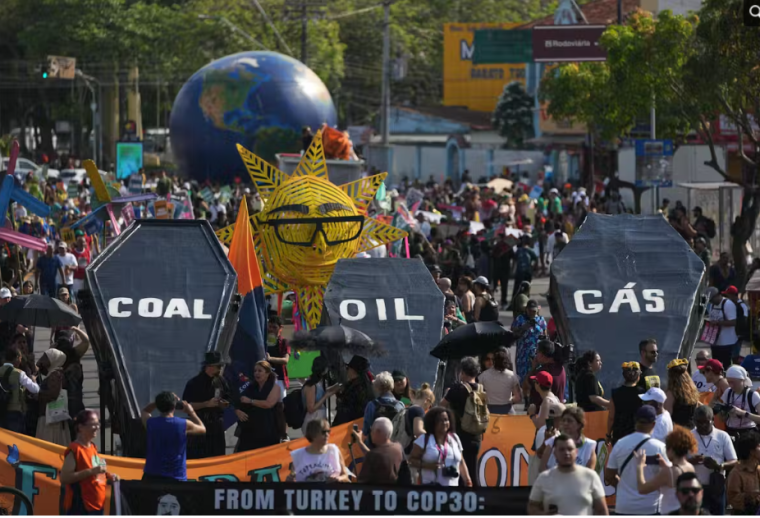
But most countries have seen the writing on the wall. In November, the COP31 climate talks in Turkey are expected to deliver a global roadmap away from fossil fuels. Dozens of countries will meet in Colombia in April to fast-track the transition. The road ahead is bumpy. But the end of fossil fuels may finally be coming into view.
No holding back clean energy
There’s no one trying harder to slow the clean energy transition than US president Donald Trump. During his bid to return to the White House, Trump pressed oil executives for US$1 billion (A$1.4 bn) in campaign finance, promising a windfall in return.
In 2025, he increased subsidies for fossil fuel producers, weakened environmental laws, gutted Biden-era support for clean energy and moved to block clean energy projects, even some near completion. The US is now one of the world’s biggest exporters of liquefied natural gas (LNG) and oil.
But clean energy growth has proved difficult to kill. Despite Trump’s efforts, domestic solar generation is still expected to grow 46% in the next two years while electricity output from fossil fuel plants falls.
Trump is betting fossil fuels are the key to future American power. He made no secret of the fact the US military raid on Venezuela earlier this month was aimed at increasing oil production. He has implored US oil companies to invest billions to revive the country’s battered oil infrastructure. The response was lukewarm. ExxonMobil CEO Darren Woods said Venezuela was “uninvestable”.
Developing Venezuela’s oil reserves assumes there will be demand for decades to come. But the world now faces an oversupply of oil, even as sales of electric vehicles grow strongly in many countries. Last month, battery electric vehicles outsold petrol cars for the first time in Europe.
Electrostates rising
While the US doubles down on 20th century fossil fuels, China is betting on an electric 21st century. It is emerging as the first electrostate, dominating production and export of solar, wind, batteries and EVs. China is now the world’s biggest car exporter. Most new Chinese cars are powered by batteries, not oil.
China’s manufacturing might has driven down the price of batteries, the main cost of EVs. As EVs get cheaper, emerging economies are finding they can leapfrog fossil fuels and move straight to solar panels and EVs – even if the national power grid is limited or unreliable.
Commodity price trends show surging global demand for copper, silver and other metals needed for mass electrification. Worldwide, investment in clean energy technologies first overtook fossil fuel investment ten years ago. In 2025, clean investment was more than double the investment in coal, oil and gas. Clean energy is where the world is headed, whether Trump likes it or not.
China, India and Pakistan are rapidly making the shift to renewable power. Developing nations from Nepal to Ethiopia are taking up electric transport to slash the cost of importing fossil fuels.

A new roadmap away from fossil fuels
This week, the US formally withdrew from the Paris Agreement. But no other country has followed.
For decades, the COP talks have focused on “cutting emissions” without dealing directly with the use of coal, oil and gas. But at the 2023 talks, nearly 200 countries agreed to “transition away from fossil fuels”.
At last year’s COP30 talks, host nation Brazil proposed a roadmap to phase out fossil fuels. More than 80 countries backed the idea, including Australia, but pushback from Saudi Arabia and Russia kept it out of the final outcomes.
In response, Brazil is working to develop a roadmap for phasing out fossil fuels. This – or something similar – may be formally adopted at the next climate talks in November.
While COP31 will be held in Turkey, Australian climate minister Chris Bowen will have a key role as “President of Negotiations” and will steer global discussion ahead of the summit.
Bowen plans to lobby petrostates to support a managed shift away from fossil fuels, drawing on Australia’s experience as a major exporter of coal and LNG facing its own transition. Korea – Australia’s third largest market for thermal coal – will retire its entire coal fleet by 2040.
Government modelling suggests Australia’s coal and gas exports could plummet 50% in value in five years as global demand falls. Independent modelling suggests the decline for coal could happen even faster if countries meet their climate targets. Policymakers must plan to manage this transition.
Coalitions of the willing?
Frustrated by slow progress, a coalition of nations is separately discussing how to phase out fossil fuels. The first conference will take place in April in Colombia. Here, delegates will discuss how to wind down fossil fuels while protecting workers and financial systems. Some nations want to negotiate a standalone treaty to manage the phase-out. Conference outcomes will also feed back into the UN climate talks.
Pacific island nations aim to be the world’s first 100% renewable region. Ahead of COP31, Australia and island nations will meet to progress this.
Progress is happening
In an ideal world, nations would rapidly tackle the existential threat of climate change together. We don’t live in that world. But it may not matter.
The shift to clean electric options has its own momentum. The question is whether the shift away from coal, oil and gas will be orderly – or chaotic.
*Wesley Morgan, Research Associate, Institute for Climate Risk and Response, UNSW Sydney.
This article is republished from The Conversation under a Creative Commons license. Read the original article.
We welcome your comments below. If you are not already registered, please register to comment
Remember we welcome robust, respectful and insightful debate. We don't welcome abusive or defamatory comments and will de-register those repeatedly making such comments. Our current comment policy is here.