
New Zealand’s first national infrastructure plan reveals a widening gap between what the country wants to build, what it’s getting and what it can actually pay for.
With costs escalating, alongside severe risks from natural hazards, the Infrastructure Commission is pushing for an overhaul. Users should largely pay for roading, telecommunication and water infrastructure, more money needs to be pumped into hospitals, and the country needs a complete catch up to lift water asset conditions and meet quality standards.
The plan, released by the Infrastructure Commission on Tuesday, laid out the risk of the way the country invests in infrastructure, saying if it doesn’t change, New Zealanders could miss out on the hospitals, schools, water systems, telecommunications and transport networks "they expect and deserve”.
“If we continue with the status quo, we’ll fall further behind,” the plan states.
The framework outlines guidance of what NZ can afford to spend over the next 30 years. Part of that recommended roads, telecommunications and water infrastructure national networks be funded by users to “free up general taxes to pay for social infrastructure such as hospitals and schools”.
“In transport, this requires reforming the investment and funding system to ensure spending commitments are in line with what we recover from users.”
It strongly recommends reforming roading priorities; “to better align transport investment with what users can fund”.
It raises serious concerns about the growth of the country’s major transport project pipeline, compared to how much money is available to deliver it, with cost escalation compounding the problem.
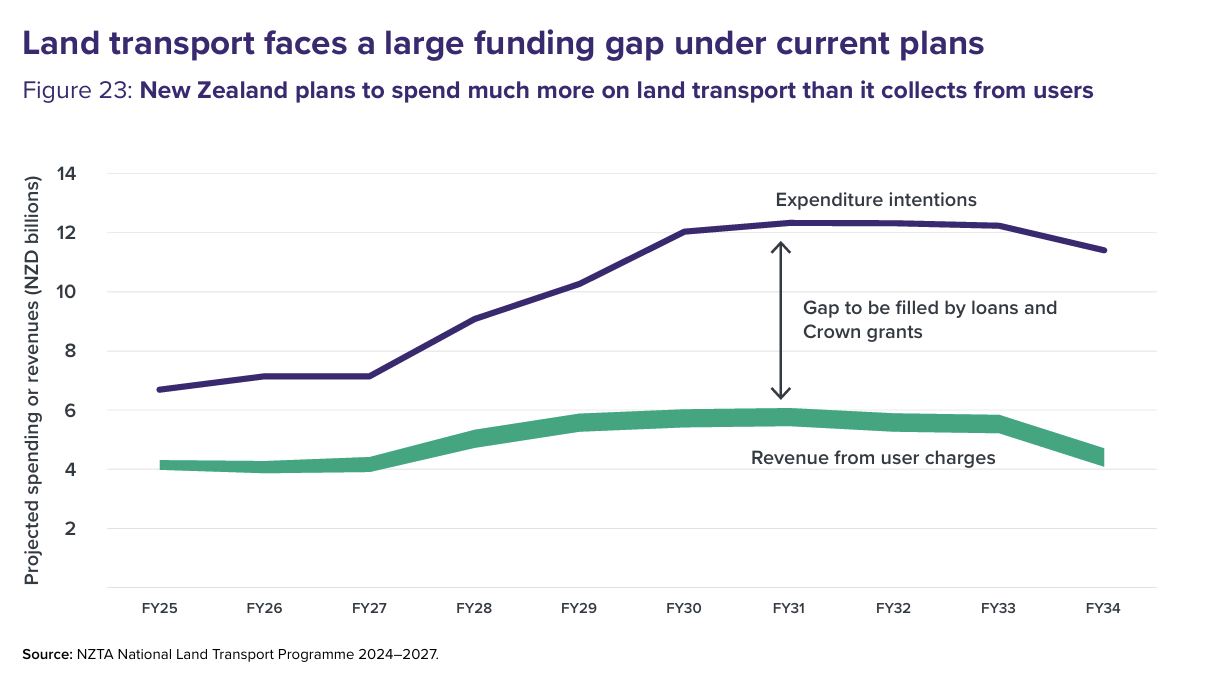
“New Zealand spends more on land transport than any other infrastructure class, yet current investment plans exceed what can be sustainably funded by users.
“Without stronger prioritisation, this risks displacing investment in other sectors and increasing pressure on general taxes.”
A $9 harbour bridge toll?
The plan outlines the mismatch of how much New Zealand plans to spend on its roading and transport network, and how much revenue it actually collects from user charges.
The list of projects include the 17 Roads of National Significance (RoNS), major rapid transit projects such as Auckland’s Northwestern Busway, and the new Waitematā Harbour Crossing.
"Taken together, these ambitions far exceed the revenue likely to be available over coming decades."
Analysis from the Commission suggested a $9 toll on the new and existing Waitematā Harbour Crossings could bring in $7 billion to $9 billion, as unlike road upgrades, it was unlikely to be funded through normal revenues.
"Building the original bridge required a steep toll, equal to $9 in inflation-adjusted terms. The current crossing faces maintenance, resilience, and capacity pressures, but repeated investigations have yet to identify an affordable solution."
It recommends a return to a system mainly funded by users, so Crown loans and grants are not required. It also suggested that investment decisions around the maintenance and growth of the roading network is moved into the hands of transport providers to be better in line with user demands, rather than central government.
“Greater autonomy, coupled with independent oversight, can enhance commercial discipline, confine investment to available revenue and reduce network integration challenges,” it says.
Another key recommendation was to implement time-of-use charging in Auckland. Legislation went through Parliament last year to allow congestion charging schemes to be put in place by local authorities. It also recommends universal road user charges as the country’s fleet becomes more electric - a move already signalled by the Government last year.
Commission Chief Executive Geoff Cooper said in New Zealand, “each year we invest just over $20 billion on infrastructure, yet on a dollar-for-dollar basis we achieve less than many of our more efficient international peers”.
“While the plan looks at the long-term, it’s clear that we need to take action now. Weather events and infrastructure failures make very clear the importance of investing to renew and build resilience into the networks that sustain our way of life.”
Infrastructure Minister Chris Bishop said many of the Commission’s recommendations reflected work already underway by the Government.
“We will be studying these recommendations carefully and the Government will publish a response to the plan in June 2026," he said.
“Infrastructure lasts for generations. Where we can build durable consensus, we should.”
Bishop said the country has real challenges ahead.
“We spend a lot on infrastructure - around 5.8% of GDP annually over the last 20 years, one of the highest in the OECD - yet we rank towards the bottom for efficiency, and fourth to last in the OECD for asset management.
“Many central government agencies do not properly understand what they own or have long-term investment plans. The assurance system for new projects and long-term investments is fragmented and inconsistent.”
Green Party co-leader Chlöe Swarbrick described the plan as being in "stark contrast to the Government's actual spending priorities".
"As parts of our country are underwater in yet another climate emergency, the need for decisive action, leadership and investment has never been more clear."
7 Comments
We can be certain that central government will not be able to deliver. Worth a read on our broken governance https://open.substack.com/pub/theintegrityinstitute/p/democracy-briefin…
User pays is not a new tax …. Yeah Right
It's all user pays, the only variable is who's picking up what portion of the tab.
Usually the user though.
“New Zealand spends more on land transport than any other infrastructure class, yet current investment plans exceed what can be sustainably funded by users."
Sums it up nicely. We rely on imported fuel to run the machines for our quarries, to pave and grit roads, and the bitumen to boot. All to re-rip it up and re-do it all over again after it gets too much use from oversized trucks that damage it faster than it is built to withstand.
Perhaps user-pays for the proportionate level of damage done to roads is more adequate and realistic. It would save councils tons in ripped up roads by transport and logging companies at the very least.
Perplexity a.i. answers some questions regarding use and damage repair costs caused by road users.
'What NZ research actually shows
Detailed NZ studies at CAPTIF and on real roads show that the damage exponent nn in the load–damage relationship is not always 4. Reported values span roughly from about 2 on strong, high‑volume state highways (long‑life pavements) up to around 6 on weaker, low‑volume local roads and short‑life pavements, with 4 being a reasonable central value for typical thin flexible pavements. Because of this spread, NZ guidance suggests using different exponents for different pavement types and design lives when doing more refined analysis, while still using 4 for general policy and charging purposes' and
'Within the government’s own cost allocation framework, heavy trucks are charged for nearly all of the pavement wear and a significant share of bridge and space‑related costs they are estimated to cause, so in that narrow engineering sense they are close to paying their “fair share.” However, because model assumptions do not fully capture weak local roads and some road funding still has to be supplemented by rates and general taxation, it is reasonable to say that heavy trucks do not consistently cover the full real‑world cost of the damage they impose, especially on local rural networks.'
And yet we have a very underutilised rail network.
.
We welcome your comments below. If you are not already registered, please register to comment
Remember we welcome robust, respectful and insightful debate. We don't welcome abusive or defamatory comments and will de-register those repeatedly making such comments. Our current comment policy is here.