
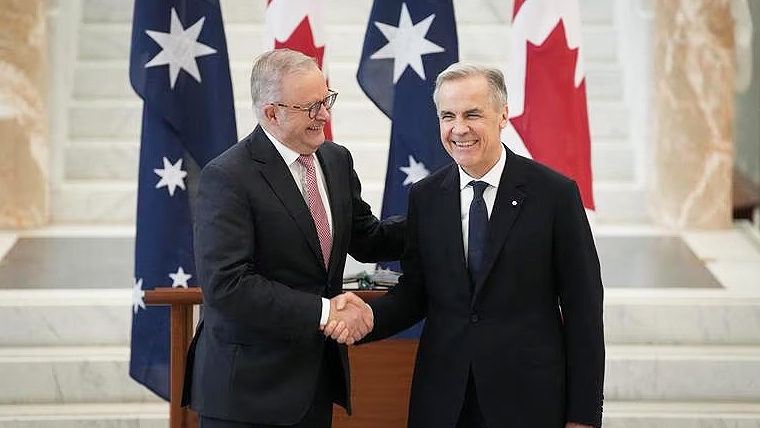
America’s allies no longer view it as a champion of collective security, free trade, and the rule of law. At the same time, China’s growing economic power and political influence concerns many whose prosperity has become increasingly dependent on maintaining constructive relations with the People’s Republic. In this fraught new environment – with the United States and China dominating the international system, and with Russia committed to upending it – Canadian Prime Minister Mark Carney warned in January that “the middle powers must act together.”
But what does this mean, exactly? Can “middle powers” bolster existing multinational institutions like the United Nations? Can they cooperate where their interests align to safeguard shared goods? There is plenty of reason for skepticism. But if they cannot find ways to assert themselves now, they will suffer what they must in a future of US-Chinese domination.
Fortunately, the current geopolitical landscape does offer opportunities for middle powers. Coalitions of willing parties like the European Union, India, Japan, Brazil, Canada, and others could work together to boost financial and political support for institutions like the UN, the World Bank, the International Monetary Fund, and the World Trade Organization.
To be sure, it will be easier to shore up existing institutions than to build new ones: the US and China could undermine anything that other powers try to construct, and the US, China, and Russia still have considerable power to resist deeper reforms at the UN Security Council. But that is why the goal would be to preserve the institutions that are most vulnerable to American abandonment and Chinese domination.
On security, the US and China’s material and military advantages still leave most middle powers dependent on a basic alignment with the US for troop coordination, weapons development, and intelligence-sharing. But exceptions are emerging. Owing to Russia’s war on Ukraine, there has been greater defense coordination within Europe, though this process will still take considerable time, money, and political will to see through.
Similarly, India has forged closer security and trade ties with Europe, owing to its longstanding rivalry with China, the poor quality of Russian defense products, and doubts about America’s long-term reliability. Europe and Canada have deepened their defense cooperation, reflecting shared fears about America’s trajectory; and Japan, South Korea, Saudi Arabia, and Turkey could all potentially develop their own nuclear deterrents.
On economics, middle-power hedging will be somewhat easier, because the US and China are less dominant in trade, investment, standards-setting, and development finance than they are in the security domain. In fact, there has already been real progress here. The recent EU trade agreements with India and Mercosur (Argentina, Brazil, Paraguay, and Uruguay) were historic in scale and scope, and Canada’s bid to broker a deal between the EU with the Asia-centered Comprehensive and Progressive Agreement for Trans-Pacific Partnership could yield profound benefits (though it would be extraordinarily complex).
Meanwhile, Brazil, with its abundance of the rare-earth minerals that China has threatened to weaponize, has been diversifying its supply chains beyond the US, most recently to India. Surely, other middle powers blessed with critical minerals can do the same.
Finally, middle powers that find themselves vulnerable to US and Chinese leverage can form collective economic-security deals. Such agreements would commit willing members to coordinate responses to unilateral tariff pressures or violations of existing trade agreements or WTO rules in ways similar to the NATO mutual-defense provision (Article 5). To accomplish this, however, middle-power governments must overcome considerable domestic resistance to the concessions needed to forge new trade agreements.
On technology, middle powers face an even more complex environment. On one hand, the US-China rivalry allows them to pivot opportunistically between two dominant players. On the other hand, there are no multilateral institutions making rules to bring predictability to tech innovation and use.
This is especially the case for AI, where the overwhelming dominance of US and Chinese firms leaves middle powers without much bargaining leverage or a common development strategy. Perhaps companies in Europe, Canada, or India could collaborate to build their own champion and develop an open, powerful AI “stack” that is available at little or no cost. But that effort would be expensive and time-consuming, and many governments are already confronting economic and geopolitical stresses.
More broadly, the biggest challenge for middle powers lies in finding common interests across such a diverse group. While non-US Western leaders generally agree that the rules-based international order is worth protecting, many in the Global South are quick to point out that Western values are not universal. Any middle-power strategy and architecture that treats non-Western powers as rule-takers rather than partners in rulemaking is doomed to produce empty alliances and weak institutions. The only way forward, then, is to address the issues most urgent for Global South governments: development investment, debt management, climate finance, and technology access.
Despite these many challenges, middle powers know that opportunities to defend their interests from US and Chinese dominance won’t remain open forever. If they fail to act, the world’s two biggest powers will lock in bilateral arrangements – in infrastructure, digital systems, and security – across the developing world. Once those deals are made and the relationships consolidated, it will be much harder for others to check US or Chinese dominance.
Carney’s warning – “if we’re not at the table, we’re on the menu” – resonated powerfully with many governments. The question now is whether and how effectively they thwart the cooks.
Ian Bremmer, Founder and President of Eurasia Group and GZERO Media, is a member of the Executive Committee of the UN High-level Advisory Body on Artificial Intelligence. Copyright: Project Syndicate, 2026, and published here with permission.
We welcome your comments below. If you are not already registered, please register to comment
Remember we welcome robust, respectful and insightful debate. We don't welcome abusive or defamatory comments and will de-register those repeatedly making such comments. Our current comment policy is here.