
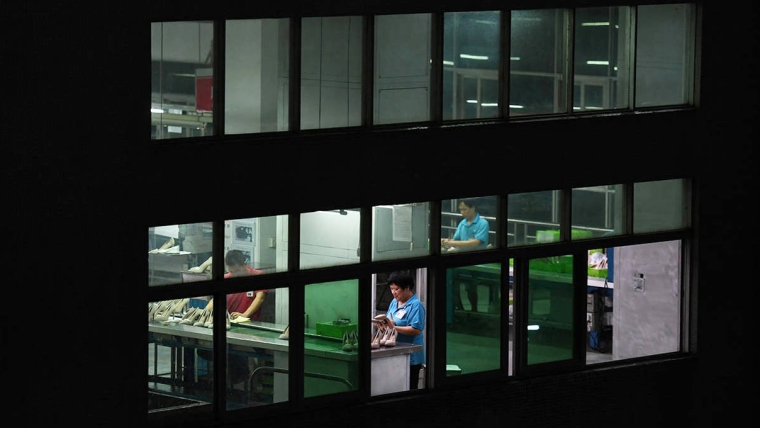
China’s government wants to strengthen domestic consumption, encourage family formation, increase fertility, and achieve more balanced growth. But a major barrier is impeding progress on all these fronts: Chinese non-agricultural workers currently work some 2,500 hours per year, and hundreds of millions of blue-collar workers, largely rural-to-urban migrants, work nearly 3,000. That is nearly 60 hours per week—a schedule that leaves little time for consumption, relationships, or family-building.
To put this in perspective, workers in OECD countries average about 1,700 hours per year—little more than half the workload of China’s 170 million rural-to-urban migrants. Accounting for 36% of urban employment, these workers are the backbone of China’s factories, construction sites, delivery networks, and service industries. They work about nine hours more per week than the urban average for China.
This largely reflects prevailing Chinese wage structures. For many blue-collar migrants, base pay is effectively tied to the local minimum wage. Earnings rise meaningfully only when workers exceed standard hours and qualify for statutory overtime premia: 150% of the regular wage on weekdays, 200% on weekends, and 300% on statutory holidays.
Migrants whose pay is at or near the minimum wage work 13–16 more overtime hours per week than comparable workers earning above the minimum, as only very long hours make their urban employment financially worthwhile. Since many migrants are unable to settle in the city officially, owing to China’s hukou household-registration system, they must focus on maximizing earnings during what remains, in practice, a temporary stay.
Analysis of individual wage-and-hours records shows a distinct bunching of workers just above the statutory 40- and 48-hour thresholds. This pattern is consistent with the exploitation of the overtime premium structure not only by workers, but also by employers, particularly in manufacturing, which benefit from staffing arrangements that rely on longer individual shifts rather than hiring more workers. While the estimates above draw on survey data through 2018, the underlying incentive structure—statutory premiums anchored to the minimum wage under the 2008 Labour Contract Law—has not changed.
Chinese policymakers long viewed extreme working schedules as a byproduct of industrial catch-up. But as China’s development priorities evolve, excessive workloads are becoming a major constraint. If Chinese workers are to become middle-class consumers and build larger families, they cannot spend most of their waking hours chasing overtime pay, only to return exhausted to dormitories. They need opportunities to spend their earnings, to form households, and to participate in urban life.
Based on data from 2008–16, I estimate that cutting about ten hours from urban migrant workers’ weekly schedules—from the low 60s to the low 50s—would raise their per-capita consumption by roughly 1.1 to 1.6 percentage points. That may not sound like much, but if you multiply it by 170 million migrants, it becomes significant.
This reduction in working hours could also raise marriage rates of unmarried men aged 20–40 by around two percentage points. The relationship between labour-market and demographic outcomes is critical. Public debate often treats falling marriage and fertility rates as cultural or housing issues. But time is a big part of the story. Workers who have little of it to sustain relationships or build stable households are less likely to form families.
China’s current favoured policy tool—one-off consumption subsidies—work only if workers have the time and security to take advantage of them. To reduce excessive work without cutting earnings, raising minimum wages may be a more effective strategy. In fact, evidence shows that higher minimum wages lead to reduced hours among those working more than 60 hours per week, without negative employment effects.
Scale matters. Since a small wage increase leads to a small reduction in hours, policymakers seeking a meaningful change in working hours should increase wages faster and by larger margins. To ensure that this does not lead to a push toward automation, which could eliminate jobs among migrants, China should also provide transitional support to firms to ease the adjustment.
But the minimum-wage lever can do only so much on its own. Long working hours are a rational response to insecurity: as long as the hukou system denies migrants access to city schools, housing subsidies, and public services, they will not regard themselves as permanent urban residents. A visitor maximizes current earnings; a permanent resident builds a life. Relaxing hukou restrictions in the mid-size and large cities where most manufacturing and service employment is concentrated is essential.
A worker with a free evening can go on a date, walk in a park, eat at a restaurant, or simply rest. A worker with a stable income and time to spare can plan for the future. These are not luxuries; they are the preconditions for building the middle class that China’s next growth model requires. Raising minimum wages faster and opening city residence to migrants could make this possible. Income transfers and consumption vouchers cannot.
Xin Meng, a professor at the Research School of Economics at the Australian National University, is the author of Labour Market Reform in China and The Great Migration: Rural–Urban Migration in China and Indonesia (Edward Elgar Publishing, 2010). Copyright 2026 Project Syndicate. Used with permission.
We welcome your comments below. If you are not already registered, please register to comment
Remember we welcome robust, respectful and insightful debate. We don't welcome abusive or defamatory comments and will de-register those repeatedly making such comments. Our current comment policy is here.