
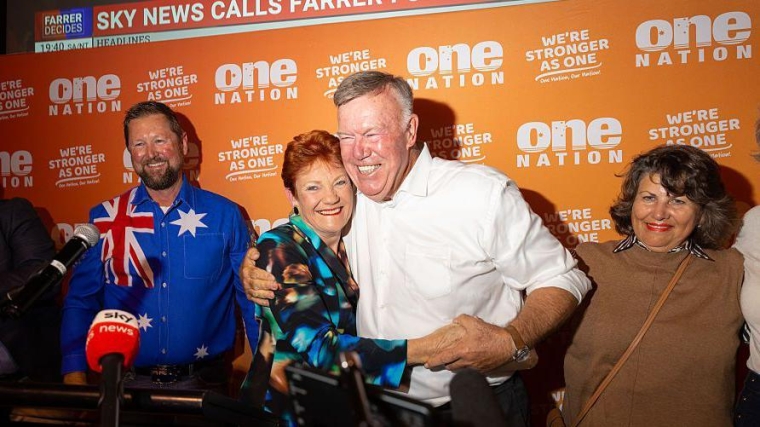
Australia witnessed a political earthquake last weekend. A by-election for the federal seat of Farrer was won in a landslide by the populist, anti-immigration One Nation Party.
New Zealanders can be forgiven for having no interest in Australian by-elections. But the result in Farrer warrants their attention.
Farrer is predominantly a rural seat covering 127,000 sq km in southwestern New South Wales. Significantly, it’s been held by the centre-right Liberal/Nationals Coalition since its creation in 1949.
Just twelve months ago, in the 2025 national election, Farrer was easily won by the Liberal Party. Last Saturday, the Liberal candidate slumped to third place, and One Nation took the seat by a wide margin.
This is the first time One Nation has won a seat in Australia’s lower house.
Who is One Nation and why is its win so significant?
One Nation was founded in 1997 by Pauline Hanson, a Senator for Queensland since 2016, and a controversial figure in Australian politics for decades. She is perhaps best known outside Australia for having worn a full burqa in the Senate on two occasions.
It’s a ‘populist’ party, in the sense that it offers simple solutions to complex problems and cultivates an attitude of ‘us vs them’. It’s also a ‘nationalist’ party that promotes allegiance to Australia and strongly opposes immigration.
Its immigration policy includes deporting 75,000 ‘illegal immigrants’, introducing an 8-year waiting period for citizenship and welfare, refusing entry to migrants from nations ‘known to foster extremist ideologies’, and withdrawing from the UN Refugee Convention.
Timing is everything in politics and One Nation’s victory in Farrer together with its rapid rise in the polls in recent months indicates the party’s immigration policies are now gaining traction with more and more voters. There are two primary reasons for this.
The first is economic. The One Nation narrative blames migrants for housing shortages, inner-city congestion, and stretched public services, issues that concern many Australians.
The second is cultural. The Israel/Gaza crisis has created social unrest in Australia with constant pro-Palestinian protests and heightened tension between Muslim and Jewish communities. That tension has been exacerbated by the Bondi terrorist attack last December and the ongoing Royal Commission on Antisemitism and Social Cohesion.
Many voters oppose immigrants who bring their foreign conflicts with them to Australia and believe that the values of some immigrants are inconsistent with ‘Australian values’.
But it would be foolish to assume that the rise of One Nation is just about immigration.
There are broader forces at play here. A decline of trust in institutions, a growing sense of grievance and resentment, and a rejection of inner-city progressivism. Perhaps most tellingly a belief among many Australians that the political system no longer works for them and that they’ve been forgotten by the politicians.
This phenomenon is hardly unique to Australia. The same trends are obvious in the United States with the emergence of the MAGA movement. They’re also present in many other western countries e.g. the rise of the Reform Party in the UK, the AfD in Germany, and the National Rally in France.
Like many of those countries, Australia is seeing a growing number of disaffected citizens turn away from the parties that have previously dominated politics. The old two-party system – Labor vs the Liberal/Nationals Coalition – is breaking down.
A key factor in that breakdown is the fact that political ideology no longer fits neatly along the traditional single left/right axis – a right-wing business/middle class party competing against a left-wing workers’ party.
There are now (at least) two separate axes – cultural and economic. If you include an environmental axis the position becomes even more complex.
This explains the ongoing fragmentation of Australian politics and the emergence of what is rapidly becoming a five- or six-party system – Labor, the Greens, One Nation, the ‘Teal’ group of MPs, the Liberals, and the Nationals.
There’s a party for every combination of ideological positions.
One Nation sits on the cultural right but is centre left on the economy. And it strongly opposes action on climate change.
The two major parties have traditionally written off One Nation and its supporters as racist. But the Farrer result and recent polling suggest that approach is becoming untenable.
Some of One Nation’s positions represent a clear threat to both the major parties. For example, its cultural conservativism has appeal to many blue-collar voters who are an important part of Labor’s base, and to many older voters who are an important part of the Liberal base.
Is the rise of One Nation relevant to New Zealand? It certainly can’t be dismissed given that a similar trend has emerged in many other liberal democracies. And the MMP system does facilitate minority party representation.
The nearest kiwi equivalent to One Nation is NZ First, a populist, nationalist party but without the hard anti-immigrant edge.
The closest NZ politics has come to the One Nation vibe was the vehement reaction in 2023 to Three Waters and the Labour policy of co-governance. A revival of that policy or other Treaty of Waitangi initiatives might trigger a surge in right-wing populism.
Immigration is not currently a source of friction in NZ. That might change if there was an extended period of economic decline. History elsewhere shows that hard economic times can be a catalyst for an anti-immigrant movement.
For Australia, the big question is whether One Nation has peaked or will make further gains in the next federal election, due in 2028.
*Ross Stitt is a freelance writer with a PhD in political science. He is a New Zealander based in Sydney. His articles are part of our 'Understanding Australia' series.
We welcome your comments below. If you are not already registered, please register to comment
Remember we welcome robust, respectful and insightful debate. We don't welcome abusive or defamatory comments and will de-register those repeatedly making such comments. Our current comment policy is here.