
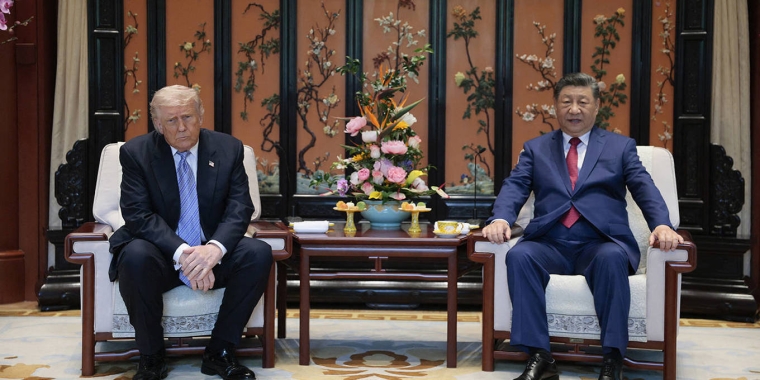
The optics of this week’s summit between Donald Trump and Xi Jinping were carefully staged to signal parity between the United States and China. Trump, the first US president to visit mainland China in nearly a decade, was accompanied by an entourage of American CEOs—including Tesla’s Elon Musk (with his son X), Apple’s Tim Cook, Boeing’s Kelly Ortberg, and Nvidia’s Jensen Huang—whose businesses rely on maintaining good relations with the People’s Republic. They were duly given a grand welcome in the Great Hall of the People.
But the summit’s (less photogenic) substance may matter more. If the meeting cements two outcomes—a longer-lasting Sino-American trade truce and a path to reopening the Strait of Hormuz—it will give the world economy something it has lacked for the past year and a half: a reduction in tail risks.
On the matter of trade, the October 2025 Busan agreement between the US and China did halt implementation of most of Trump’s punitive tariffs, with China agreeing to ease its rare-earth export controls. The economic implications of a summit-level agreement to extend this truce through 2027 would be difficult to overstate. China processes roughly 85% of the world’s rare earths and over 90% of its rare-earth magnets—inputs in every electric vehicle, wind turbine, F-35 fighter jet, and Nvidia AI accelerator (an advanced data-processing platform). A stable supply removes a binding constraint on multiple Western industries at once.
The likely winners are easy to identify. Boeing, starved of Chinese orders since 2019, may finally receive the type of headline-making aircraft purchase that Trump can boast about back home. Apple would gain a more reliable supply of rare-earth magnets for everything from speakers to camera modules. Tesla would benefit from clearer rules for its Shanghai gigafactory, which now produces more than half of its global output. And American farmers—a constituency Trump cannot ignore—would regain access to the Chinese soybean and grain import markets, which quietly redirected their orders to Brazil and Argentina.
For China, the most immediate benefit is greater predictability. The greatest costs incurred over the past year and a half came not from any particular US policy or statement by Trump, but from the cloud of uncertainty that he has cast over the global economy. A stabilised regime would allow for companies around the world—not least Chinese exporters—to resume normal corporate planning.
The second potential dividend concerns the Strait of Hormuz. The International Energy Agency has described Iran’s effective closure of the Strait as the largest supply disruption in the history of the global oil market. The global oil price is now about 50% higher than it was before the US-Israeli war on Iran began. Roughly 20% of seaborne oil and liquefied natural gas normally pass through the Strait, and in 2024, 84% of that crude went to Asia, with nearly 70% destined for China, India, Japan, and South Korea.
Thus, the pain has been unevenly distributed. Bangladesh faces what some analysts describe as recession-like conditions. Pakistan and Vietnam are rationing energy. Asian airlines have surcharged fares in response to higher fuel costs. And with over 30% of urea normally routed through Hormuz, fertiliser prices have raised food-security alarms from Cairo to Manila.
If the summit creates the conditions for a sustainable reopening of the Strait—with China pressuring Iran as its largest oil customer, and the US lifting its counter-blockade of Iranian ports—the global economy would regain roughly one-fifth of its hydrocarbon supply. The worst-hit emerging economies would benefit immediately from lower oil prices, fertiliser costs, and shipping insurance premiums.
Still, three caveats are in order. First, China’s relaxation of its rare-earth export controls will remain partial, in order not only to deter future US tariff escalations and export controls, but also actions by Europeans and others to support such US measures or introduce their own. To prevent others from building up large stockpiles, China will probably maintain sufficient rare-earths exports to support current use, but not strategic hoarding.
Second, whatever happens with the Strait of Hormuz will rest on a ceasefire that has proved fragile. Iran has demonstrated that it can close Hormuz at will, and that knowledge will not be unlearned. Lastly, any bargain struck at the summit could be undone when America’s famously mercurial president returns to Washington.
In any case, the most important result of the summit may be one that the headlines miss. For a year and a half, corporate decision-making—about where to locate plants, how much inventory to carry, which suppliers to diversify toward, whether to hire—has assumed that the global trading system is progressively fragmenting. The costs of this calculation are evident everywhere, from the Chinese auto giant BYD’s new plants in Thailand and Vietnam, to TSMC’s $165 billion commitment to a semiconductor fab in Arizona, Apple’s shift of iPhone assembly to India, and the duplication of capacity across many other sectors.
A stable US-China economic relationship would not reverse those decisions (many geopolitical considerations are here to stay), but it would slow the next round of fragmentation. Firms that have been building two of everything could strike a better balance between efficiency and resilience.
Trump’s trip to China, and Xi’s planned visit to the US in September, will not end the era of strategic competition. But if these summits lower the probability of accidents or escalations—an expansion of the US chip embargo, a sudden stop of rare-earth shipments, or a shipping crisis spiraling into something worse—they will have done more for the world economy than most recent summits have. In a year when so much has gone wrong, that is a welcome prospect.
Shang-Jin Wei, a former chief economist at the Asian Development Bank, is Professor of Finance and Economics at Columbia Business School and Columbia University’s School of International and Public Affairs. Copyright: Project Syndicate, 2026, published here with permission.
We welcome your comments below. If you are not already registered, please register to comment
Remember we welcome robust, respectful and insightful debate. We don't welcome abusive or defamatory comments and will de-register those repeatedly making such comments. Our current comment policy is here.