
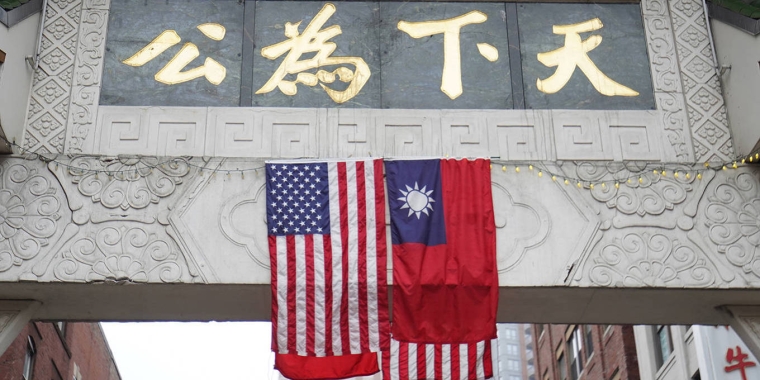
Donald Trump’s recent summit with Xi Jinping has revived a familiar debate: Would the United States defend Taiwan if China invaded?
Skeptics point to America’s competing priorities—from the conflict in the Middle East to operations in the Western Hemisphere—as evidence that Taiwan is slipping down the US national-security agenda. Trump himself has questioned whether Americans would fight a war “9,500 miles away,” as well as describing arms sales to Taiwan as “a very good negotiating chip.” The change in US rhetoric seemed like a gift to Xi.
But a close focus on Trump’s words obscures the realities on the ground. Over the past decade, US-Taiwan relations have undergone a structural transformation. US support for Taiwan is not a preference that could change with a US administration, nor is it a bargaining chip. Rather, it is thoroughly embedded in the machinery of American power—in congressional mandates, defense planning, semiconductor supply chains, state-level partnerships, and private-sector investment.
These ties make the relationship difficult for any US administration to unwind, and even more difficult for China’s government to weaken. The era when analysts parsed every presidential statement for clues about Taiwan policy is fading. High-level rhetoric still matters, but the durability of US-Taiwan ties now rests less on individual leaders than on institutional momentum.
Despite new presidents coming to power in both Taipei and Washington over the past two years—and despite unprecedented Chinese military pressure on Taiwan—the relationship has only deepened. Congressional delegations (most recently from the Senate Foreign Relations Committee) regularly visit Taiwan, and arms sales have continued (so far)—with the Trump administration greenlighting the largest weapons packages in the relationship’s history. Trump has signed new legislation reinforcing bilateral ties, his National Security Strategy has emphasised deterrence in the Taiwan Strait, and a recently announced reciprocal trade framework has formalised a strategic economic partnership.
Private-sector developments have been especially transformative, mainly because Taiwan’s dominance in high-end semiconductors and AI infrastructure has transformed the island from a traditional geopolitical flashpoint into a pillar of the global economy. “Non-red” supply chains (trusted networks that are insulated from Chinese leverage) have moved from concept to practice, with Taiwan sitting at the center of this shift.
TSMC’s expanding campus in Arizona is only the most visible example of this broader trend. Taiwanese firms of all sizes are investing in US data centers, advanced materials, and electronics; and US technology companies are deepening their presence in Taiwan, particularly in AI and cloud computing. Meanwhile, both are reducing exposure to China.
For years, US policymakers talked abstractly about “decoupling” from China. Now markets and industry are making it real, with Taiwanese capital revitalizing US manufacturing, and US firms increasingly relying on Taiwan for next-generation innovation. Crucially, defense technology partnerships are linking private-sector advances to Taiwan’s asymmetric defense and the US military’s modernisation.
Just as importantly, these ties are changing public perceptions. More Americans are coming to see Taiwan not as a distant security problem, but as a democratic and technological partner with a central position in the 21st-century global economy. Far from being a security client in need of reassurance, Taiwan has become part of the technological infrastructure underpinning US and allied power.
Perhaps the most underappreciated dimension of this trend is occurring below the federal level. More than half of US states now maintain some form of trade or investment presence in Taiwan, competing to attract Taiwanese capital across various industries. Dozens have signed agreements to support workforce development tied to Taiwanese investment. State delegations visit Taiwan regularly, and subnational political support has become formalised. In 2025 alone, more than 30 state legislatures passed resolutions supporting Taiwan.
At the same time, people-to-people relationships are expanding. As educational exchanges in mainland China have declined, Taiwan has emerged as the leading destination for Mandarin-language immersion. Programs like the Global Cooperation and Training Framework routinely convene public health, cyber-security, and humanitarian experts from around the world to leverage Taiwanese expertise.
These exchanges may lack the hard-power commitments implied by arms sales, but they matter. They diffuse support for Taiwan far beyond Washington, embedding the island into local economies, universities, and communities across the US.
The great irony is that while China has long tried to isolate Taiwan diplomatically, many of its actions—military coercion, gray-zone operations, and economic intimidation—have had the opposite effect. Rather than weakening Taiwan’s international position, Chinese pressure has accelerated Taiwan’s integration into democratic technology and security networks, giving rise to supply chains designed specifically to reduce dependence on China.
But this dynamic carries risks. As Taiwan becomes more integrated into the Western technology and security architecture, Chinese leaders may conclude that the window for coerced unification is closing. Deterrence may be strengthening, but so, too, is the danger of escalation.
That is why Trump’s outreach to Xi should not be interpreted as evidence of weakening support for Taiwan. The strategic ambiguity that the US has maintained since the days of President Jimmy Carter may have become more ambiguous, but the broader trajectory of the US-Taiwan relationship is now shaped less by diplomatic theater than by structural forces that continue to deepen integration. Congressional leaders, Pentagon planners, governors, mayors, universities, and private industry are all reinforcing the relationship, and Taiwanese firms have strong economic and geopolitical incentives to continue the trend.
Taiwan’s future no longer depends solely on how much attention the US government is giving to it at any given moment. It depends, instead, on Taiwan’s expanding presence within the institutions, economies, and technologies of the free world.
Channing Lee is Director for Global Partnerships and host of the Strait Forward podcast at the Special Competitive Studies Project.Copyright: Project Syndicate, 2026, published here with permission.
We welcome your comments below. If you are not already registered, please register to comment
Remember we welcome robust, respectful and insightful debate. We don't welcome abusive or defamatory comments and will de-register those repeatedly making such comments. Our current comment policy is here.