
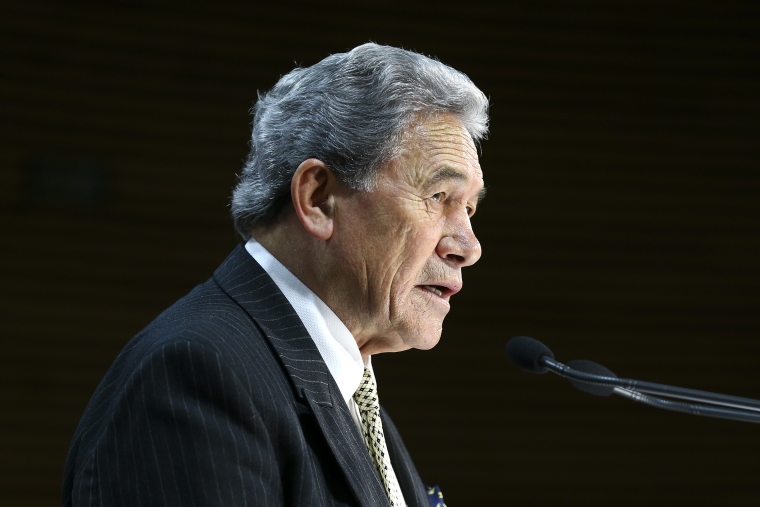
New Zealand First has unveiled it will be campaigning for an offshore oil and gas reserves survey as it goes into the 2026 election, with the party saying the initiative will require an initial investment of $1 billion.
NZ First leader Winston Peters announced the policy at the party’s 2026 campaign launch on Sunday, which was held in South Auckland.
Peters said that to create a National Subsurface Development Survey, NZ First will be campaigning on an initial investment of $1 billion over the term of government.
The $1 billion proposed survey will identify and create one national dataset across energy, geothermal and CO₂ storage sites.
According to Peters, this will help create a framework for New Zealand to then develop those sites, extract those resources and build the country’s “resilience and prosperous economic future”.
“New Zealand has ten prospective basins with world-class potential, the Great South Basin has had eight wells drilled in its entire history and the deeper horizons are untested. The existing seismic data is two technology generations old, covering only a fraction of our subsurface inheritance,” he said.
Peters said New Zealand potentially holds “Norway-scale energy prospects in our offshore basins“ and that potential has never previously been accurately surveyed or characterised with modern tools.
“If we identify those reserves in our basins, we will have the ability to utilise the natural resources we have to make our country secure, prosperous, and to build real resilience,” he said.
“Under this plan we would expect to see first results within twelve months and convert that potential into knowledge that global capital can bid against. This is at a time when we are in the midst of the largest basin-capital movement in a generation.”
NZ First expects to have the surveying of the highest-ranked basins completed within two years.
“Potentially within just six years, we will have a pathway forward for our country to own and control our own supply of energy that we can use domestically and export around the world,” Peters said.
He told attendees in his campaign speech that the existential threat to fuel security and fuel supply was one of the most concerning issues currently facing New Zealand.
Peters added that since the conflict in the Strait of Hormuz had begun earlier this year, capital is now moving into “politically stable basins” elsewhere in the world. But for capital to move, it needs modern data, he said.
“We have seen the immediate effects of being isolated and totally dependent on international supply lines of oil and gas, and the dramatic and costly effects it has on New Zealand’s sustainability, planning and future certainty,” Peters said.
“We are totally susceptible to the geopolitical choices made by other nations in the cost, supply and certainty we need as a country to survive, today and into the future.”
‘Goes back to the '70s’
Following his campaign speech, Peters told reporters the inspiration for the proposed policy goes “way back to the '70s” when England and Norway found North Sea oil reserves.
Norway discovered the Ekofisk oil field in December 1969 and England detected its first major Forties oil field in October 1970.
Peters said while UK Prime Minister Margaret Thatcher had decided to turn those oil revenues “into tax cuts”, Norway had decided to put that money in a sovereign fund. As a result of Norway’s decision, that fund, the Government Pension Fund Global, is currently valued at over $2 trillion.
“I know who made the right decision,” Peters said.
He said he had a “good idea” of the royalties that could be gained from the results of the $1 billion proposed survey – but wouldn’t reveal what those royalties would look like. However, he confirmed that the NZ Government would own the findings of the survey.
Peters reiterated that the current subsurface survey knowledge is 20 years old. “It's primitive compared with what we should be knowing,” he said.
The new survey will find out how wealthy the country can be, he told reporters.
We welcome your comments below. If you are not already registered, please register to comment
Remember we welcome robust, respectful and insightful debate. We don't welcome abusive or defamatory comments and will de-register those repeatedly making such comments. Our current comment policy is here.