
New Zealand’s Emissions Trading Scheme is in need of major reform, the Parliamentary Commissioner for the Environment Simon Upton says.
“It is a question of ‘when’, not ‘if’ reform happens,” Upton says.
“The role of forestry in particular needs a fundamental rethink if New Zealand is to have any hope of achieving its climate commitments and reducing the risks that the inclusion of forestry in the ETS (Emissions Trading Scheme) has created.”
Upton’s comments come as the Parliamentary Commissioner for the Environment publicly released a report called Adrift: what future does the Emissions Trading Scheme have? It looks at the challenges and future facing the ETS. A key recommendation he makes is achieving cross-party agreement the ETS is in need of major reform, along the lines of the consensus politicians have achieved with infrastructure.
The ETS prices emissions by requiring certain sectors of the economy to have "surrender obligations" for the greenhouse gases they release into the atmosphere. These sectors include forestry, liquid fossil fuels, stationary energy, industrial processes, synthetic greenhouse gases, and waste.
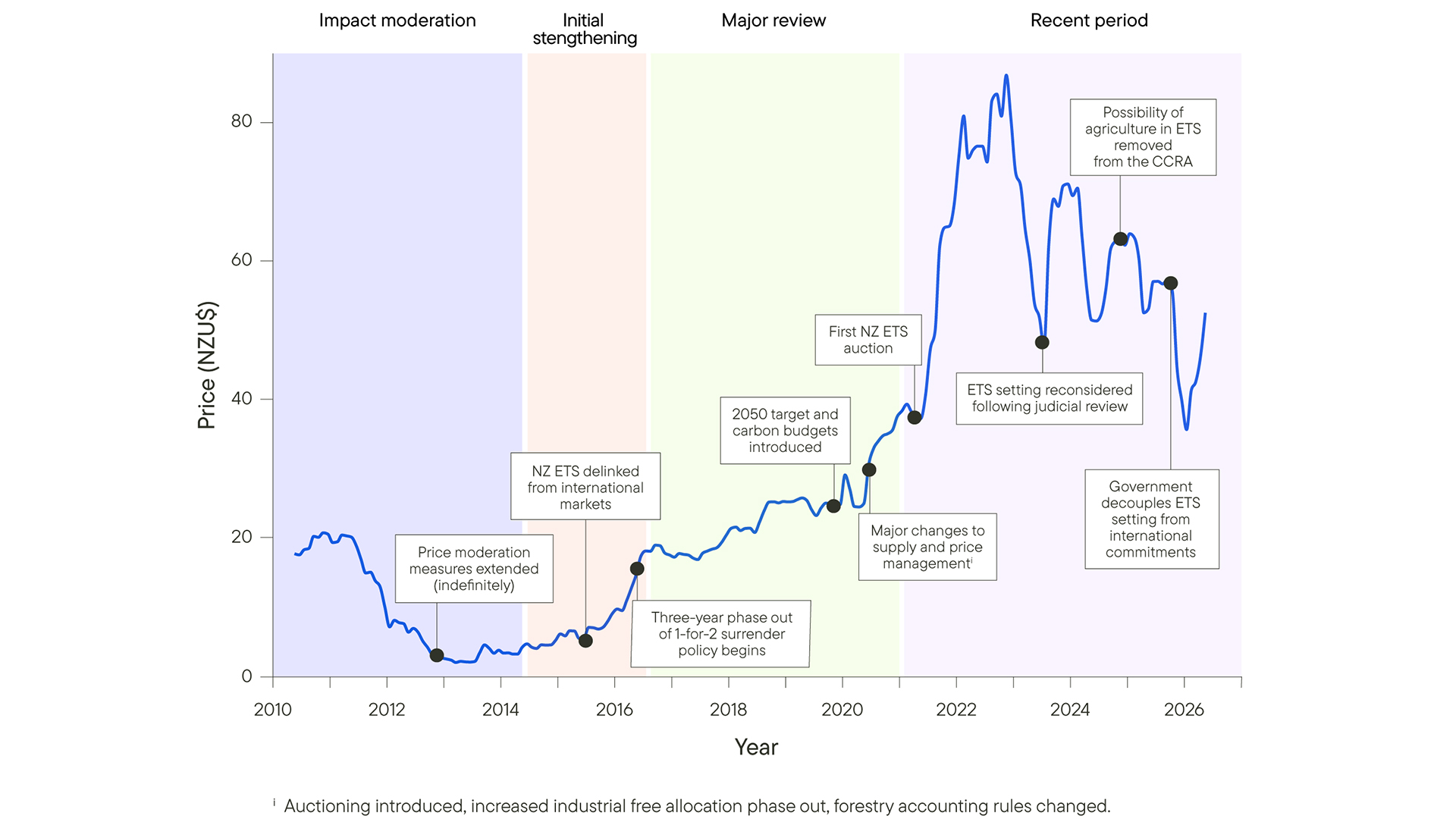
The ETS was initially set up to help NZ meet its 2050 net emissions target and international obligations under the Paris Agreement. Recent changes to climate change law removed a provision which stated the ETS unit volumes and price control regulations must "accord with" Nationally Determined Contributions (NDC) under the Paris Agreement.
“When the ETS has raised concerns in the past, politicians have stepped in and made what have sometimes been quite radical changes, and there is no surprise that this is not a creature of the market," Upton said at a media briefing on Tuesday afternoon ahead of the report's release on Wednesday.
“This is a creature of politics and regulation, and the people who create those things change their minds. There is no reason to think the ETS in its current form will be immune from further political intervention.”
In the report, Upton says the ETS is “essentially rudderless.”
“It has broken its policy moorings and is heading for the rocks. It is at risk of being swamped by unit supply. Yet the Government does not have the levers to effectively manage that supply nor to steer the NZ ETS towards achieving New Zealand’s climate targets.”
He says these issues had been apparent for some time but the need to address them is becoming increasingly urgent.
Forestry
The report says almost any scenario that included forestry, both existing and new exotic NZ ETS forests, could initially meet net zero emissions targets but would not sustain the government's 2050 target much beyond 2050.
“To avoid that, the NZ ETS will need to be modified significantly, with either a focus on the role of forestry in reducing supply or on increasing the coverage of the scheme to increase demand.”
But Upton says modelling shows without forestry, net zero would not be met at all and that the NZ ETS’ effect on reducing gross emissions is small.
“That suggests that there is a need for ‘complementary’ measures outside the NZ ETS, both to encourage greater reductions of gross emissions, especially for emissions outside the NZ ETS and those covered by emissions-intensive and trade-exposed (EITE) ‘free allocation,’ and to encourage afforestation to meet the target.”
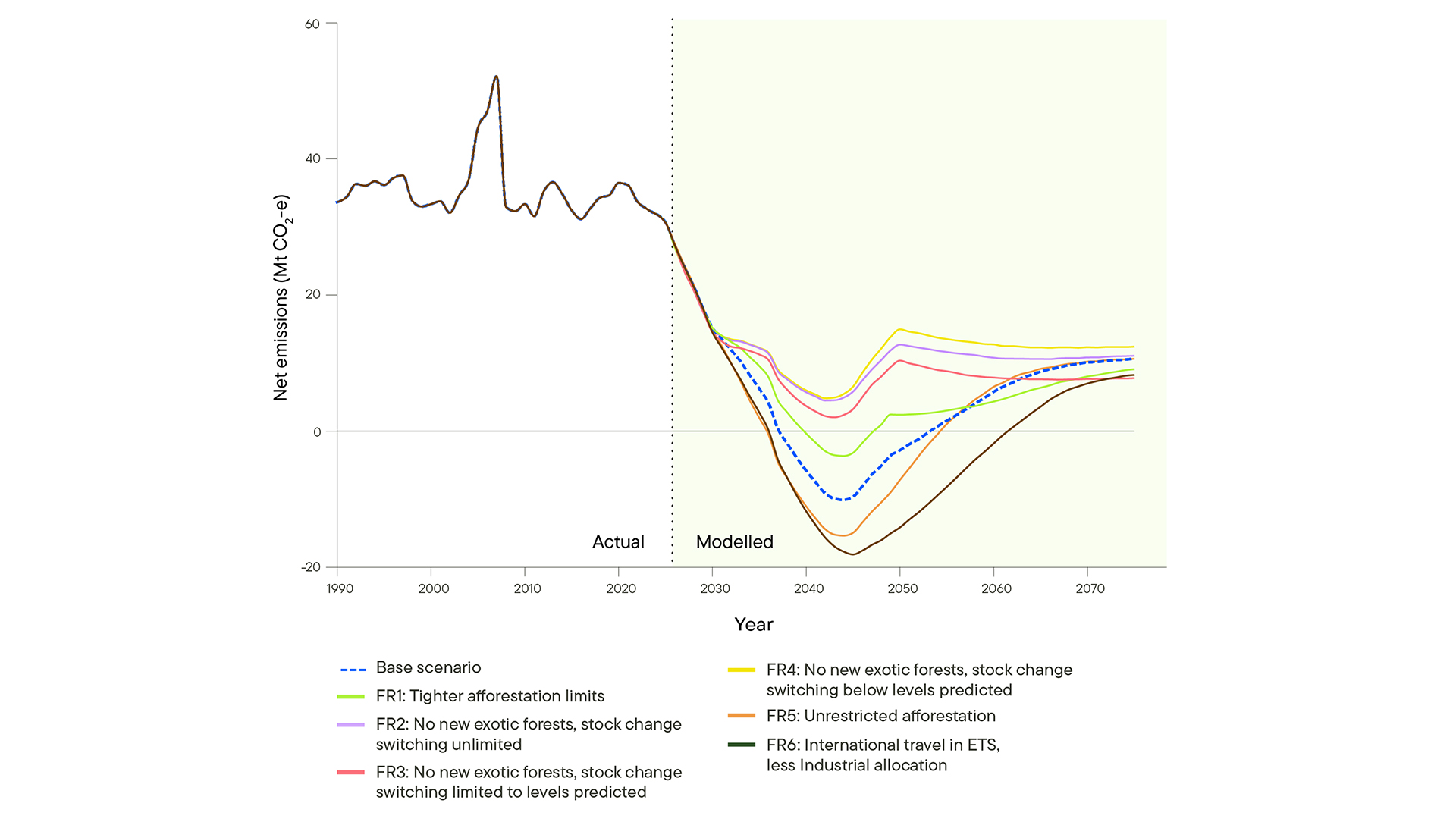
“Not meeting the 2050 target is not just a modelling artefact. The Government’s projections about the achievement of its emissions budgets, which are stepping stones towards the 2050 target, show that they are at risk of not being met,” the report says.
The report says if forest owners do not meet their liabilities, that obligation will likely fall to the Crown.
“In the short term, it will mean the Crown will have to replant the forest itself, or cover the lost carbon in one or all of three ways: requiring additional gross emissions reductions, purchasing offshore mitigation, or absorbing the reputational hit associated with not meeting its targets.
“In the longer term, the Crown will have to pick up permanent management responsibilities for forests planted to avoid emissions reductions decades earlier. This bill is passed to future generations.”
Upton says: “Forestry still has an important role to play in New Zealand’s climate policy."
“The question is not whether forestry has a role – it is whether that role should continue to be delivered through the NZ ETS."
‘Reform is, in my view, inevitable’
The report says under the current settings, the ETS is achieving none of the aims such a scheme could be expected to address and while it might meet the goal of net zero 2050, it probably won’t meet the crucial second leg of that goal by maintaining net zero thereafter.
“In the shorter term, the NZ ETS design is hindering the achievement of New Zealand’s statutory emissions budgets and its international NDCs. Significant use of forestry removals will keep the price artificially low, blunting gross emissions reductions.
"The result will be that more forestry needs to be planted in the long term. Future generations will have to forgo other options for using that land, needing instead to maintain this forestry estate indefinitely. They will have to do so in the face of mounting risks from fires, pests, diseases and extreme weather.”
Modelling and analysis in the report shows major changes to the ETS are needed. “Small tweaks will not suffice. While some may critique the modelling - no model is a perfect representation of reality or the future - the warnings it sends should not be ignored.”
The report says a review of the NZ ETS should, at a minimum, include:
- revisiting whether the NZ ETS should focus on gross or net emissions reductions questioning the role of forestry and assessing the implications of various restrictions to forestry, including its complete removal from the NZ ETS
- considering increasing the demand side of the NZ ETS by, for example, including long-lived agricultural emissions, international transport emissions, and reducing (or eliminating) free allocation to EITE firms
- identifying those sectoral reductions that are not best achieved through the NZ ETS (e.g. agricultural methane) and spelling out what policies outside the NZ ETS might be
- needed to target those emissions – this should include exploring the merits of a separate NZ ETS to manage biogenic methane emissions
- improving the models on which changes to the NZ ETS are assessed
Upton says in the report: “I am not calling for a commitment to any particular solution. I am calling for a serious and informed debate.”
“There will inevitably be debate about the solutions and pushback from those who perceive they might be worse off because of them. That is normal in a democracy."
“There will be attempts by those who want to resist changes to prevent a debate commencing. But it is a debate we cannot afford to avoid. The problems we face are too serious to permit that,” he says.
Asked if the ETS should be ditched altogether, Upton says he didn't think so as a proper functioning ETS could help reduce our gross emissions.
“It’s just that having forestry in it has effectively ... almost neutralised that capacity.”
He pointed to analysis suggesting a 4% difference between having forestry and not having it part of the ETS.
“It should be much more than that. It’s because we haven’t dialled back or eliminated forestry being in there … If you were to say let’s get rid of it right, you get rid of it. So how are you going to get your emissions down? Well, the alternative is going to be a tax, maybe on fossil emissions or complementary policies. Now they haven’t been popular.”
‘We start from where we are’
The report says challenges posed by the design of the ETS aren’t recent, going back to debates held in the 1990s “and encompass the responsibilities of all governments over more than two decades.”
“A challenge that casts as long a shadow as climate change exists outside any electoral cycle and requires all political parties to acquaint themselves with the forces that have been set in train. There is nothing to be gained by trying to apportion blame for the risks we now run. We start from where we are.”
The report recommends:
- securing cross-party agreement that the NZ ETS is in need of major reform
- the Minister of Climate Change, supported by opposition climate spokespeople, should direct relevant government agencies, led by the Ministry for Cities, Environment, Regions and Transport (MCERT), to begin policy work and modelling on future options for the NZ ETS
- there should be a renewed engagement focused on winning cross-party agreement on the broad strokes of what a climate strategy should look like
- place a temporary moratorium on new NZ ETS forestry registrations until the major review has been completed and decisions made on its recommendations Change the NZ ETS forestry rules for stock-change forests to prevent them from becoming de facto permanent forests
- change the NZ ETS rules for permanent forests to limit their use to native afforestation on erosion-prone and marginal land
- rule out any new types of biological offsetting in the NZ ETS, at least until the review has been completed and decisions made on its recommendations
- alongside a major review of the NZ ETS, the Government should develop options for the alternative roles forestry might play in New Zealand’s climate mitigation efforts
Cross-party consensus needed
When it came to cross-party consensus, Upton says whoever forms the next government needed to sit down with parties who aren’t forming a government and “build a consensus as to what is a stable long-term policy”.
“I mean, if we can do these things for infrastructure, surely we can do them for a policy tool like this.”
Upton says the most important thing was acknowledging there was a problem and he was making it easy by presenting this report to MPs.
“It's for them to do the hard work on the alternative solutions. But again, we've given them a bit of a flavour of what that might be.”
Upton warns that time is not on our side.
“Waiting longer to address the issues, especially around forestry, will only make them harder and more expensive to solve. Reform is, in my view, inevitable. We cannot let the problem get worse in the meantime.”
We welcome your comments below. If you are not already registered, please register to comment
Remember we welcome robust, respectful and insightful debate. We don't welcome abusive or defamatory comments and will de-register those repeatedly making such comments. Our current comment policy is here.