
The New Zealand Agricultural Climate Change Conference 2023 (NZAGRC) finished a few days ago. It aimed to showcase the latest research and policy developments and implementation actions being undertaken to reduce agricultural greenhouse gases in Aotearoa New Zealand.
Given the recent flooding events around the country in the last 12 months or so the audience will have been more receptive than ever. To date the proceedings are still to be published with the exception of the main gist of the speech presented by the Parliamentary Commissioner (PCE) for the Environment Rt Hon Simon Upton. In my view he has always presented a rational approach and hasn’t avoided the hard questions even if he spells them out a bit more diplomatically than some.
He has avoided bringing the latest flooding into his speech, however he has here and in a previous publication last October brought the issue of utilising trees as offsets for methane (CH4) into the discussion. He is on record as believing that trees should not be seen as a means to opt out of GHG emissions. However he does believe there is a case for them to be utilised in the case of livestock and specifically in offsetting CH4 emissions. However, I interpret this as only being a stop gap solution until other technologies that actually reduce methane emissions come into production and also by targeting less productive land avoid the “wholesale land use change driven by fossil fuel emitters who have no long term stake in the land”.
However, he believes that tree planting can only ever be part of the solution due to the “unrealistically large area of forest (required)”. The table below shows just how much per animal class requires as an offset for its emissions.
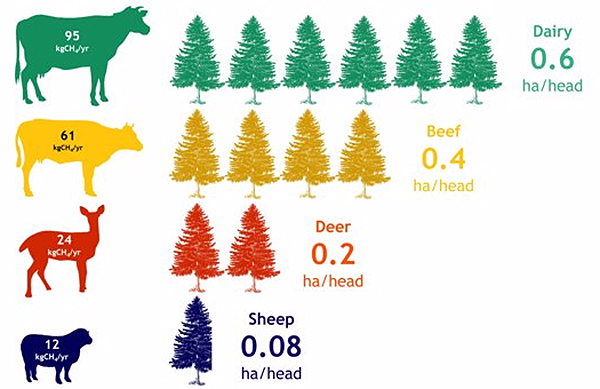
Sources: PCE Publications 2022.
Why the focus on CH4? He quotes data that shows that CH4 is responsible for up to 55% of New Zealand’s contribution to warming (as opposed the GWP which measures different parameters) and believes the focus needs to be on methane due to the ability to not only stop emissions but due to its shorter active life in the atmosphere actually reduce CO2e concentrations and the effects there after. As opposed to carbon dioxide largely from fossil fuels which are there for hundreds of years. And, as we have the means (or hopefully with current research).
In the graph below he outlines why CH4 needs to be reduced. The left-hand side graph illustrates methane emissions and shows how they have been relatively constant for the last 30 years however their contribution to GHG warming are still increasing.
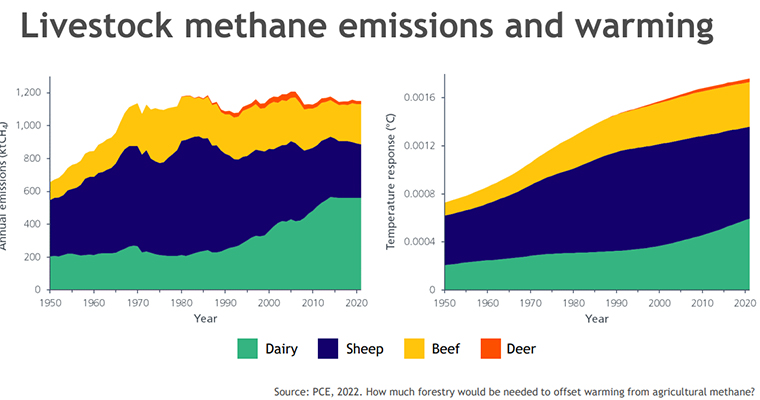
The increases are due to “inertia in the heat transfer between different parts of the Earths system” and other climate feed back loops.
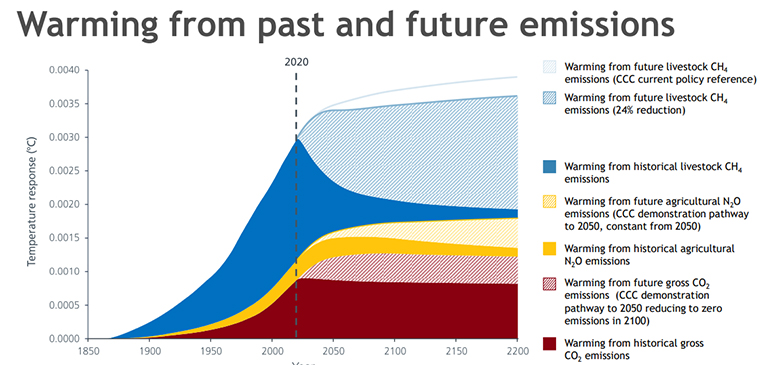
Not only does the PCE believe Government need to review its policy on farm trees for methane but also it needs to narrow down (not necessarily decrease) its 2050 target for methane emissions which are currently between 24%-47%. (if we use the Fonterra payout analogy that would put the likely target at around 35%). He believes it needs to be far more focused to allow better planning. His graph below shows the combined impact of all gas emissions, currently and into the future.
Reading the PCE speech has brought the question around plantations back into focus again although I doubt that was his intention.
Having just watched “Sunday” on the impact of the flooding and John Campbells doco “Slash” the policy around trees gains far more significance. Government and Council policies could dictate what land had to go into trees post-Bola so their response post the 2 month review on forestry on the East Coast will be interesting.
Ultimately for the East Coast the final say does reside with them. Overseas owners may believe they have the rights to do what they can still legally can (or illegally as the case may be) but if Ngati Porou want to they could make logging an impossible task within their boundaries and judging by some of the passion shown in the doco that may be an option.
So, while the PCE speech didn’t discuss the East Coast I can’t help feeling that his attitude to carbon plantations in some placements may have changed. On the evidence of what has just happened, mine has.
In 10 years time when the current layers of slash has disappeared and the scars have healed over then perhaps future policies on logging could be re-examined but at the moment if I was a ‘Coasty” I would want the loggers out and New Zealand doing what it can to reduce future impacts of climate change.
I hope in the mass of questioning that many parts of the country are now carrying out with a view to climate adaptation, they are not forgotten.
We welcome your comments below. If you are not already registered, please register to comment
Remember we welcome robust, respectful and insightful debate. We don't welcome abusive or defamatory comments and will de-register those repeatedly making such comments. Our current comment policy is here.