
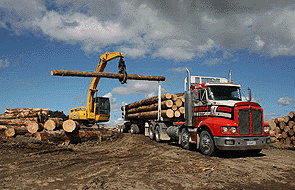
July At Wharf Gate (AWG) prices for export logs mostly recovered from the losses in June predominantly due to the softening of shipping costs. AWG prices increased by about $6 per JASm3. The Chinese market remains well balanced despite recent storms and flooding affecting parts of southern China. Softwood log inventories and daily offtake have remained steady, while lower log supply from New Zealand is providing additional support to the market. However, ocean freight costs have risen sharply again in recent weeks as shipping markets respond to ongoing tensions in the Middle East. These fluctuations combined with foreign exchange movements creates uncertainty for future AWG pricing.
Domestically, sawmill demand continues to outperform expectations for the winter period. Forward orders are increasing, domestic timber supply remains tight following recent mill closures, and strong export demand from Asian markets is supporting sawn timber price increases.
The PF Olsen Log Price Index increased $3 to $122, which is $2 above the two-year average and $3 above the five-year average.
Domestic Log Market
Most domestic log pricing has remained stable for Quarter 3. Most domestic log processors are charging a 2% fuel surcharge on domestic sawn timber in July, and the surcharge is reviewed monthly.
As noted in previous months, while construction activity remains below long-term averages, sawmill demand has generally held up better than expected. Mill closures over the past two years have tightened timber supply, resulting in a better balance between supply and demand. Mills report July sales were lower than June, but still relatively strong for the winter period and more importantly, forward orders are increasing.
Residential construction continues to show gradual signs of recovery. The annual number of new dwelling consents has continued to increase, led primarily by townhouse and multi-unit developments, although activity remains well below the post-COVID peak. In contrast, non-residential construction remains subdued, reflecting cautious business investment and ongoing project cost pressures.
There is strong demand from Asian markets for New Zealand export sawn timber, with price increases recorded across most grades. The combination of improved export demand and tighter domestic supply has supported sawmill utilisation and pricing despite the traditionally quieter winter construction period.
The recent introduction of the Government's Building Amendment Bill, which aims to streamline consenting and improve efficiency within the construction sector, is a positive medium-term development. While the reforms are unlikely to influence timber demand immediately, they should support future residential and commercial building activity once implemented.
China
CFR prices for A-grade logs from New Zealand are currently in the range around USD 126 per JASm³ for the larger exporters.
Softwood log inventories in China have remained stable as has overall demand, despite activity reducing in the South China and Yangtze River Delta regions due to storms and flooding. Daily log offtake remains steady at approximately 55,000 m³ per day, which is encouraging given the weather events and hot climate in China. The supply chain has noticed log volumes from New Zealand has dropped compared to this time last year, which is positive for the market.
Some price increases in the coming months will help offset increased shipping costs. However, exporters will need to be cautious not to try and push prices too high too quickly, as wholesale prices are not moving up yet and will take longer in the areas affected by the flooding.
China’s Manufacturing Purchasing Managers' Index (PMI) was 50.3 in June, slightly above the expansion threshold of 50.
India
Kandla is facing delayed monsoon rains and many sawmills in Gandhidham were inundated with flood waters, so production of sawn timber has been reduced. Prices for sawn radiata pine timber have weakened from INR 671 per CFT to INR 651 per CFT.
Berthing delays in Kandla Port for log vessels were about 7-12 days but very recently berth number 6 in Deendayal Port, Kandla, suffered significant damage as harbour mobile cranes (HMC’s) were handling iron ore. A portion of the jetty collapsed into the water, and operations have been suspended at berth 6 as well as the adjacent berth 7. While the overall operational impact is still being assessed, monsoon rain will likely impair the rehabilitation, and this may negatively affect log vessels.
Some unsold NZ logs in Kandla are offered to the market at $145 USD per JASm3 for A grade logs, but the buyers are waiting to see if the market may further soften. CFR prices for New Zealand pine logs into Kandla was around USD 158 per JASm³ last month.
Ocean Freight
Ocean freight costs (USD/JASm3) for logs from New Zealand had reduced in June to assist with a recovery in July AWG prices. However, shipping cost have risen about 8 USD per JASm3 in the last week which will negatively impact AWG prices. Most of August shipping departures were already locked in so this increased cost, if maintained, will put pressure on September AWG pricing in New Zealand. These shipping cost fluctuations are primarily driven by changes in fuel costs as the market reacts to events happening in the Middle East conflict. You can see below the volatility in fuel and bunker prices since March.
The BDI is a composite index comprising three sub‑indices: Capesize (40%), Panamax (30%) and Supramax (30%), and reflects average daily USD hire rates across key ocean freight routes. Most New Zealand log exports are carried on Handysize vessels, which are not directly included in the BDI calculation, though broader freight cost trends can still exert indirect influence on this segment.
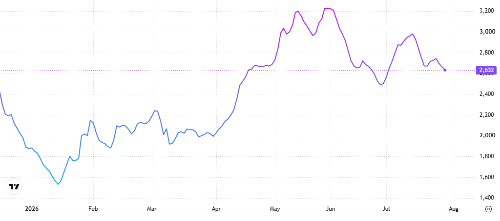
Baltic Dry Index (BDI)
Source: TradingEconomics.com
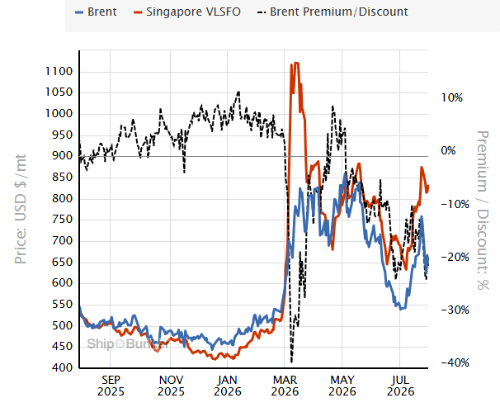
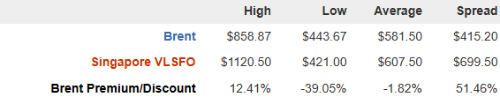
Singapore Bunker Price and Brent Crude Oil Price
Source: TradingEconomics.com
Exchange Rates
The NZD has strengthened against the USD by 3.6% over July. This will negatively impact AWG price calculations for New Zealand log suppliers. The CNY remains stable against the USD with a slight increase of 0.4% over the month.
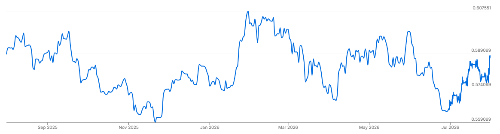
NZD:USD
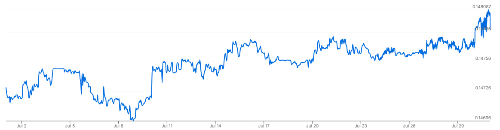
CNY:USD
PF Olsen Log Price Index - July 2026
The PF Olsen Log Price Index increased $3 to $122, which is $2 above the two-year average and $3 above the five-year average.
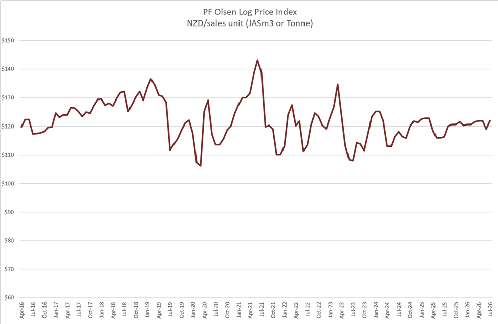
Basis of Index: This Index is based on prices in the table below weighted in proportions that represent
a broad average of log grades produced from a typical pruned forest with an
approximate mix of 40% domestic and 60% export supply.
Indicative Average Current Log Prices – July 2026
| Log Grade | $/tonne at mill | $/JAS m3 at wharf | ||||||||||
| Jul-26 | Jun-26 | May-26 | Apr-26 | Mar-26 | Feb-26 | Jul-26 | Jun-26 | May-26 | Apr-26 | Mar-26 | Feb-26 | |
| Pruned (P40) | 175-200 | 175-202 | 175-200 | 175-200 | 175-202 | 175-200 | 194 | 192 | 196 | 196 | 196 | 194 |
| Structural (S30) | 123-145 | 120-145 | 123-145 | 123-145 | 120-145 | 120-145 | ||||||
| Structural (S20) | 95-100 | 93-100 | 95-100 | 95-100 | 93-100 | 93-100 | ||||||
| Export A | 125 | 118 | 125 | 125 | 125 | 123 | ||||||
| Export K | 114 | 109 | 117 | 117 | 116 | 114 | ||||||
| Export KI | 104 | 100 | 107 | 107 | 107 | 105 | ||||||
| Export KIS | 91 | 100 | 98 | 98 | 98 | 96 | ||||||
| Pulp | 45 | 51 | 46 | 46 | 51 | 46 | ||||||
Note: Actual prices will vary according to regional supply/demand balances, varying cost structures and grade variation. These prices should be used as a guide only.
A longer series of these prices is available here.
Log Prices
Select chart tabs
This article is reproduced from Stand/PF Olsen's Wood Matters, with permission.
We welcome your comments below. If you are not already registered, please register to comment
Remember we welcome robust, respectful and insightful debate. We don't welcome abusive or defamatory comments and will de-register those repeatedly making such comments. Our current comment policy is here.