
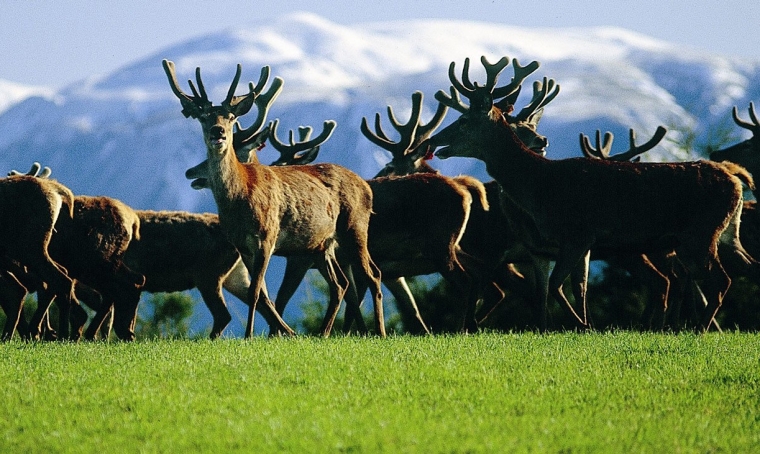
New Zealand’s deer industry may be relatively small, but it has rarely lacked an ability to adapt.
From the early pioneers capturing deer from helicopters through to the development of farmed venison and velvet industries, deer farming has been built around finding opportunities that other agricultural sectors have not necessarily pursued.
New Zealand Deer Farmers Association chair Evan Potter believes that willingness to adapt will again be important as the industry confronts rising costs, declining deer numbers, competing land uses and the need to extract greater value from its products.
Potter says profitability remains one of the biggest issues facing deer farmers, alongside pest and disease pressures, compliance costs and the longer-term challenge of maintaining a sustainable industry as livestock numbers decline.
Like sheep and beef farmers, deer producers are also operating in an environment where there are increasingly valuable alternative uses for their land.
“Most deer farmers are fairly positive. They’re a pretty optimistic type of character, but they’re also realistic,” says Potter.
“There’s lots of options for competitive land use. Not only do we have competing land uses encroaching on our traditional areas, but as producers we too have choices.”
Those choices can include changing livestock species or moving land into forestry, carbon, viticulture or horticulture where the property and land class allow it.
That puts pressure on deer farming to demonstrate its value within a modern farming business.
Potter says deer can provide benefits beyond the immediate return from venison or velvet, particularly on mixed livestock operations where different species can complement one another.
Deer can fit particular land classes and provide another income stream, while cross-grazing can also play a role in managing parasites and making better use of pasture.
That flexibility was demonstrated during Covid when the collapse of the white-tablecloth restaurant trade severely affected venison demand and prompted a significant shift towards velvet production.
Venison has since recovered as the industry has developed different distribution channels and marketing initiatives.
But Potter believes the longer-term opportunity is not simply to sell more venison as another red meat product.
“I don’t think we want to continue to compete just as a red meat protein,” says Potter.
“I think we need to differentiate, have that backed up by science and research and make claims.”
The same challenge exists for velvet.
Potter says greater diversity of markets and end uses will be important, with Vietnam providing another market opportunity this year. He believes the industry also needs to become better at retaining the intellectual property generated through industry-funded research and leveraging that work for the farmers who ultimately paid for it.
At the same time, another deer issue has been attracting increasing public attention.
Wild deer populations have expanded significantly in parts of New Zealand and Potter says it is important that discussions about controlling those populations do not become confused with the farmed deer industry.
He describes the wild deer issue as complex, with changing land use, expanding forestry and carbon farming, biodiversity planting and limited funding for control on conservation land among the factors involved.
For the farmed industry, one of the biggest concerns is protecting the reputation of New Zealand venison.
“They are chalk and cheese,” says Potter.
“A domesticated slice of venison is quite a uniform, reliable type product that a chef can use. It has distinct eating characteristics that are very different to wild venison.”
Wild venison can vary considerably depending on what an animal has been eating and its condition before being harvested.
Potter says that creates potential risks around eating quality, animal health and ultimately market reputation if the distinction between the two products is not maintained through the supply chain.
There is clearly an opportunity to make better use of New Zealand’s wild deer resource, including providing meat for food banks and creating economic activity through processing.
Potter is not opposed to that, but says the integrity of the supply chain has to come first.
“If we go and destroy market reputation for short-term gain, that would be really detrimental to an industry that’s been built over many years of passion and hard work,” says Potter.
Protecting the future of the industry is also about attracting the next generation.
NZDFA has invested heavily in programmes including its Next Generation initiative, Young Deer Farmer of the Year and farmer extension events such as the Big Tick Day Out.
Potter says the Next Generation programme has been running for 14 years and is designed both to introduce young people to different parts of the industry and to help them build relationships with other deer farmers.
That ability to share information has long been one of the strengths of what remains a relatively close-knit farming sector.
NZDFA has 17 branches around the country, providing both a representative voice for farmers and a network through which knowledge and experience can be shared.
Potter believes farmer-to-farmer extension needs renewed attention, particularly as government-supported programmes have come to an end.
The advantage of the branch structure is that the demand for information can come from farmers themselves rather than being imposed from above.
“Farmers are the ones that will identify where their shortcomings are or where they think they’d like to learn a bit more,” says Potter.
“Ultimately, we’re all trying to improve efficiency, reduce that gap between profitability and inflationary pressures and be sustainable and create a vibrant future going forward.”
Environmental management is another area where Potter believes deer farmers have quietly performed well.
He was the first deer farmer to win the Gordon Stephenson Trophy, although he is characteristically reluctant to make too much of the achievement.
Potter describes much of the environmental work on his own property as common sense rather than environmentalism.
Land better suited to native vegetation was retired, waterways were protected, difficult areas fenced and planted and tracks developed to improve stock and farm management.
“I’ve always said that I’m not green, and I’ve been told that maybe I am, so we’ve settled on a light shade of green,” says Potter.
“If you’re not looking after your physical environment, then you’re only eroding profitability or long-term sustainability.”
Since Potter's win, other deer farmers have gone on to receive the Gordon Stephenson Trophy, something he believes demonstrates the priority the industry has placed on environmental management.
Looking five to 10 years ahead, Potter sees product differentiation, new markets and technology as three of the industry's biggest opportunities.
He also believes more work is needed to demonstrate the underlying stability of deer farming to the financial sector, which he says can still regard deer as a relatively high-risk industry.
That perception can make access to capital more difficult, particularly for younger farmers interested in entering the sector.
Technology could also change how deer are farmed.
Potter points to developments such as virtual fencing in the cattle industry and says it is difficult to know where similar technologies might eventually take deer farming.
What gives him confidence is the industry's history.
Deer farmers have rarely been afraid of trying something different, whether that meant adapting existing technology or developing something entirely new.
The challenge now is to ensure another generation sees the same opportunity.
“The future is in your hands,” says Potter.
“I’d encourage them to take any opportunity to educate the uneducated, share their ideas, which deer farmers are renowned for, or inspire the next generation.”
For an industry born from innovation and a willingness to do things differently, that may be the most important message of all.
We welcome your comments below. If you are not already registered, please register to comment
Remember we welcome robust, respectful and insightful debate. We don't welcome abusive or defamatory comments and will de-register those repeatedly making such comments. Our current comment policy is here.