
It’s amazing how quickly people’s demeaner changes with a run of fine weather and increased temperatures, even with a backdrop of a very negative election campaign by the big players. While the election results still hang in the balance, the improved demeanour has been buoyed by better economic news, strong farm returns and as of this month, the highest export log prices in 20 months. Sort of like Christmas has come early, especially if you’re the leader of the Opportunity Party.
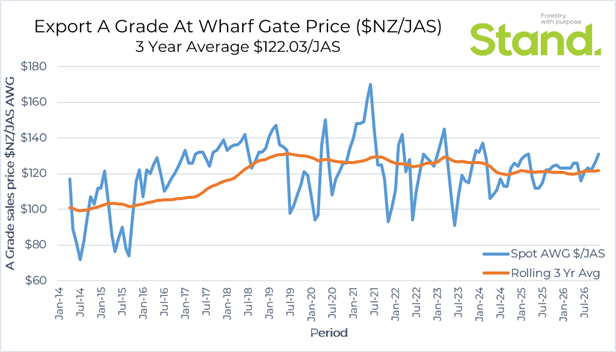
While an increase in export log prices wasn’t entirely unexpected, the magnitude of increase caught a few off guard. A-grade short prices in Southern North Island ports have topped $131/JAS and there are reports of prices upwards of $135/JAS in some other ports where there is a battle for volume. Although in many cases the increase may only cover the additional cost of fuel, we are definitely headed in the right direction. Before we get too carried away and order a new Maserati, it’s important to understand that this increase is not due solely to a supply and demand imbalance and more thanks to reduced shipping costs and foreign exchange.
The holding of the OCR by the Reserve Bank saw the NZ dollar take a popularity dip reminiscent of the Republicans in the mid-terms and, although it has rebounded somewhat, it is still around a cent lower than mid to late October. Also helping is the strengthening of the Yuan against the $US which is now at a 4 year high. Shipping rates have eased thanks to softened demand for Handysize vessels globally although, unfortunately, the Pacific Basin is holding up better than the Atlantic. Further softening is however, expected throughout the month.
Current uplift from Chinese ports is running at 65,000m3 per day, which is a solid number, and port inventories have dropped by 270,000 m3 from September to 2.3million m3. So, on the face of it, we are headed in the right direction but until we get close to a 2.0 million m3 inventory level we are unlikely to see significant increases in CFR sales prices.
NZ supply will drop over the Christmas break, potentially creating a hole in mid-February deliveries which times well for the Chinese New Year (CNY) break. This annual holiday effectively takes a month of demand off the table. If we can head into the CNY period at a sub-2.0million inventory level then we will likely look rosy headed into Q2 2027, however, NZ supply generally increases during the summer months (especially with increased export prices) which may scupper this potential.
There’s not much in the way of great economic news out of China. The Purchasing Managers Index (PMI) dropped into negative territory in October with a result of 49.3 from a slightly positive September number of 50.1. In addition, the October China Producers Price Index (PPI) was at a 2026 high of 5.7% versus the Consumer Price Index (CPI) of 0.7%. This indicates that the raw materials and other goods used by manufacturers are rising faster than actual consumer goods which will be putting a significant squeeze on manufacturers’ margins. Ultimately if this trend continues it will lead to inflation, however they are coming off a rather low base of 0.9% to the year ended September so there’s a fair bit of head room.
India cargos continue to be problematic with ridiculously long delays to unload vessels at Kandla Port. In addition to the already antiquated unloading methods that add significant cost, bulk vessels are unloading cargoes such as iron ore destined for Iran onto Kandla Port for reloading onto much smaller coastal freighters (which are less of a loss if they have an unfortunate missile interaction) before heading for the Strait of Hormuz. Until India drags its port operations into the current century, it is unlikely that this market will be able to play with the big boys both in terms of operational cost and volume throughput.
The local market continues to show more than a few green shoots. Following strong building consent numbers in August, September also showed a decent lift with an 18% annual increase (compared to 21% in August). Canterbury still leads the charge with a 35% increase to the end of September, which should come as a surprise to no-one. Non-residential consents don’t paint the same picture unfortunately with a slight lift of only 2.2% for the same period. These numbers are lead indicators and don’t necessarily convert into immediate additional timber demand, however they do point to improved sentiment and generally flow through the system in the following 12 months.
The recent announcement of the MPI ballot for registering forests planted on Land Use Capability (LUC) class 6 land into the ETS saw an over subscription in the over 100ha class and an under-subscription in the under 100ha class. Information released by MPI shows that in the over 100ha category there were only about 12,000ha of unique titles submitted which is less that 10% of what was initially reported. This indicated that many properties were entered multiple times in an effort to improve one’s chances which is less than ideal.
The current NZU spot price has crept up over the $50 mark with trades currently at $50.90/NZU. Depending on the makeup of the next Government, there may be price pressure in either direction as each party has a different view on what they want to do with the ETS. Our hope is that they keep their wee fingers away from it but that’s looking less likely.
So, as we roll ever closer to putting the tinsel on the Christmas tree, the general feeling is a positive one in terms of log prices that will hopefully last past the new year’s hangover. Once the deals are done in the Beehive and the new round of MP’s are minted into the system we will know how the cards fall and what, if any, lollies are left in the jar for the forest industry. It would be great to see the Minister of Forestry within Cabinet and preferably at the important end of the table, but generally, in the political lollie scramble, we’re the ones running in from the back with a limp, and a club hand…and that’s before we get ankle tapped by Federated Farmers.
This article is reproduced from Stand/PF Olsen's Wood Matters, with permission.
We welcome your comments below. If you are not already registered, please register to comment
Remember we welcome robust, respectful and insightful debate. We don't welcome abusive or defamatory comments and will de-register those repeatedly making such comments. Our current comment policy is here.