

By Guy Trafford

New Zealand horticulture has made the news recently with the demand for fruit harvesters that is not being meet. With the unemployment rate hovering around 4% (3.9% is latest data) the likelihood of finding enough staff from that sector is reasonably remote.
The same issue has been an ongoing one for agriculture. Dairying has had an ongoing issue with finding and maintaining staff and while sheep and beef and cropping have lower rates of turn over, finding new staff has still been a problem and getting more difficult by the year.
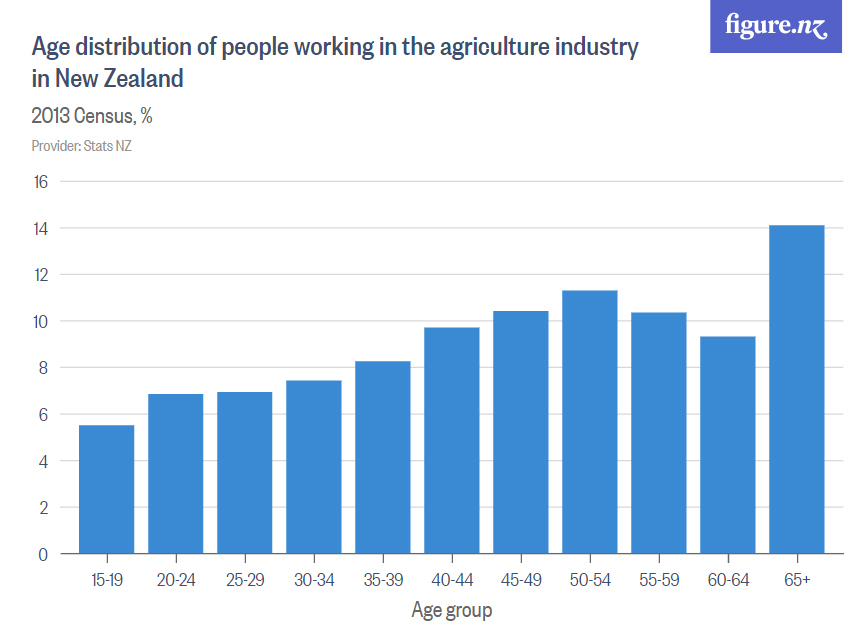
When the age profile of those working in agriculture is examined then more concern should be raised.
While most New Zealand industries have some variation of a bell shaped curve, agriculture, based upon the 2013 census results and it will have only got worse since, has a distinctly lop sided graph with the major age group involved being the 65+ group at over 14%. This is 3% higher than the next largest group 50 -54 at 11.3%, and when compared to the average New Zealand worker's age of around 43, it is over 4% higher. This does not paint a positive picture going forward for NZ ag and with the demise of ag training institutions it is not going to get better anytime soon.
Any solution is proving elusive. Bringing in more migrants will meet some of the requirements, but the need has now grown so great that productivity is being affected. For some time, large back country stations have had to curtail their expectations around farm intensification due to the additional staffing needs required to operate such systems, likewise some dairy farms. More migrants from a worker's perspective also means that there is more demand for housing and inevitable downward pressure on workers' wages.
A current article by Andrew Coleman, published here discusses whether New Zealand’s taxation system is adversely affecting productivity by the ‘signals’ it sends through the taxation process. New Zealand is lagging behind other OECD countries when it comes to productivity and largely this is due to a lack of capital going into areas of productivity. So, investing in newer and more efficient ‘technologies’ should be seen as part of the solution. However, while most sectors are enjoying reasonably good returns at the moment there is no guarantee these will remain. And with the already large rural debt, investors will need to think hard about adding to it in uncertain times.
The soon to be announced proposals from the Tax Working Group (TWG) may change some of the incentives away from investing in property to putting capital into more productive uses. This may have the effect of further highlighting the lack of skilled labour to take up some of the opportunities, but it may also provide the overdue impetus to upgrade technologies and reduce less skilled labour requirements. An irony coming on the back of the Taratahi Training Institute going into receivership is that now Agresearch is selling off the bulk of the Winchmore Irrigation farm. It may be that it has had its time, obviously Agresearch believe so. But New Zealand Ag does have the appearance of being steadily run down at the national level and no indications of a comprehensive plan going forward. Perhaps the heavy investment into combatting the M.Bovis outbreak is the best that can be hoped for.
The Government does appear to be trying to front foot New Zealand’s interests in maintaining and protecting market access into the UK. A Prime Minister to Prime Minister meeting took place last Monday with Theresa May providing assurances that the current access will be maintained. However, given the uncertainty that currently reigns over what the UK’s border access is going to look like post March 29th, any assurances have to be taken with a fairly liberal grain of salt. Already there is an issue with the sheep meat quota being agreed between the UK and Brussels being set at what the current division between the two parties is. This may suit for the time being but if Britain does leave the EU then the trade between them is very likely to change. This will impact on the amount of sheep meat flowing from Britain to the EU and change the current balance. So New Zealand’s EU markets may change, most likely improve if larger tariffs are imposed on UK lamb and conversely with more lamb staying at home the UK market may diminish. This is all speculation but what we do know is that nobody knows what the fallout will be even to the point that there could be a change of government. To date the impasse seems to have split Parliament in about four groups who have preferred options and none have the numbers to push through their view and so the ‘soap’ continues.
Markets
Little change to markets overall from last week when the major news was the lift in the Global Dairy Trade auction, the fourth in succession.
SHEEP
Lamb schedules have had some tweaking downwards and mutton schedules remain largely unchanged. Saleyard prices have reduced as a result of the falling works prices and with the climate now reverting to more normal patterns growth has reduced, reducing demand, and more store lambs are coming onto the market.
WOOL
The sale last week held onto the small gains made in the previous sale, however brokers comments seem to indicate they still think prices are at a precarious level with buyers being somewhat fickle.
BEEF
Manufacturing grades remained unchanged but there was some positive movement in the prime grades although nothing too dramatic. Stores prices remained firm.
VENISON
The largest falls in the schedules occurred here with prices dropping by about -15 cents per kg. Fortunately, producers have been receiving good prices for velvet which for those who farm for it will be getting some compensation.
We welcome your comments below. If you are not already registered, please register to comment
Remember we welcome robust, respectful and insightful debate. We don't welcome abusive or defamatory comments and will de-register those repeatedly making such comments. Our current comment policy is here.