
By Philippe Aghion
While debates about Europe’s flagging growth prospects have been ongoing at least since the turn of the century, the 2020s have lent them new urgency. Not only did Russia’s invasion of Ukraine expose a dangerous dependence on imported energy, but a change of administration in the United States has forced Europeans to rethink how they will ensure their prosperity, security, and sovereignty in the future. Moreover, with America and China racing ahead in AI – widely assumed to be the next general-purpose technology, on par with the internet – Europe’s lack of dynamism has become an emergency.
The problem is not just the commonly cited gap between per capita incomes in the European Union and US. It is that Europe has long been falling behind technologically, boasting few globally recognized leaders in the digital platform economy, AI, the new space race, and other sectors that will be central to competitiveness and security in the 21st century.
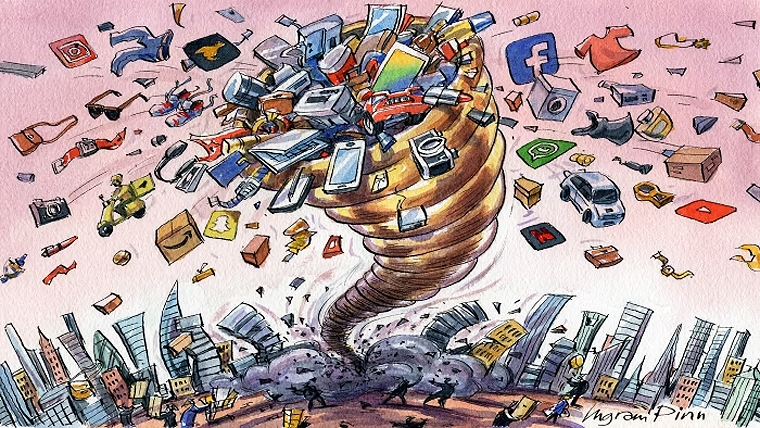
Deeply dependent on advanced technologies made elsewhere, and unable to generate the growth needed to finance its strategic objectives and future liabilities, Europe is a textbook example of why creative destruction – the toppling of less productive firms by innovative new challengers – matters. Forego it, and moderately reduced growth prospects are only the start of your problems.
For all its success as a trade and regulatory power, Europe will remain vulnerable unless it can unleash innovation at the same pace and scale as the US, China, and others. Because AI has the potential to generate new knowledge and ideas, in addition to performing a wide range of services or traditional productive functions, it could be a doubly potent engine of the kind of creative destruction that ultimately drives growth over time.
Frontier innovation becomes more important the closer an economy gets to the technological frontier. But while increasing R&D investment is necessary to generate breakthrough innovation, it is not sufficient. As stressed in former European Central Bank President and Italian Prime Minister Mario Draghi’s report for the European Commission, “The future of European competitiveness,” the continent will remain stuck in mid-tech incremental innovation unless it makes significant progress on three main fronts: removing all the barriers that stand in the way of achieving a fully integrated market for goods and services; creating an appropriate financial ecosystem to encourage long-term risk-taking by firms, starting with venture capital and institutional investors (pension funds, mutual funds); and pushing for pro-innovation and competition-friendly industrial policy in key domains such as the energy transition, defense and space (including AI), and biotechnologies.
Europe has not only avoided industrial policy under the pretext of implementing competition policy, but has also emphasized competition among incumbent firms within Europe while paying little attention to entry by newer players and to competition from outside Europe, starting with the US and China. Market entry by new innovative firms from the rest of the world is indeed the very essence of the creative destruction Europe needs to grow faster. In the early 2000s, Giuseppe Nicoletti and Stefano Scarpetta of the OECD showed that while churn (the replacement of old, less efficient firms by new, innovative ones) had played an important part in US productivity growth, most productivity gains in Europe were occurring within existing firms. Many of Europe’s current problems can be traced to this basic difference.
More generally, Europe needs to update its economic doctrine, which turned it into a regulatory giant and a budgetary dwarf. First, in implementing the Maastricht Treaty’s limits on budget deficits, policymakers should no longer put growth-enhancing investments on the same footing as the various recurrent public spending programs (such as pensions and social benefits). Moreover, they should allow for industrial policies that are properly governed, in particular when these are designed to be pro-competition and pro-innovation. Lastly, eurozone countries should be allowed to borrow collectively in order to invest in the new technological revolutions, as long as member states show discipline in managing their public spending frameworks.
Fostering creative destruction and breakthrough innovation in Europe will also require complementary policies to help workers reallocate from lagging to more advanced sectors, and to compensate short-term losers from structural reforms. To that end, I have advocated a Danish-style “flexicurity” model, where the state covers displaced workers’ salaries while they pursue retraining and re-employment. An AI-driven industrial revolution demands nothing less.
It was a European, Joseph Schumpeter, who recognized the centrality of creative destruction to economic development. Today’s Europeans must embrace it but also make it inclusive and socially acceptable if they are to thrive in the years and decades ahead.
Philippe Aghion, a 2025 Nobel laureate in economics, is a professor at the College de France and the London School of Economics and an associate at the Centre for Economic Performance. This content is © Project Syndicate, 2025, and is here with permission.
We welcome your comments below. If you are not already registered, please register to comment
Remember we welcome robust, respectful and insightful debate. We don't welcome abusive or defamatory comments and will de-register those repeatedly making such comments. Our current comment policy is here.