
By Peter Drennan*
If you've ever worked from New Zealand with North American or European teams, you know the pain. I spent 10 years in Canada, moved back in 2022, and have maintained contracts with Canadian businesses since. The overlap is thin.
You're dragging yourself out of bed at 6am for a standup with someone in Toronto who's mentally halfway out the door. You're the person requesting a team meeting at 5pm EST, which is a reliable path to unpopularity. You lose an entire working day to the dateline unless you're willing to pull the oar on a Saturday morning. I'm convinced we have the most inconvenient timezone in the world for working with Western markets.
So it's with genuine disbelief that I'm writing this: our terrible timezone may now be an AI structural advantage.
Tokens are the new electricity
AI inference (the process of generating responses from large language models) has a peak load problem that looks remarkably like electricity generation. There are only so many GPUs (graphics processing unit) available to turn prompts into responses. When demand spikes, something has to give: response quality drops, wait times increase, or users get cut off.
Every major provider is reaching for the same playbook that electricity companies have used for decades. Flatten the curve. Incentivise people to shift consumption away from peak times.
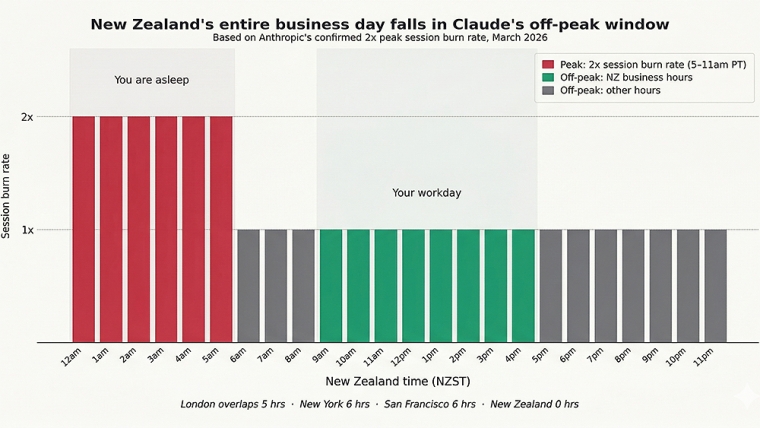
Anthropic (the company behind Claude) is the most transparent about it. In March 2026 they confirmed that during weekday peak hours of 5am to 11am Pacific Time, users burn through their session limits significantly faster. About 7% of users now hit limits they previously wouldn't, with heavy Claude Code users burning through their allocation in as little as 90 minutes. The company even ran a two-week promotion doubling usage limits during off-peak hours, a tacit admission that substantial capacity sits idle outside US business hours.
OpenAI and Google impose less explicit but functionally similar constraints: silent model downgrades, delayed responses, reduced reasoning depth during busy periods, and quietly tightened quotas. The specifics vary, but every provider is responding to the same fundamental problem: exponential demand colliding with physical infrastructure that takes years to build.
My experience has been miraculous
I'm a heavy user of both Claude and ChatGPT. I code with Claude daily and use ChatGPT's Codex for longer-running tasks. American developers on identical plans are hitting limits constantly. The Reddit threads are full of frustrated US-based coders watching their usage meters spike to 100% mid-morning.
My experience? I hardly ever hit limits. A large part of that is simply working off-peak.
Off peak grinders
Claude's peak constraint window is 5am to 11am Pacific Time on weekdays. New Zealand is currently on NZST (UTC+12), 19 hours ahead of PDT. So 5am PDT is midnight here, and 11am PDT is 6am. Our entire business day, 9am to 5pm NZST, maps to 2pm to 10pm Pacific. The overlap between NZ working hours and the global AI peak window is zero.
London and New York both overlap with peak time. New Zealand and Australia are the only major English-speaking markets that completely misses it. As with all things New Zealand, it looks like Australia has a slight edge on us, but in the ANZAC spirit, lets not quibble.
Is this temporary?
The natural question: how long does this last? The data suggests a multi-year window, at minimum.
The top five hyperscalers are projected to spend roughly US$600 billion on capex in 2026, with approximately 75% directed at AI infrastructure. The Stargate project has committed US$500 billion over four years. Amazon alone plans US$200 billion in 2026. Yet every hyperscaler reports being supply-constrained. The binding bottleneck has shifted from chips to electricity: grid connection timelines stretch two to six years, transformer lead times run two to four years, and NVIDIA's Blackwell GPUs are sold out through mid-2026 with a 3.6 million unit backlog.
Meanwhile, ChatGPT added 500 million weekly active users in just 12 months, reaching 900 million by February 2026. AI spending is forecast to hit US$2.5 trillion in 2026, up 44% from 2025. Bain & Company notes that demand for AI compute is growing at more than double the rate of Moore's Law. The consensus among analysts is that meaningful relief is three to five years away.
Video and world generation will make it worse
And this advantage only grows as workloads get heavier. AI video generation and synthetic world-building for gaming consume orders of magnitude more compute than text. These are the workloads that will stress GPU infrastructure hardest over the next few years, and they're scaling fast.
New Zealand has real exposure here. Wētā FX is already partnering with AWS on AI-driven VFX tools. Wellington's gaming studios have shipped titles downloaded over half a billion times. As AI embeds itself in film and game production, our timezone advantage applies with even greater force to the most GPU-hungry workloads.
Will agents flatten the curve?
Possibly, as Americans schedule agent workloads to run overnight. But agents work fast, and I believe the real constraint is human steering and comprehension. Knowledge workers need AI during their working hours because that's when decisions get made and outputs get reviewed. The bulk of token consumption will continue to follow business hours for the same reason electricity demand peaks when people cook dinner: that's when the work happens.
The global nightshift
This leads to what I think is the most interesting implication. In a world where AI-augmented teams move dramatically faster, timezone coverage becomes an advantage. When American or European colleagues close their laptops, a Kiwi team member can pick up the AI-assisted workstream and keep it moving, working in the fastest, least-constrained compute window available.
For years, our timezone made us the inconvenient add-on to North American and European teams. The dynamics of AI infrastructure have flipped this. The same 17-hour offset that made synchronous collaboration painful makes asynchronous AI-augmented collaboration extraordinarily efficient.
For once, the timezone works in our favour!
*Peter Drennan is Christchurch Manager at Waterstone Insolvency. This article first ran here and is used with permission.
We welcome your comments below. If you are not already registered, please register to comment
Remember we welcome robust, respectful and insightful debate. We don't welcome abusive or defamatory comments and will de-register those repeatedly making such comments. Our current comment policy is here.