

Interest.co.nz is unpacking how AI will change your everyday life - the risks, the opportunities, and what to actually expect. Our new series brings you the policymakers, experts and industry leaders from New Zealand and overseas, with a new story every workday over the next couple of weeks.
New Zealand was the last country in the OECD to publish a national AI strategy, which came with no timelines or measures of success.
Now, a scathing review of the Government's digital delivery agency (GDDA) has shone light on a system "poorly informed" about its own tech investment, with agencies duplicating work, missing deadlines, and in one case, potential data sovereignty issues being raised at a large agency.
The critical review, which found major performance issues in an area deemed critical in streamlining and improving the New Zealand public service, came after the Government’s digital delivery agency functions were moved from the Department of Internal Affairs to the Public Service Commission, with the Commissioner eyeing a major overhaul with new veto powers to stop agencies spending frivolously.
The release of the report closely follows the Immigration NZ saga, where investigations were launched following its failed Biometric Capability Update (BCU) project, launched in 2018 without Cabinet approval, misled ministers and has needed $31 million from this year’s Budget just to end it.
AI strategy gap
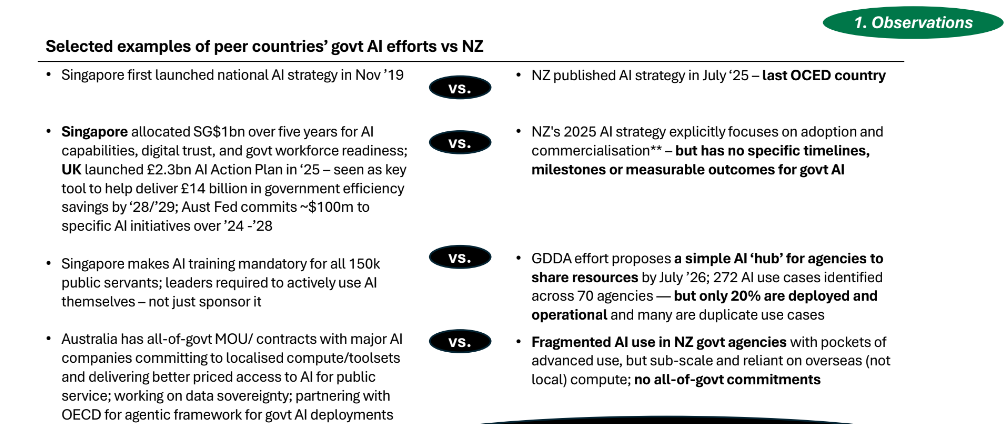
NZ was the last of the OECD countries to publish an AI strategy (in 2025), with no timelines or measurable outcomes, with fragmented AI use across agencies, “with pockets of advanced use, but sub-scale and reliant on overseas (not local) compute; no all-of-govt commitments”.
The GDDA proposed an AI hub so that agencies could share resources, with 272 AI use cases identified across 70 agencies, but only 20% were actually deployed or operational, and many of those were duplicate use cases.
Comparatively, Singapore launched its national AI strategy in 2019 and makes AI training mandatory for its 150,000 public servants, Australia has all-of-govt agreements with major AI companies to deliver better priced AI and were working on data sovereignty, and both Singapore and the UK have made significant investments in rolling out AI in Government.
Data sovereignty questions
The review went deeper into the GDDA functions - saying there was poor prioritisation, duplication and projects falling short of government objectives, and that agency leaders were frustrated.
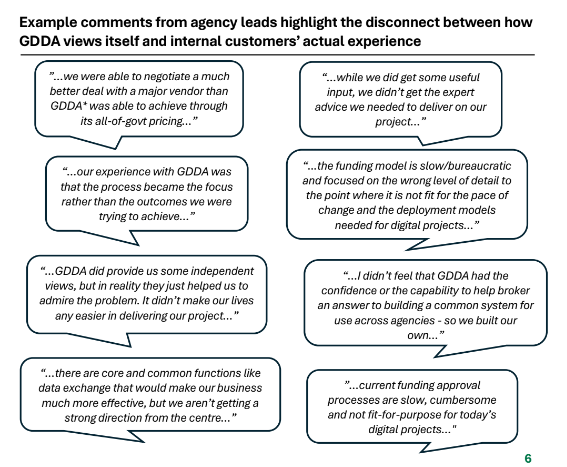
Examples included agency leaders trying to engage with the GDDA as they needed help to roll out a new online national compliance system, but ended up having to use external consultants instead, and a large agency forced to rely on AI tools based in Australia data centres rather than in NZ.
“Vendor advised that the single agency demands do not justify investment in required AI compute/tools inside NZ – raising potential data sovereignty issues,” the review said.
The rapid review
The rapid review was ordered by Public Service Commissioner Brian Roche, after the functions of what were known as the Government Chief Digital Office and the Government Digital Delivery Agency (GDDA), that previously sat under the Department of Internal Affairs, were pulled this year into the centralised position of the Public Service Commission.
That followed a series of decisions by government “aimed at reducing the cost of digital in government, reflecting its view that the public service had a history of waste, duplication, and poor delivery on technology projects”, the review, written by former Auckland Airport CEO Andrew Littlewood, PWC’s Justin Gray and former Kāinga Ora CEO Matt Crockett, stated.
Roche wanted to know what what the GDDA should be able to do, and the leadership, technical, delivery, and decision-making capability needed.
The review said it had a “weak central digital function that focuses on the functional rather than the strategic and is not seen as playing its critical role as the expert support needed by the agencies – all at a time of fiscal constraint, greater public expectations and remarkable change in foundational tech, such as AI.”
This was despite operating with 170 full time equivalent workers and running on $42 million a year.
It found technology funding and investment/approval models were slow and cumbersome and could drive the wrong behaviours.
One of those issues included agencies struggling to secure funding to pursue opportunities or manage legacy system renewals. This forced them to push for either bigger project business cases, to hide smaller discretionary projects within IT operating budgets, or to forgo or delay “sensible incremental” improvements.
It gave Health NZ, as an example, saying issues it had faced led to major hurdles in delivering tech and service innovation. That was despite Treasury’s view that tech transformation in health could deliver huge benefits for the country, with a 5% saving in labour costs equating to an estimated $600 million a year.
The GDDA lacked commercial experience to assess non-standard proposals and it lacked credibility to support innovation at pace.
The review said while global investment in AI capability and capacity continued to grow and businesses were starting to reset around AI, NZ was quickly falling behind with its lack of ambition or a coherent strategy.
It called the Government’s AI effort fragmented and with unrealised opportunities, saying AI could transform the work of government as a foundational capability.
Among the recommendations, it urged the Government to run an urgent diagnostic process, then apply a strong governance model for digital and data projects, referencing Australia’s oversight model.
What's next for the country's digital agency
Talking to Interest.co.nz shortly before the report was released, Roche said the centre would be stronger and provide the leadership the system needs, now the functions are sitting in the Public Service Commission.
"The handicap we have in our current system is we have 40-42 agencies, they get their own technology for their silo - we need a system view."
He gave the example of the Wellington Bowen House building - "we've got six or seven government agencies in this building, we've all got our own corporate functions, we've all got our own payroll systems."
Another part of the change was the added veto rights over the individual digital aspirations of agencies.
The Government has an estimated $13 billion worth of digital investments in the pipeline over the next five years - with a Cabinet paper from last August saying one-third of that was unfunded and much of it was duplicated.
Now, the GDDA, with Treasury, have the right to say a business case doesn’t make sense, “or that piece of technology, you could actually get it from one of the other government agencies, you don't need to go and buy your own thing.”
“Historically, people got their business case done, got it signed off, and they didn't have to think about things like interoperability, does it operate across the system? They didn't have to think about, could I buy it from someone else, do I need to own it, why do we have over 42 payroll systems?”
GDDA has already stopped some projects. “We're not trying to deprive the system of good quality expenditure. We are just trying to optimize for the taxpayer."
"We spend a lot of money, and we're not necessarily getting the best value for it," Roche said.
We welcome your comments below. If you are not already registered, please register to comment
Remember we welcome robust, respectful and insightful debate. We don't welcome abusive or defamatory comments and will de-register those repeatedly making such comments. Our current comment policy is here.