
Few things generate both as much hope and as much fear as artificial intelligence.
It may cure cancer and turbocharge productivity, but it may also create massive unemployment and feed inequality.
For the moment at least, its primary effect seems to be to produce trillion-dollar US tech companies. China aside, it’s difficult to see how competitors to Anthropic, OpenAI, Google, Meta, Microsoft etc will emerge anywhere outside America.
Therefore, the issue for countries like Australia and New Zealand is whether they can apply US-sourced AI technology to boost economic growth. The key will be ensuring they have an appropriately skilled population and the necessary physical infrastructure.
Last month saw the release of the QS World Future Skills Index 2027. This a survey of 89 countries that ‘examines how effectively higher education systems are aligned with labour-market demand, and whether economies are creating the conditions needed to turn talent into productivity, innovation and growth’.
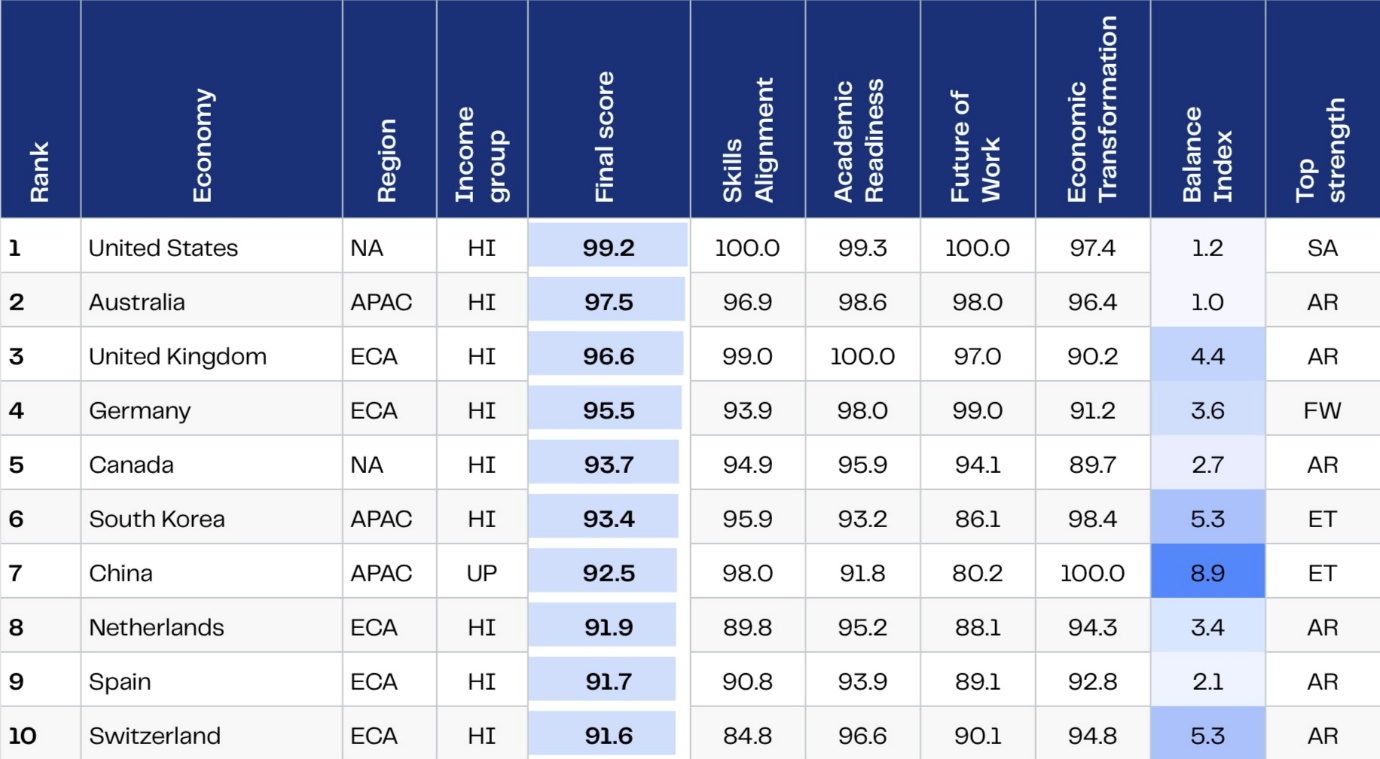
The survey is based on a wide range of data canvassing both the supply of skills and the demand for skills. It assesses each country on four specific issues – skills alignment (the ability of its university graduates to meet business needs), academic readiness (the capacity of its higher education system to produce ‘future-ready’ talent), future of work (its labour market flexibility), and economic transformation (its capacity to generate productivity and growth from its human capital).
Unsurprisingly the US ranked number one on the QS World Future Skills Index. More surprising was that Australia came in second, and ahead of countries with more top universities (United Kingdom) and more technologically advanced manufacturing economies (Germany, South Korea, and China).
QS World Future Skills Index 2027
Source: qs.com
According to the report, Australia’s strong and consistent performance indicates that its ‘talent systems are well-aligned with labour market demand and broader economic transformation needs’.
The report stresses the impact of the balance in an economy between jobs that are augmented by AI and jobs that are automated (i.e. replaced) by AI. That balance will be a major factor in economic competitiveness in the medium to long term.
Countries like Australia rank well from an AI transformation perspective ‘not necessarily because they are adopting AI more rapidly, but because their economies are more concentrated in occupations where AI augments human capability rather than replaces it’.
Securing the benefits offered by an AI future requires more than just suitably qualified workers. Another key requirement is the digital infrastructure i.e. accessible, effective, and affordable internet and cloud computing.
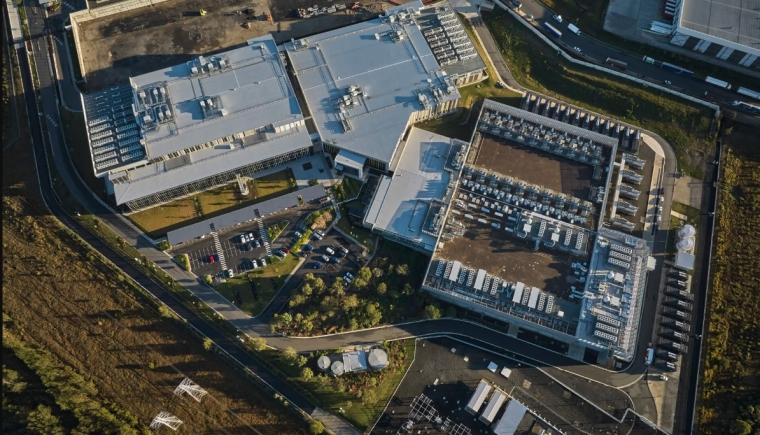
And a big part of that is data centres, facilities that most people had never heard of five years ago but that now dominate business headlines in Australia.
Precise numbers are difficult to pin down but there are currently close to 300 data centres in Australia. Significant operators include AirTrunk, NextDC, Equinix, Digital Realty, and Macquarie Technology Group. And of course, CDC Data Centres which is nearly 50% owned by NZ-based Infratil. That stake is valued at around A$10 billion.
Goodman Group, the global property behemoth, is a developer of data centres across Australasia, Asia, Europe, and the US.
Many of these companies are listed on the Australian stock market, offering investors exposure to the data centre industry. Collectively they are investing tens of billions of dollars in data centres with the current Australian pipeline estimated at around A$150 billion.
And it’s not just data centre developers and operators that will profit from the current boom. Australian energy and materials suppliers also stand to benefit. Copper is a major input into the construction of data centres and the world’s largest copper miner is Australia’s BHP.
In a sign of the growing economic significance of data centres, last month CBA, Australia’s biggest bank, held its inaugural Accelerate AI summit. The stated purpose of the summit was to bring together ‘global visionaries, local changemakers, experts and business leaders to explore how AI-led transformation is taking hold across business, innovation and the Australian economy’.
The undoubted highlight was the ‘virtual’ appearance of OpenAI’s CEO Sam Altman in conversation with CBA CEO Matt Comyn. It’s well worth watching.
Perhaps unsurprisingly given his Sydney audience, Altman was highly complimentary about Australia’s data centre prospects –
If Australia wanted to become a data centre capital of the world, it would certainly be able to. I think it would be in the very few top places in the world in terms of what’s possible here.
Altman identified Australia’s natural resources, abundant clean energy, stable institutions, predictable rule of law, and ‘great national security posture’, as key assets for its data centre industry.
Not everyone is thrilled at the prospect of hundreds of new data centres in Australia. For some, the enormous appetite of data centres for energy and water is an environmental challenge.
But given the importance of AI to Australia’s future economic competitiveness, it’s a challenge that will have to be met.
*Ross Stitt is a freelance writer with a PhD in political science. He is a New Zealander based in Sydney. His articles are part of our 'Understanding Australia' series.
We welcome your comments below. If you are not already registered, please register to comment
Remember we welcome robust, respectful and insightful debate. We don't welcome abusive or defamatory comments and will de-register those repeatedly making such comments. Our current comment policy is here.