

The mortgage business is a volume business.
Despite what borrowers may think, making home loans profitably is best done with significant scale. And if you don't have it, it is a hard barrier to break.
Gains can be hard-won, but they only seem to be minor, very minor year by year.
The best 'long-term' set of data by institution we have is the RBNZ's Dashboard data series, which has been going now for a bit more than six years. Over that whole period since June 2018, home loan market shares have really moved very little. True there are some shifts, but you have to have the full five-year-plus perspective to find them.
And the key takeaway is that the small are weak. They may be challengers, but together they are making almost zero progress in growing market share. But there is always an exception of course.
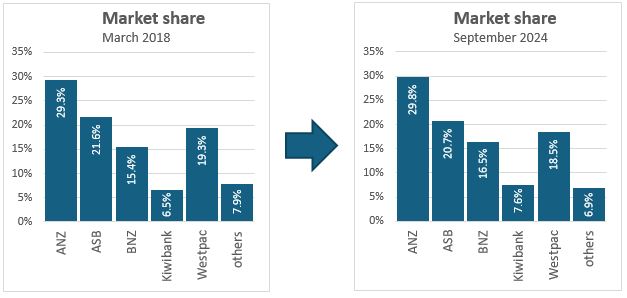
You have to look hard to find the changes.
Here is a summary of the changes from March 2018 to September 2024.
| Lender / market share | 2018 | change | 2024 |
| % | % | % | |
| ANZ | 29.3 | +0.56 | 29.8 |
| ASB | 21.6 | -0.86 | 20.7 |
| BNZ | 15.4 | +1.05 | 16.5 |
| Kiwibank | 6.5 | +1.02 | 7.6 |
| Westpac | 19.3 | -0.79 | 18.5 |
| All others | 7.9 | -0.97 | 6.9 |
Over those six years, the best any bank did was to grow its share of the home loan business by +1%.
But as any manager knows, what really matters is what is happening at the end of this review period. Who has the momentum?
And here we can see that only one bank can really claim that: Kiwibank.
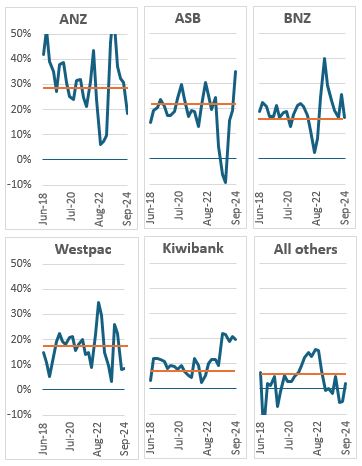
Kiwibank has been able to grow its home loan market share by taking more than a 20% share in each of the past five consecutive quarters. Given they have the smallest mortgage book of the big five, that is quite some achievement.
But a closer look tends to suggest Kiwibank has essentially won most of its gains at the expense of the other challenger banks.
In the charts above, the red line represents the overall embedded share of a bank's home loan business. Gains above that line means the bank is taking business from its rivals. Below that, they are ceding market share to their rivals.
These perspectives also reveal the own-goal ASB conceded when their Aussie masters prevailed on them to not chase "unprofitable business". They have had to work hard to recover from that mistake, but they are clearly not there yet even with a recent push.
The other bank making progress over the medium term is BNZ. They have the smallest market share of the big-four, but mostly they operate above the red-line, taking share from their rivals in most quarters.
But it is also clear from this data that it is hard to sustain market share growth. Do well, and your rivals respond. Only Kiwibank has been able to sustain a recent expansion - and yet the larger BNZ activity has resulted in a slightly better long-term result.
State-owned Kiwibank has a long way to go, but it does seem on a better track than most of its rivals. It certainly is batting above the average.
"More capital" is the usual (political) refrain to help them continue to become a full major. But the providers of that capital (equity market investors?) are going to want a return on their investment. "More capital" won't be available for a discounting strategy. But "more capital" will work if Kiwibank has benefits that attract borrowers other than price. (And don't forget, Kiwibank starts behind the eight-ball on average returns for shareholders.) It will be a hard-sell by Kiwibank's board to attract the capital they need unless the business itself can deliver the returns investors expect.
We welcome your comments below. If you are not already registered, please register to comment
Remember we welcome robust, respectful and insightful debate. We don't welcome abusive or defamatory comments and will de-register those repeatedly making such comments. Our current comment policy is here.