
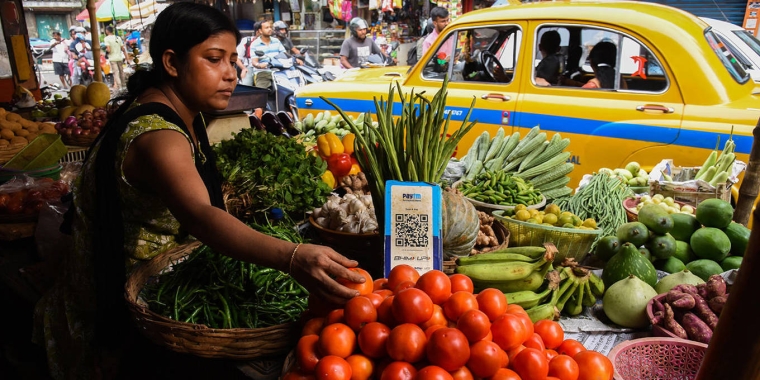
On most days, India quietly does something that no other country has ever done at such a scale: it moves money instantly, billions of times, for free. The country’s Unified Payments Interface (UPI) has unleashed a financial revolution that now runs silently in the background of chai stalls, small shops, and cabs. And this success story is no longer just about fintech. It signals India’s arrival as a global economic and high-tech superpower.
In 2024, UPI processed about 172 billion transactions, up 46% from the year before, and a staggering 247 trillion rupees ($2.7 trillion) moved along this free money highway, according to the National Payments Corporation of India.
For comparison, Visa’s global network processed about 234 billion transactions in 2024, and Mastercard around 160 billion. In other words, a piece of Indian public infrastructure that operates at zero cost to consumers is already playing in the same league as the world’s private payment giants and growing faster than both.
Another point of comparison is China, whose Alipay and WeChat Pay platforms have created one of the world’s largest mobile payment ecosystems. In 2024, mobile payments via Alipay and WeChat Pay exceeded $80 trillion in value, with Alipay handling more than 120 million transactions a day and WeChat Pay surpassing one billion transactions daily.
Unlike the systems operating in China, India’s is an open and fully interoperable public platform that every bank and fintech can plug into. Data from the Reserve Bank of India show that UPI now accounts for more than 80% of all digital payment volumes in India, and that digital payments themselves constitute nearly all the payment volume in the country. A global assessment by ACI Worldwide also notes that UPI represents about 49% of all fast-payment transactions globally, making it the single largest real-time payments system anywhere. These numbers do more than reflect the size of one system; they speak to a global shift in the center of economic gravity.
UPI rests on India’s broader digital public infrastructure, the famous JAM trinity: Jan Dhan bank accounts, Aadhaar identity, and mobile phones. India has more than 530 million Jan Dhan accounts (designed to broaden financial inclusion), many held by women and rural residents. These accounts serve as basic sockets into which UPI can plug. Any smartphone with a data plan and a QR code becomes a digital point-of-sale terminal.
Then there is the RuPay program. Launched as India’s domestic debit-card network, it built scale through government financial-inclusion initiatives, with more than 360 million RuPay cards issued through Jan Dhan alone. RuPay credit cards were later permitted to operate on UPI, and the network experienced explosive growth. By 2024, RuPay had captured 12-14% of India’s card-transaction volume, up from just 3% the previous year. Current estimates suggest that RuPay now holds around 18% of the credit-card market and accounts for nearly 40% of all UPI credit-card transactions by volume. Between April and October 2024, RuPay credit cards accounted for more than 750 million UPI transactions.
India has not only created a domestic alternative to Visa and Mastercard; it has done so within its instant, zero-fee retail payments grid. For a country that has lived through foreign-exchange shortages and external vulnerabilities in the past, this kind of sovereignty over payments infrastructure is strategically transformational.
Perhaps the most radical feature of UPI is its low cost. Transactions are free for all consumers, and the fees are negligible for small merchants compared to traditional card merchant charges. This is no accident. India treats digital payments as public infrastructure, not as a premium private service. That is why UPI was able to grow to 400 million ordinary users by 2024, up from 30 million in 2017. This is financial inclusion at a national scale, not a mere slogan.
Moreover, UPI is now going global. The UPI-PayNow linkage with Singapore is live, enabling instant, low-cost cross-border transfers. UPI is also already accepted in Bhutan, Nepal, the United Arab Emirates, Mauritius, Sri Lanka, and France. India and the United Arab Emirates are working to interlink UPI with Emirati payment systems, and India is exploring integration with Europe’s TARGET Instant Payment Settlement network.
Imagine Indian travelers paying in Dubai or Paris using the same UPI app they use to buy vegetables back home. Imagine foreign tourists using their own apps to pay on UPI rails in India. Payments are becoming a two-way diplomatic bridge, with UPI emerging as the sharpest soft-power instrument at India’s disposal.
India has shown that it can design and operate the world’s largest real-time payments system; that inclusion and scale go together; and that a public, interoperable model can compete with and surpass the most powerful private networks. UPI and RuPay offer not just a cheaper way to pay, but a template that developing countries in Asia, Africa, and Latin America can study if they want to achieve rapid digital-payments growth without being dependent on a few multinational corporations. It is no wonder that international organizations now cite India’s digital-payments architecture as a global benchmark.
When a country can move money more than 170 billion times per year across a billion people, instantly and almost without cost, and when it starts exporting that capability, it is no longer just participating in the global economy. It is shaping it. UPI is not merely a payments innovation. It is India’s quiet but unmistakable message that the world’s digital financial highways could one day flow through India.
Rishi Suri, a former director at the School of Policy and Governance in Bengaluru, Karnataka, India, is a media fellow at the Australia India Council. Copyright: Project Syndicate, 2026. It is here with permission.
We welcome your comments below. If you are not already registered, please register to comment
Remember we welcome robust, respectful and insightful debate. We don't welcome abusive or defamatory comments and will de-register those repeatedly making such comments. Our current comment policy is here.