

Rising swap rates and a competitive home loan market are blamed by ASB's parent Commonwealth Bank of Australia (CBA) for a weaker performance from its NZ subsidiary in the second-half of its financial year versus the first-half.
On Wednesday ASB posted a 4% drop in June-year net profit after tax to $1.398 billion, with both expenses and loan impairments rising.
In a conference call with CBA's CEO Matt Comyn and CFO Alan Docherty following the results, Goldman Sachs analyst Brendan Sproules asked what was behind "a turn in the momentum of operating income growth" in the second half-year from the first half-year.
ASB's total operating income for the six months to December 31 last year was $1.805 million, and fell $121 million, or 7%, to $1.684 billion in the six months to June 30 this year.
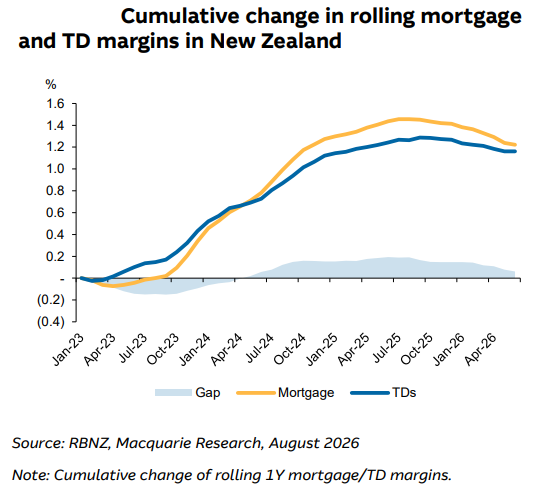
"The big change that we’ve seen there was actually the increase in swap rates that you’ve seen in the New Zealand market. So swap rates there were up around 50 basis points from December through to June. Obviously, it’s a very heavily fixed rate home loan market. The combination of that increase in fixed rates, and I think some real intense competitive pricing pressure amongst the banks in New Zealand, seeing a compression of fixed rate home loan margins in the second half. So that’s been the number one reason for that performance," Docherty said.
The NZ home loan market is dominated by fixed-term loans in contrast to Australia where floating, or variable, interest rates dominate. Comyn said some NZ banks were content to originate loans at very low margins.
"You can see some very significant reductions in the margins that are available. Some of the New Zealand banks are happy to originate [home loans] at very low levels of margin because they turn over probably typically every 18 months. They get an opportunity to reprice them. We have not done as much of that as peers, but I guess in between, across all of the businesses, we feel like there is opportunities to both strengthen the relationship we have with clients, as well as manage the profitability, hopefully to a very high level of discipline," Comyn said.
ASB is NZ's second biggest home lender, with total loans of nearly $86 billion at June 30.
New Zealand 'a drag,' watch out ANZ
In a report on the CBA annual results, Macquarie Securities' banking analysts described the NZ division as a "drag," suggesting the ANZ Banking Group could experience worse with its ANZ NZ subsidiary, NZ's biggest home lender with loans of more than $116 billion as of March 31, and a bigger contributor to ANZ Group earnings than ASB is to CBA's.
"Increased competition and large movements in swap rates drove a 10 basis points half-on-half decline in NZ margins [to 2.25%]. This has emerged as a sector-wide trend and could represent a larger headwind for ANZ," Macquarie says.
"Increased mortgage competition has been a key driver, and we expect this pressure to persist over the next 12 months."
ASB also reported loan impairment expenses of just $3 million in the first-half and $75 million in the second-half.
Daily swap rates
Select chart tabs
*This article was first published in our email for paying subscribers early on Friday morning. See here for more details and how to subscribe.
We welcome your comments below. If you are not already registered, please register to comment
Remember we welcome robust, respectful and insightful debate. We don't welcome abusive or defamatory comments and will de-register those repeatedly making such comments. Our current comment policy is here.