

- Most economists expect historically high inflation to moderate over the next year, but the near-term outlook is uncertain.
- Over the long term, changing structural inflation forces may create even greater uncertainty for investors.
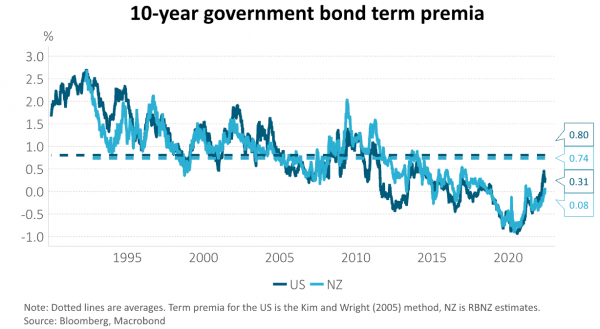
- The possible end of the great moderation – the period of relatively benign economic cycles - that has prevailed for most of the past 40 years - may see fixed income investors seek greater compensation (term premia) to part with their money for long periods of time and presents an upside risk to bond yields.
Most economists expect historically high inflation to moderate over the next year, but the near-term outlook is uncertain. Inflation should decline as long as tradable inflation pressures don’t worsen and monetary tightening works its way through economies. We may have passed the inflation peak in most countries and the global economy is returning to more sustainable levels of growth. However, the ongoing war in Ukraine and China’s zero-tolerance COVID approach are key risks to the economic outlook. Both could keep inflation elevated for longer and weigh more heavily on global economic activity.
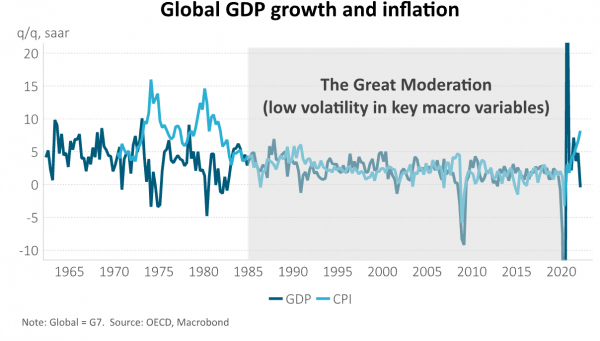
Over the long term, changing structural inflation forces may create even greater uncertainty. For much of the past 40 years globalisation, demographics and digitisation have been helpful disinflationary forces. Along with central bank independence, greater demand for less volatile services over goods, and deregulation, these factors have contributed to a period of low volatility in key macroeconomic variables since the mid-1980s that is often referred to as the “Great Moderation” (see figure below). However, over the coming decades it may just be digitisation (technological advancement) among these factors that helps economies to contain inflation pressures. An additional structural inflation force may have also emerged in the world’s effort to tackle climate change via de-carbonisation.
We expand our discussion of each of these structural inflation factors below:
De-globalisation
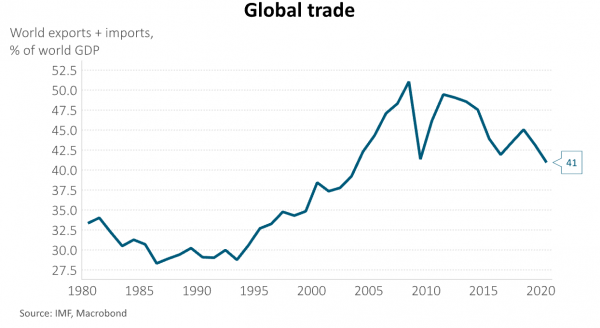
Global trade allows countries to specialise and goods to be produced at the lowest cost. Global trade probably peaked just after the global financial crisis (GFC) and has been steadily declining since (see figure below). Structural drivers of the decline include rising protectionism (think Trump and Brexit), but cyclical drivers have also contributed, such as weak business investment (that tends to be trade-intensive) that was related to higher economic uncertainty.
De-globalisation may accelerate after COVID-19 exposed the vulnerability of a “just-in-time” inventory cycle and increased the incentive for countries to develop local supply chains to minimise future disruptions. This will ultimately be a more expensive product source, however.
Demographics
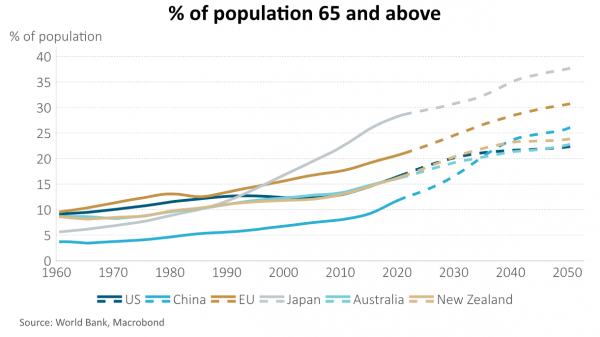
Baby boomers have blessed the world with a large, experienced and productive work force over the past 30 years – helping to reduce upward pressure on wages. However, as large parts of the world reach older age over the next 30 years, they may no longer be available as an input into production but continue to demand goods and services – both of which will contribute to inflation (see figures below). Demand by these older people will be concentrated in labour-intensive service sectors, such as healthcare. Natural rates of population growth (births less deaths) are unlikely to make up the shortfall and likely accelerate the push towards robotics and technology to help.
De-carbonisation
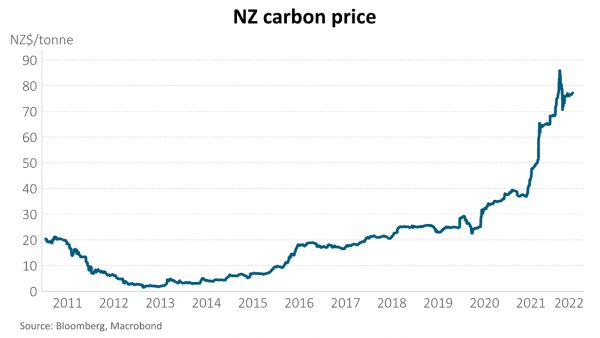
The world has largely embraced the need to slow climate change via a reduction in greenhouse gas emissions. Measures to disincentivise carbon, such as carbon taxes, are likely to increase the cost of fossil fuels which the world is still very reliant on (see figure below). For example, 60% of the world’s current electricity production comes from fossil fuels (NZ 20%; EU 40%; US, China Japan and Australia are between 60-70%). Harsher government measures, such as imposing deadlines for the use of fossil fuel assets, and geopolitics may force fossil fuel generation to be replaced – with the associated costs likely passed on to consumers.
The impact, however, may be moderated by the lower cost of some low-carbon alternatives. The International Energy Agency, for example, expects onshore wind to have, on average, the lowest Levelised Costs of Electricity generation (LCOE) in 2025.[1] Although costs vary strongly from country to country, this is true for a majority of countries (10 out of 14). Photovoltaic Solar, if deployed at large scale and under favourable climatic conditions, can also be very cost competitive. Offshore wind is also experiencing major cost declines.
The possible end of the great moderation may see fixed income investors seek greater compensation to part with their money for long periods of time and presents an upside risk to longer-dated bond yields. Term premia can be estimated from fixed income securities and represents the compensation that investors demand for the risk that interest rates change over the term of the security. The US 10-year Treasury term premium[2] has increased from all-time lows of -0.90% in the middle of 2020, to 0.30% today. The average since 1990 is 0.80%, however, suggesting upside risks to longer-dated bond yields. The Reserve Bank of New Zealand’s equivalent measure[3] for NZ tells a similar story, having increased from all-time lows but currently well below its long-term average (see figure above).
In addition, any persistence in higher inflation can be expected to lead central banks to have a bias towards setting cash rates somewhat higher than we have seen over previous years. This reinforces the likelihood that bonds yields trade in a higher range.
For equities, if this scenario plays out, there may be some challenges as expectations about medium-term inflation and interest rates are revised higher. Once this is factored in, the bias towards lower equity prices should cease, and be replaced with a greater level of volatility. For investors, there are opportunities amongst all of this for active investors, but they will also need to review their willingness to be exposed to higher levels of market volatility.
[1] LCOE tries to capture the average net present cost of electricity generation for a plant over its lifetime (including building and land costs). LCOE = sum of costs/sum of electricity produced. Values at 7% discount rate.
[2] Using the Kim and Wright (2005) method. For more detail see here.
This article is here with permission. It was originally published here. This does not constitute advice to any person. www.harbourasset.co.nz/
We welcome your comments below. If you are not already registered, please register to comment
Remember we welcome robust, respectful and insightful debate. We don't welcome abusive or defamatory comments and will de-register those repeatedly making such comments. Our current comment policy is here.