
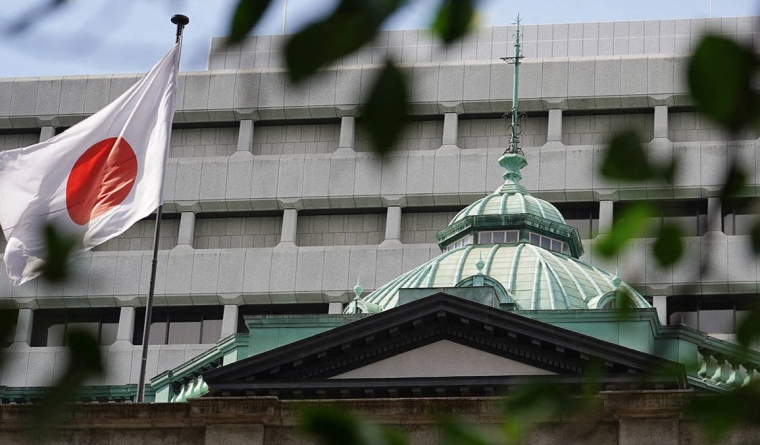
Earlier this month, global bond markets were rocked by remarks from Bank of Japan Governor Kazuo Ueda suggesting that the BOJ would soon weigh whether to raise interest rates. The resulting sell-off in the US bond market raised yields on ten-year and 30-year US Treasuries sharply.
Normally, mild comments by a mild-mannered Japanese central banker are not enough to perturb US and global markets. But the BOJ has a well-earned reputation as a canary in a coal mine. In February 1999, it cut interest rates to zero in a desperate effort to fend off deflation, anticipating the zero-interest-rate policies of other central banks when they, too, confronted the specter of deflation.
Today, the BOJ’s prospective move in the other direction could be indicating that not just Japan but also other heavily indebted economies, including the United States, are about to face sharply higher yields on government bonds, with all the difficulties that entails.
The Japanese government’s total debt as a share of GDP is on the order of 230%, twice that of the US. Net debt, subtracting the Japanese government’s assets, is a more manageable, if still high, 130%. Unfortunately, many of those government assets, such as landholdings, are illiquid, so they are of little comfort to public debt managers.
None of this was a problem so long as interest rates – and therefore debt-service payments – were at or near zero. But if interest rates now rise to, say, 4%, debt service will begin to strain the government budget. The BOJ has kept rates low through a combination of bond buying and yield-curve control, whereby it targets specific maturities where the debt is concentrated. Now that inflation is back, this de facto subsidy is ending.
There are no easy solutions to Japan’s debt problem. Taxes as a share of GDP are above the OECD average. An elderly population complicates any effort to cut pension and healthcare costs. And Japan, like other countries, now faces geopolitical pressure to spend more on defense.
The only way out is to boost the debt ratio’s denominator: GDP. Prime Minister Sanae Takaichi's fiscal stimulus is designed to jumpstart growth. Subsidies for electricity bills, cash handouts to households with children, and payments to government-licensed bear hunters (you read that right) will stimulate demand.
The question is how to stimulate supply. More immigration would help. So would policies that raise female and elder labour-force participation, comprehensive reskilling for older workers, deregulation of the service sector, and tax incentives for technology upgrading by small and medium-size enterprises. On the supply side, however, Japan is moving slowly, if at all.
So, the new government’s supplementary budget threatens to worsen the fiscal position instead of improving it. It may be premature to panic, but Mrs. Watanabe, that mythical investor in Japanese government bonds, now appears fully awake to the risks.
Moreover, what happens in Japan doesn’t stay in Japan. It is transmitted to the US via two channels. First, if yields on Japanese government bonds go up, they will become more attractive relative to US Treasuries, putting upward pressure on US interest costs. Second, the more difficulty Japan has in managing its debt, the more investors will begin worrying about other heavily indebted countries.
Fortunately, the US has an easy way out. In the US, unlike Japan, taxes as a share of GDP are below the OECD average. Closing even half the gap between the US and advanced-economy averages would eliminate the primary budget deficit (excluding interest payments) and stabilise its debt ratio.
Of course, tax increases are for the US what supply-side reform is for Japan: a political third rail. President Donald Trump’s administration has futilely sought to address the deficit problem by cutting government spending. The result has been to cut muscle rather than fat, gutting government and university spending on research and public services essential for productivity growth. The legacy of Trump’s “Department of Government Efficiency” has been zero progress in curtailing the deficit.
Democrats are now focused, appropriately, on the affordability crisis caused by higher food, health-care, and housing costs. But they also need to worry about the mortgage costs that will follow from higher interest rates, and about the politically toxic inflation that will occur on what they hope will be their watch, after 2028.
A tax on billionaires won’t close the budget gap and fend off these dangers. What is needed is a broad-based but progressive increase in taxes, together with that fabled closing of loopholes such as carried interest.
Implementing this will require a very different Congress and a very different president. A crisis often is needed to trigger the kind of political realignment that can deliver both. A debt crisis, during which inflation and interest rates shoot up, would certainly qualify. The question is whether US politics can realign in the absence of one.
Barry Eichengreen, Professor of Economics at the University of California, Berkeley, is the author, most recently, of In Defense of Public Debt (Oxford University Press, 2021). Project Syndicate, (c) 2025, published here with permission.
We welcome your comments below. If you are not already registered, please register to comment
Remember we welcome robust, respectful and insightful debate. We don't welcome abusive or defamatory comments and will de-register those repeatedly making such comments. Our current comment policy is here.