
There is angst in the air about the US dollar’s once and future global role. For insight into the greenback’s prospects, pundits have looked to the British pound sterling, the dollar’s predecessor as the dominant international currency, and asked how economic stagnation, heavy debts, and failed geopolitical adventures, like that in Suez in 1956, conspired to rob it of its global role.
But informed observers can draw on a much longer history of international currencies—units used in cross-border transactions—stretching from the Dutch guilder of the 17th and 18th centuries back to the Florentine florin of the 14th and 15th centuries and the silver denarius of ancient Rome.
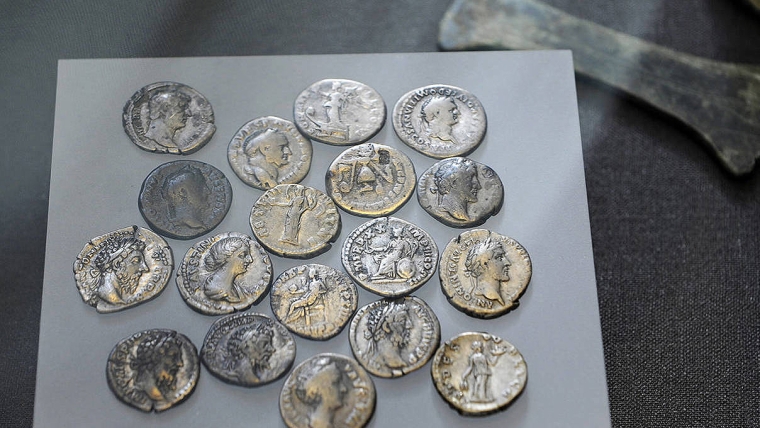
In fact, it can be argued that the Roman denarius was the first true international currency. Hoards have been found not only throughout the former territories of the Roman Empire but also along the Silk Road from India and Sri Lanka to China.
The dates of these coin hoards coincide with the arrival in Europe of merchandise from these same parts of Asia, highlighting the importance of Rome’s trading prowess and commercial span in supporting its currency. The Romans had cargo ships of unprecedented size capable of long voyages. No surprise, they took their native coin with them.
Political unification of the Mediterranean Basin under Roman rule further encouraged commercial activity. This activity was regulated by Roman officials, backed by a formidable military, and facilitated by the availability of a stable and uniform money. To ensure quality, only the Roman authorities were permitted to mint silver and gold coin. Coinage was under the authority of the Senate, whose members received regular reports from the tresviri, junior magistrates overseeing the mints.
Reflecting this authority, the silver content of the denarius remained stable, in both weight and purity, for 300 years. Uniform coinage meant that merchants, when accepting payment, knew what they were getting. It allowed them to make payment without requiring physical movement of heavy and valuable coin or bullion. And, because coin could be provided in one place against sales and receipts in another, thereby avoiding the costs and risks of transporting precious metal, currency began to shade into credit, anticipating the development of modern financial markets.
Thus, we see in Rome the core requirements for a widely accepted international currency: quality assurance, commercial prowess, a sophisticated financial system, political checks and balances, and geopolitical security for the issuer.
The Roman case also reminds us that these prerequisites should not be taken for granted. The Roman state, as it aged, became more bureaucratic. The Republic’s democratic traditions, which allowed the Senate to check excessive emission, gave way to rule by one man, whose imperial whims, including over money, could go unchecked.
The rule of law waned, and corruption grew pervasive, as property was increasingly concentrated in the hands of the politically connected. Provisioning a large army required levying taxes that absorbed as much as one-third of Rome’s income, undercutting the empire’s commercial activities. Heavy taxes encouraged evasion by large estate owners, in cahoots with functionaries (often large estate owners themselves) responsible for collecting the payments.
As a result, debasement—reductions in the silver content of the denarius—started under Emperor Nero, who churned out additional coin in a desperate effort to finance his ambitious program of canal building, as well as to reconstruct Rome following the great fire of 64 AD, build his extravagant 300-room Domus Aurea palace, and prosecute costly wars on multiple fronts. The tresviri were subordinated to central imperial authority.
Subsequent emperors followed Nero down this slippery slope. Older coins were hoarded or melted down as the economy was flooded with near-worthless new denominations. Within a couple of centuries, the international role of the denarius was no more.
It is not hard to hear echoes of this ancient history in current anxiety around the dollar. China has overtaken the United States as a trading power. President Donald Trump’s tariffs are driving other countries into China’s arms and encouraging them to cut preferential trade deals among themselves.
The US hasn’t debased the dollar, but there is plenty of talk about the so-called “debasement trade,” where foreign investors shift away from US Treasuries for fear that high government debt and threats to the independence of the Federal Reserve will erode the greenback’s purchasing power. The country may be militarily secure, but the fiscal costs of unleashing that military in the Middle East only heighten worries about debt and dollar depreciation.
America does not have an emperor, but its politics are increasingly subject to rule by one man who threatens its democratic traditions. Institutionalized corruption has become the norm, not the exception.
Does this augur the fall of the American Empire, much as Nero’s rule augured the fall of the Roman Empire? We don’t need an oracle to know that none of these developments bodes well for the dollar.
Barry Eichengreen, Professor of Economics at the University of California, Berkeley, is the author, most recently, of In Defense of Public Debt (Oxford University Press, 2021). Project Syndicate, (c) 2025, published here with permission.
We welcome your comments below. If you are not already registered, please register to comment
Remember we welcome robust, respectful and insightful debate. We don't welcome abusive or defamatory comments and will de-register those repeatedly making such comments. Our current comment policy is here.